

 i_need_contribute
At the junction of Lai Chi Kok Road and Tong Mi Road, Lui Seng Chun (雷生春) is one such landmark: a four-storey tong lau on a triangular site, with a curved façade whose white exterior, deep verandahs and thick granite columns still command attention from busy passersby. Completed in 1931, the building — now a declared monument — combines neo-classical and Art Deco elements. It was commissioned by Lui Leung, a businessman born in Taishan and one of the founders of Kowloon Motor Bus, after he purchased the site from the Hong Kong government in 1929. He appointed W. H. Bourne, a local architect known for designing shophouses, to create the building.
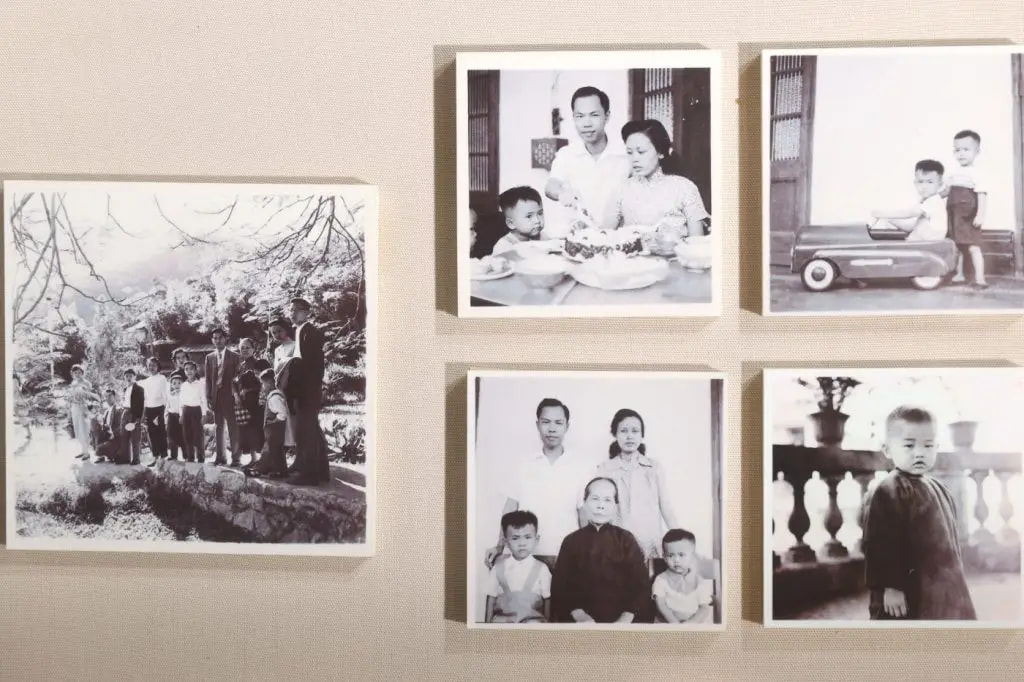
The Lui family during the 1950s
Its ground floor once housed the Lui family’s Chinese bone-setting medicated wine (跌打藥酒 dit3 daa2 joek6 zau2) shop. The name Lui Seng Chun came from a rhyming couplet inside the building that symbolised the healing power of Chinese medicine and a commitment to serving the community — a bold promise that reflected the shop’s formidable local and overseas reputation across Southeast Asia, Australia, the United States and even Peru, which had a large Chinese diaspora.
Today, the building has a new lease of life. From the 1970s until 2003, when the transfer of the Lui family’s donation to the government was completed, the building was largely vacant and fell into disrepair — earning it the neighbourhood nickname of a haunted house. Lui Seng Chun was later revitalised under the Hong Kong government’s Revitalising Historic Buildings Through Partnership Scheme. Hong Kong Baptist University (HKBU) has operated it as a Chinese medicine and healthcare centre since 2012.
It has three core uses: clinical services, education and exhibitions. The ground floor houses a herbal tea shop and displays on the Lui family and the building’s history. The first floor contains reception, a pharmacy and an exhibition on herbal tea; the second and third floors contain consultation, treatment and seminar rooms alongside displays on Chinese medicine, tong lau architecture and the building’s revitalisation. The rooftop is now a medicinal herb garden. The ground-floor display areas are open to the public, while free guided tours to the upper floors are available by registration. Collectively, these elements have made the tong lau both an architectural curiosity and a living reminder of Hong Kong’s enterprising past.
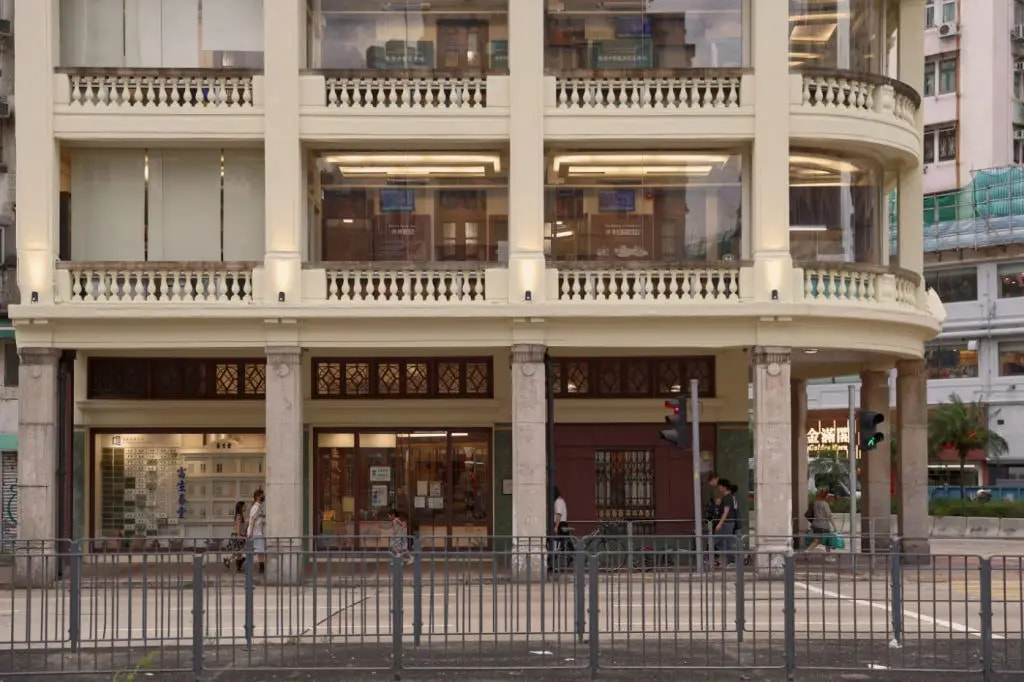
The building’s iconic white exterior with granite columns at ground level. Photos: May James
As construction noise permeates the street, an autumn breeze carries a sense of calm into the building’s entrance. After passing glass display cases filled with old equipment, including a basin once used for grinding Chinese medicine, and taking a quick lift ride, we enter the office of Chow Chi-ho, associate professor of practice at HKBU’s School of Chinese Medicine and centre-in-charge of Lui Seng Chun, on the third floor.
Chow specialises in orthopaedics and traumatology in Chinese medicine. After earning his Chinese medicine and biomedical science degrees at HKBU, he completed a master’s degree in Chinese medicine in 2009 and a PhD in orthopaedics and traumatology at Guangzhou University of Chinese Medicine in 2017. Chow took over from the then centre-in-charge, Xu Daji, in 2016. His passion for sharing his knowledge matches his drive to make Chinese medicine known and accessible to the public. Every week, he spends four days at Lui Seng Chun, prescribing medicines to patients while contributing to teaching, research and student placements.
When asked why HKBU’s School of Chinese Medicine was chosen to operate Lui Seng Chun, Chow pauses, deep in thought. There are two main reasons. “The first is that HKBU has a long history of providing Chinese medicine clinics,” he says. The second is the location. “While CUHK is mainly based in the New Territories and HKU across Hong Kong Island, HKBU chiefly represents the Kowloon area.” In 2009, the government selected HKBU under the Revitalising Historic Buildings Through Partnership Scheme to conserve Lui Seng Chun and convert it into a Chinese medicine and healthcare centre.
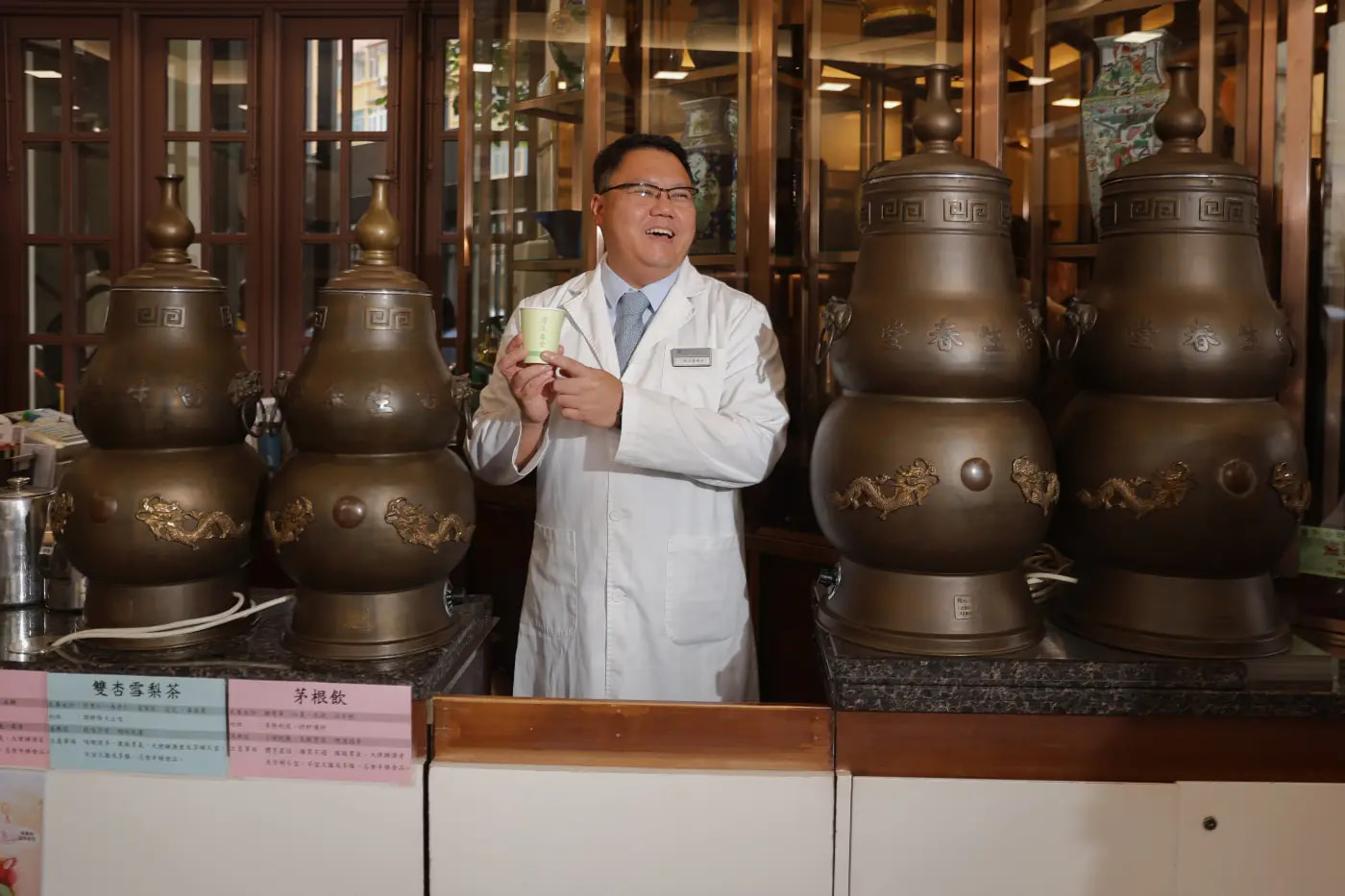
The herbal tea counter on the ground floor sells teas such as snow pear tea. Photos: May James
Since opening nearly 15 years ago, Lui Seng Chun’s impact on the development of Chinese medicine and public health cannot be ignored. The process begins with research into Chinese medicine consultations for specific conditions and with giving students practical clinical experience through internships. It continues in the clinic, where patients are referred to Chinese medicine specialists for targeted care — an orthopaedic specialist for bone and joint pain, or a dermatology specialist for acne or eczema. “What is most important is that the public has confidence and recognition in Chinese medicine and healthcare,” Chow says, smiling.
Beyond the building’s premises, that confidence is further cultivated through close relationships built in classrooms, clinics and community spaces. HKBU runs lectures and workshops for schools — such as Pun U Association Wah Yan Primary School in May — where participants can handle and smell samples of ingredients used in herbal tea blends such as five-flower tea (五花茶 ng5 faa1 caa4) and learn about Chinese medicine approaches to preventive care and health maintenance.
Lui Seng Chun has also become a node in Hong Kong’s tourist landscape. Tour guides weave the tong lau’s architecture, conservation story and Chinese medicine into itineraries that connect visitors to local ideastea around food, drink and wellness. KMB has promoted Lui Seng Chun as an attraction along Route 2, one of several Kowloon routes it recommends to visitors. Chow says the building draws up to 30 visitors a week, many of whom come not only to admire a historical relic but to experience Chinese medicine first-hand.
The historic building might catch one’s attention while walking by, but Chow isn’t completely satisfied. He hopes to offer international visitors in particular clearer information about the different elements of Chinese medicine and the symptoms for which herbal teas are traditionally used, so they can leave with a basic understanding and a seed of curiosity to discover more.
To that end, various herbal tea blends are introduced; Lui Seng Chun normally has four to five types to recommend and 10 as backup. One is snow pear tea (雪梨茶 syut3 lei4 caa4), which Chow says is traditionally recommended in Chinese medicine for symptoms such as fever or a swollen throat; he describes it as soothing and easy to drink. Five-flower tea, meanwhile, is traditionally regarded as cooling and gentle on digestion. Through surveys and free herbal tea tastings, Chow hopes the centre can gather more information about visitors’ thoughts and reactions in the future.
Looking ahead, Chow also envisions a clinic where quality consultation services and research extend beyond dispensing remedies. Although still in the planning stage, the associate professor hopes to “hold more regular workshops that would invite visitors to learn about different herbal tea blends.” Another proposed workshop would show visitors how Chinese medicine uses pressure points on the hands or legs, including points associated with headache relief and blood-pressure management.
Ensuring that the culture of traditional Chinese medicine and herbal tea — both recognised in Hong Kong’s intangible cultural heritage inventory — continue to thrive in the present is equally crucial. Under Chow’s stewardship, Lui Seng Chun is becoming less a static monument and more a living part of the community’s health and well-being.



 Medicine