

 i_need_contribute
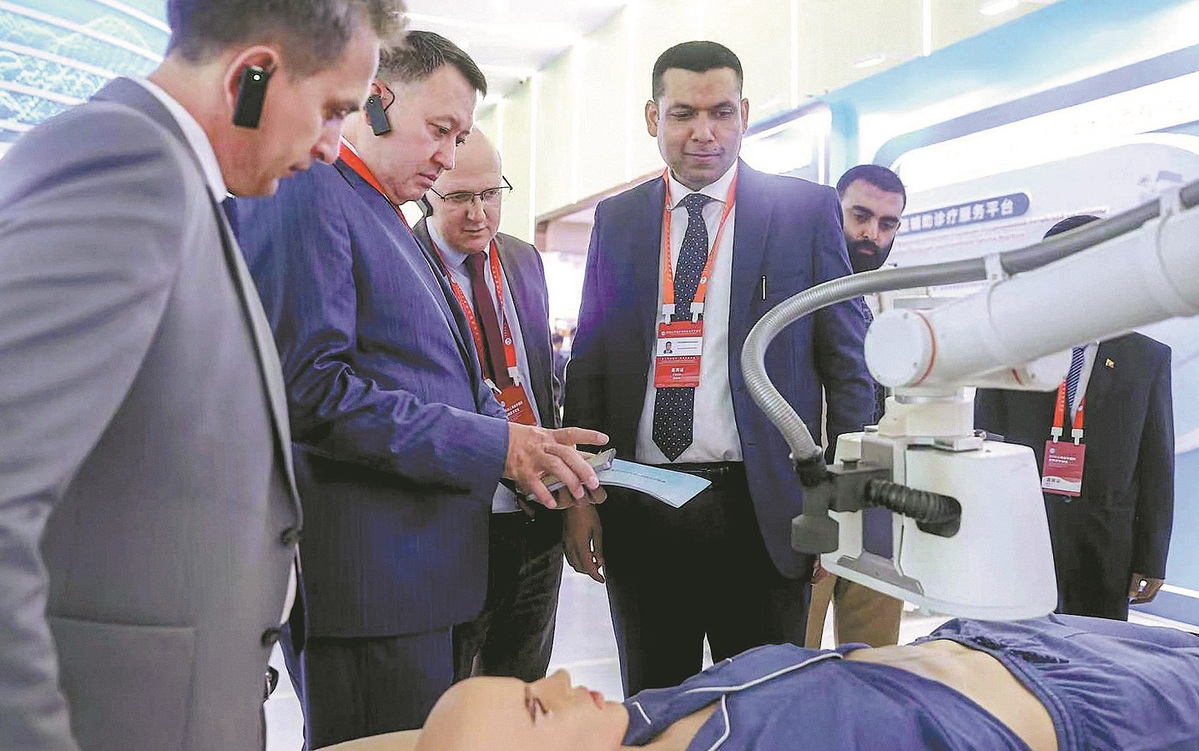
Participants explore a moxibustion robot during the forum on traditional medicine in Jiangxi province on Thursday. LIU LIXIN/CHINA NEWS SERVICE
The remarks were made at the 2026 Shanghai Cooperation Organization Forum on Traditional Medicine in Nanchang, Jiangxi province. The three-day forum, co-hosted by the Good-Neighborliness, Friendship and Cooperation Commission of the Shanghai Cooperation Organization and the Jiangxi provincial government, has 81 foreign guests from 21 countries confirmed to attend.
Jagath Wickramaratne, speaker of the Parliament of Sri Lanka, said traditional medicine should not be regarded merely as a legacy of the past, but as a valuable body of knowledge that can contribute to the health and well-being of present and future generations.
He said Sri Lanka and China have considerable potential for cooperation in medicinal plants, scientific research, education and training, quality standards, technology and the development of safe and effective traditional medicine products.
Huang Luqi, deputy director of China's National Administration of Traditional Chinese Medicine and president of the China Academy of Chinese Medical Sciences, said traditional medicine requires both preservation and innovation.
Huang said cooperation in traditional Chinese medicine has been incorporated into intergovernmental joint statements between China and 11 countries, including Russia, Kazakhstan and Tajikistan. China has also signed memorandums on traditional medicine cooperation with seven countries, including Belarus and Iran, while nine overseas TCM centers have been established in SCO member countries.
China will continue exchanges with SCO countries and promote the integration of traditional medicine with big data, AI and other emerging technologies, he said.
Yin Hong, Communist Party of China secretary of Jiangxi province, said digital technologies are creating new opportunities for traditional medicine.
Jiangxi has about 264,700 hectares of land planted with Chinese medicinal herbs and 3,146 TCM institutions, Yin said, adding that the province will further explore applications including AI-assisted diagnosis and intelligent health management.
Brylevich Ihar Maksimavich, deputy chairman of the Council of the Republic of the National Assembly of Belarus, said the development of TCM in Belarus has risen to the national level, with the country officially recognizing two medical specialties — reflexotherapy physician and traditional Chinese medicine physician.
Belarusian medical professionals receive training in China and cooperate with institutions in Zhejiang province and Tianjin, while the two countries regularly conduct academic exchanges and training programs, he said.
Brylevich also highlighted cooperation at the Great Stone China-Belarus Industrial Park, where a medical products and biotechnology cluster is being developed, with Chinese companies investing in medical equipment, diagnostic test kits and pharmaceuticals.
Panina Elena Vladimirovna, director of the Russian Institute for International Political and Economic Strategies and vice-president of the Russian Union of Industrialists and Entrepreneurs, said traditional Chinese medicine and modern medicine can complement each other.
China and Russia agreed in a joint statement in May to continue cooperation in areas including traditional medicine, digital health, medical education and medical science and innovation.
She called for broader cooperation to advance traditional medicine cooperation.



 Medicine