


 i_need_contribute
As Hong Kong cools, experts reveal how traditional Cantonese soups can help aid digestion and prevent inflammation, and how not to cook them.
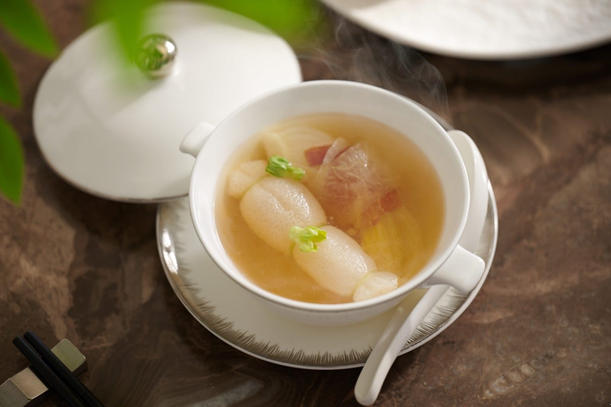
Double-boiled superior soup with bird's nest, stuffed bamboo pith and baby cabbage at ShanghaiPlus, a Chinese restaurant in Hong Kong's Wan Chai neighbourhood. Photo: Shanghai Plus
In many Chinese households, soups are seen as a show of love from the cook – usually the matriarch of the family.
Soup can be everyday food or a banquet course made with ingredients according to the season. The Chinese year has 24 solar terms traditionally used to guide farmers.
In the hot summer months, cooks might reach for cooling winter melon. As autumn sets in and the air is drier, they use pears, snow fungus or dried lily bulbs to nourish yin – the body’s reserve of moisture and cooling fluids. During winter, soups turn heartier, with simmered marrow bones and root vegetables to build strength and ward off colds.
Chef Tam Kwok-fung of Chef Tam’s Seasons in Macau builds his menu – featuring a rotating seasonal soup – around the solar terms. On a visit during the frost term, when frost historically begins to form in the morning across much of northern China, the weather in Macau is still a balmy 28 degrees Celsius (82.4 degrees Fahrenheit), but the humidity is significantly lower than in Hong Kong.
Tam prepares a watercress, dried duck gizzard and tangerine peel soup.
“We have stepped into the drier months, and we concentrate on nourishing dryness when making soups,” he says. “Around this time of year, watercress is at its best and doesn’t have any bitterness when cooked in soups, especially for long periods of time.”
So what does modern medicine make of these time-honoured healing soups?
Cantonese kitchens had perfected them long before wellness brands started pushing electrolyte sachets, collagen powders and bone-broth detoxes.
Modern gut science is beginning to substantiate what grandmothers have claimed for generations – that slow cooking pulls the nutrients out of the ingredients.
When marrow bones and meat simmer gently in water, tough connective tissue breaks down into easily absorbed building blocks such as glutamine, glycine and proline. In clinical studies, these amino acids have been found to soothe irritation inside the digestive tract, repair the gut barrier and keep inflammation at bay.
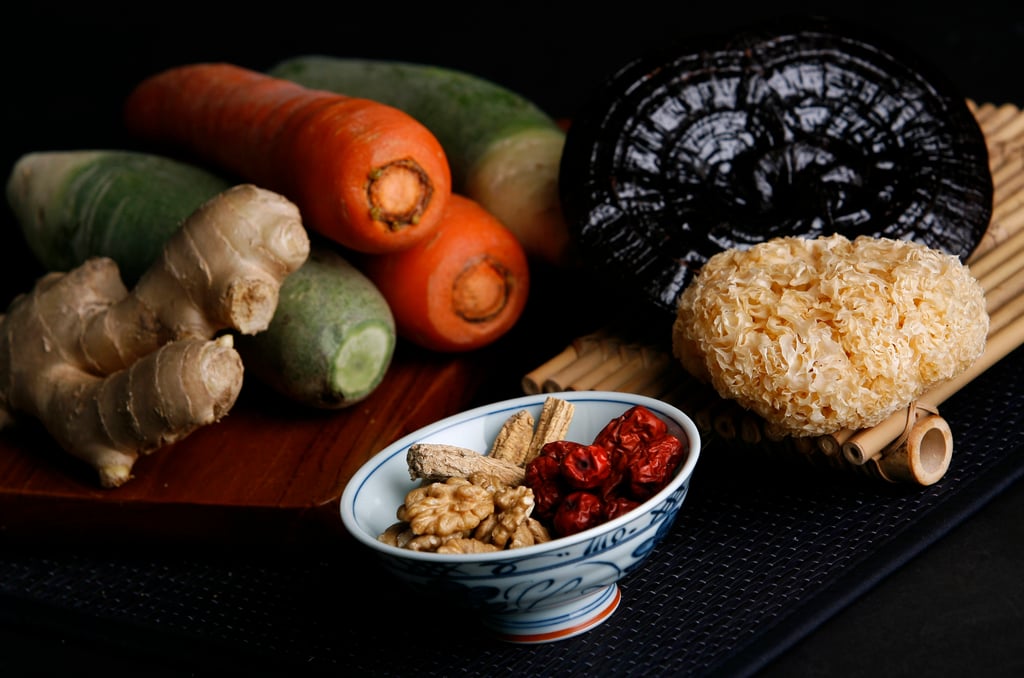
Typical ingredients for traditional Chinese soups include snow fungus, ginger, walnuts and dried dates. Photo: Jonathan Wong
There is also science behind the traditional practice of eating soup to “moisten dryness”.
Autumn staples such as snow fungus and dried mushrooms turn thick and gelatinous when simmered because they are packed with natural fibres called beta-glucans. Our stomachs cannot digest these fibres, so they pass through into the colon intact. There, friendly gut bacteria feast on them, turning them into anti-inflammatory compounds that protect the gut lining and help keep seasonal colds from taking hold.
Even the simple habit of starting a meal with warm broth has an edge over drinking iced water. Drinking cold liquid while eating can shock the stomach and narrow local blood vessels, and plain water often rushes straight through the kidneys without properly hydrating our tissues.
A warm bowl of soup works differently. As roots, meat and vegetables simmer, they release natural electrolytes such as calcium, potassium and magnesium into the liquid. These minerals help cells hold on to fluids while the warmth boosts blood flow to the stomach and primes the digestive system for the rest of the meal.
A vegetable-packed broth also fills the stomach naturally, helping diners feel comfortably satisfied without needing sugary drinks.
For home soup cooks, what goes into the pot is less about science and more about keeping everyone happy. In traditional Chinese medicine (TCM), a family soup must balance the health needs of all those who are eating it, as well as the season.
Hong Kong resident Emmy Lee Wan-ping knows this well. She cooks soup for her nearly 80-year-old father, her teenage nieces and her husband every day.
“My father is almost 80 and has a long-term illness, while my nieces are younger and eat all sorts of confectionery and fried foods throughout the day, and then there’s me and my husband who are middle-aged. So we stick to very general soup types,” she says.
Chef Tam appreciates this kind of household reality. “Family cooks would not want to make anything too extreme on TCM principles because they have a wide range of constitutions to take care of on the dinner table,” he says. “A typical household will have very balanced ingredients such as Chinese yams and coix seed in the pantry for soups.”
Lee keeps mild, neutral staples on hand, including red dates, goji berries, dried longan, Chinese yams, snow fungus and astragalus root. In winter, she turns to dried seafood to add richness without loading her soups with sugar.
“Fish maw has better yin properties and has less sugar than something like apples, which is better for my father and nieces,” she says.
This homestyle balance reflects a classical TCM herbal formula rule known as jun, chen, zuo, shi – which translates as “the ruler, minister, assistant and envoy”. The ruler ingredient tackles the main health goal, the minister backs it up, the assistant balances or softens any harsh properties, and the envoy brings the whole mix together.
Hong Kong-based TCM practitioner and nutritionist Karen Cheung says home soups are often gentle, everyday variations of these traditional prescriptions. In a standard home recipe, she points out, lean pork or chicken often acts as the principal ruler; codonopsis root serves as the minister; and a single candied date can be the assistant, lending natural sweetness and easing digestion.
The way a soup is cooked is also important. A quick-boiled gwan tong containing sliced lean pork, tofu, and fresh leafy greens or melon can be on the table in 15 to 45 minutes and is ideal for busy weeknights. A classic family simmer typically takes one to two hours, giving roots and denser vegetables enough time to release their goodness.
For deeper nourishment, lou fo tong (old-fire soup) bubbles away on the stove for three to four hours, as flavours escape from bones and dried herbs. Then there is dan tong (double-boiled soup), for which ingredients sit in a ceramic jar that is steamed inside a larger pot of water for four hours. It is prized for producing a clear broth with subtle aromas.
As Hong Kong chef Luk Wai-kau of Sang Kee, a traditional Chinese restaurant in Hong Kong’s Wan Chai neighbourhood, told the Michelin Guide, a soup’s fo hau – the careful balance of fire and time – gives it its soul.
In modern food science, it is believed that boiling a soup longer does not always make it healthier.
Studies looking at the chemistry of Cantonese soups reveal antioxidant power and beneficial nutrients peak after about 1.5 to 2.5 hours on the stove. Leave the soup to cook past the three-hour mark and the benefits start to fall off, as heat-sensitive vitamins, including vitamin C and some B vitamins, break down.
Cheung warns that simmering meat, bones and offal for more than three hours introduces high levels of purines. Having too many purines can cause a build-up of uric acid. In Hong Kong, where gout and high uric acid are common, drinking rich lou fo tong can trigger a painful flare-up or worsen kidney issues.
She also says long boiling concentrates potassium and sodium in the broth, which can put strain on anyone managing high blood pressure or chronic kidney disease. What is more, rich bone broths often have heavy layers of animal fat floating on the surface. Unless you let the pot cool and skim that fat off before serving, drinking it regularly can push up “bad” LDL cholesterol. For these reasons, Cheung recommends keeping home simmering to around two hours.
Plant-based soups are healthy alternatives without the purines and fat.
In Hong Kong, where people commonly work long hours and live in flats with tiny kitchens, few can afford the luxury of standing over a soup pot for hours. But retailers have stepped in with handy workarounds.
Historic herbal brands such as Eu Yan Sang and Wai Yuen Tong sell dried tong liu – soup ingredient packets. These range from classic ching po leung packs to “moisten” the lungs, to energising blends of astragalus and goji berries, with clear instructions for a one- to two-hour simmer.
Hong Kong’s wet markets and supermarkets now pack pre-chopped vegetable trays, cutting out the prep work for a simple 20-minute weeknight boil.
For desk-bound workers in office towers, services like Smart Soup and Healthworks deliver soups through delivery apps straight to customers’ homes and desks. Convenience stores and kiosks in MTR stations carry ready-to-heat pouches from brands such as Hung Fook Tong and Healthworks that can be cooked in hot water in just five minutes.
On these quick fixes, Cheung says: “While it is important in TCM to consume fresh ingredients when possible, pre-packaged soups are not a bad alternative if you’re really short on time.”
Through these adaptations, Hongkongers have found new ways to prepare and eat soup, so this traditional expression of care in a bowl remains an enduring part of daily health.




 Health