

 i_need_contribute
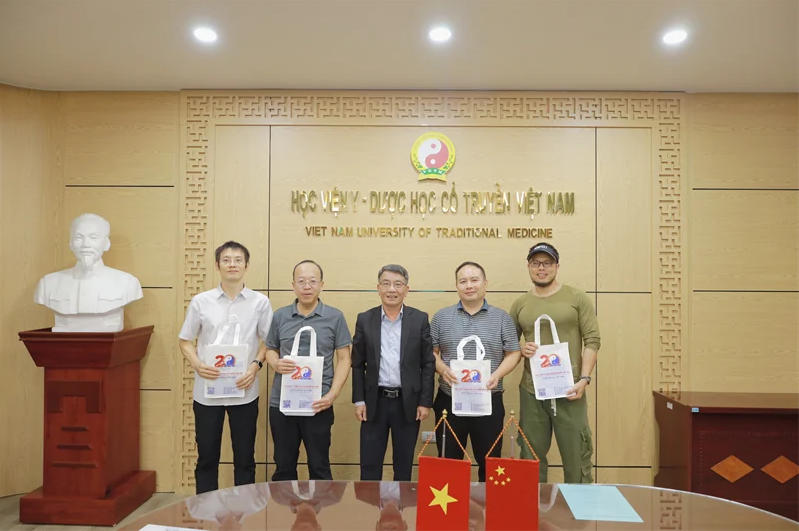
On November 9, 2026, the Vietnam Academy of Traditional Medicine held a working session with a delegation from the Guangxi Institute of Botanical Research and the Chinese Academy of Sciences to discuss opportunities for cooperation in the search, exploitation, and development of medicinal resources for research, drug production, and the creation of natural food products.
The meeting was chaired by Assoc. Prof. Dr. Pham Quoc Binh, Deputy Secretary of the Party Committee and Deputy Director of the Academy. Also attending were Assoc. Prof. Dr. Vu Duc Loi, Dr. Nghiem Tien Chung, and representatives from relevant units of the Academy.
The Chinese delegation included Prof. Dr. Wen Fang, Head of the research group at the China Elephant Ear Plant Conservation Center, Guangxi Institute of Botany, Chinese Academy of Sciences (CAS); Prof. Dr. Wei Yigang, researcher, Guangxi Institute of Botany (CAS); Prof. Dr. Duong Huy, researcher, Guangxi Institute of Botany; Prof. Dr. Ngo Sieu, researcher, Guangxi Institute of Botany (CAS).
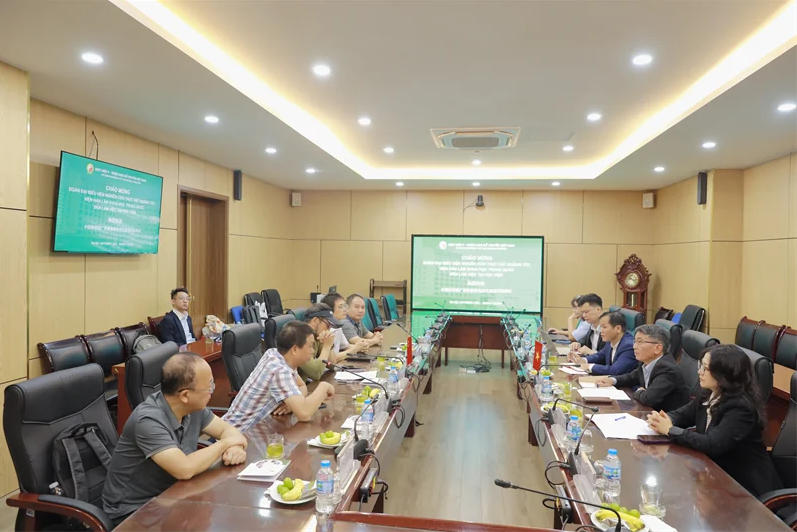
Meeting between the two units
Speaking at the meeting, Associate Professor Pham Quoc Binh gave an overview of the construction, development, training scale, and future development orientation of the Vietnam Academy of Traditional Medicine. Currently, the Academy has nearly 7,000 students and trainees enrolled and has established cooperative relationships and professional exchanges with many research, training, and organizational institutions in China.
Associate Professor Pham Quoc Binh emphasized that developing Vietnam's valuable medicinal plant resources and herbs is one of the directions that the Party, Government, and Ministry of Health are actively promoting. Vietnam has great potential in medicinal plant resources, along with a system of traditional medicine knowledge and many valuable indigenous remedies. However, the development of medicinal plant resources currently faces difficulties, especially in planning, establishing concentrated cultivation areas, ensuring the quality of raw materials, and researching and developing valuable active compounds for application.
Based on this experience, the Academy hopes to strengthen cooperation with research institutions in Guangxi in in-depth research on medicinal plants, exploiting the potential of native plant species and developing products with scientific, economic , and practical value. With similarities in climate and ecological conditions, Guangxi is expected to be a suitable partner for both sides to exchange experiences, coordinate research, and develop medicinal resources.
Associate Professor Pham Quoc Binh also provided information about the plan to develop the Academy's second campus with financial support from China, with the new facility expected to be inaugurated by 2030. This is one of the favorable conditions for expanding training, scientific research, and international cooperation in the future.
During the meeting, Associate Professor Dr. Vu Duc Loi, Director of the Tue Tinh Institute of Traditional Medicine, expressed his hope that both sides would soon find concrete areas of cooperation, based on leveraging the expertise and research capabilities of the Tue Tinh Institute of Traditional Medicine and research units in China. In particular, combining research experience, plant resources, and traditional medicine knowledge will open up many new approaches in the research of medicinal plants and the development of herbal products.
On behalf of the Chinese delegation, Professor Tang Hui expressed his interest and desire to strengthen cooperation with Vietnamese institutions. The professor highly appreciated the unique characteristics of Vietnamese culinary culture, especially the habit of using fresh, clean, and naturally sourced products in daily meals, contributing to nutrition and health. This is also one aspect that could open up avenues for exchange and research on plants with valuable uses in food and healthcare, opening up prospects for cooperation in research and development of plant-based products.
The meeting provided an opportunity for both sides to share information, identify potential and challenges in exploiting and developing plant resources for public health care. In particular, connecting the research strengths of Chinese scientific institutions with Vietnam's rich medicinal plant resources and traditional medicine knowledge is expected to create further impetus for in-depth research, standardization of medicinal material quality, and development of products with practical applications. Based on the exchanges at the meeting, the Vietnam Academy of Traditional Medicine wishes to further expand its relationship with Chinese research institutes and scientific organizations, aiming to build practical and effective cooperation programs that contribute to the conservation and development of medicinal resources and enhance the value of traditional medicine in the current context.
VUTM Communications Team



 Education