

 i_need_contribute
【Editor's Note】
Plants do not speak, yet wisdom resonates. Each herb is a window—within its nature, flavor, and meridian tropism lies a dialogue between the body and the natural world; amid the curling fragrance of medicinal materials, the harmonious resonance of life and culture echoes. From the Eastern medicinal garden to a bridge to the world, traditional Chinese medicine culture is being rediscovered through the eyes of international friends. Here, medicinal materials are not merely knowledge stored in herb drawers, but rather cultural collisions, emotional resonances, and understandings of life. Now, let us follow this series to draw near to each "foreign disciple's" herbal journey, and together embark on a dialogue from "knowing" to "seeing".
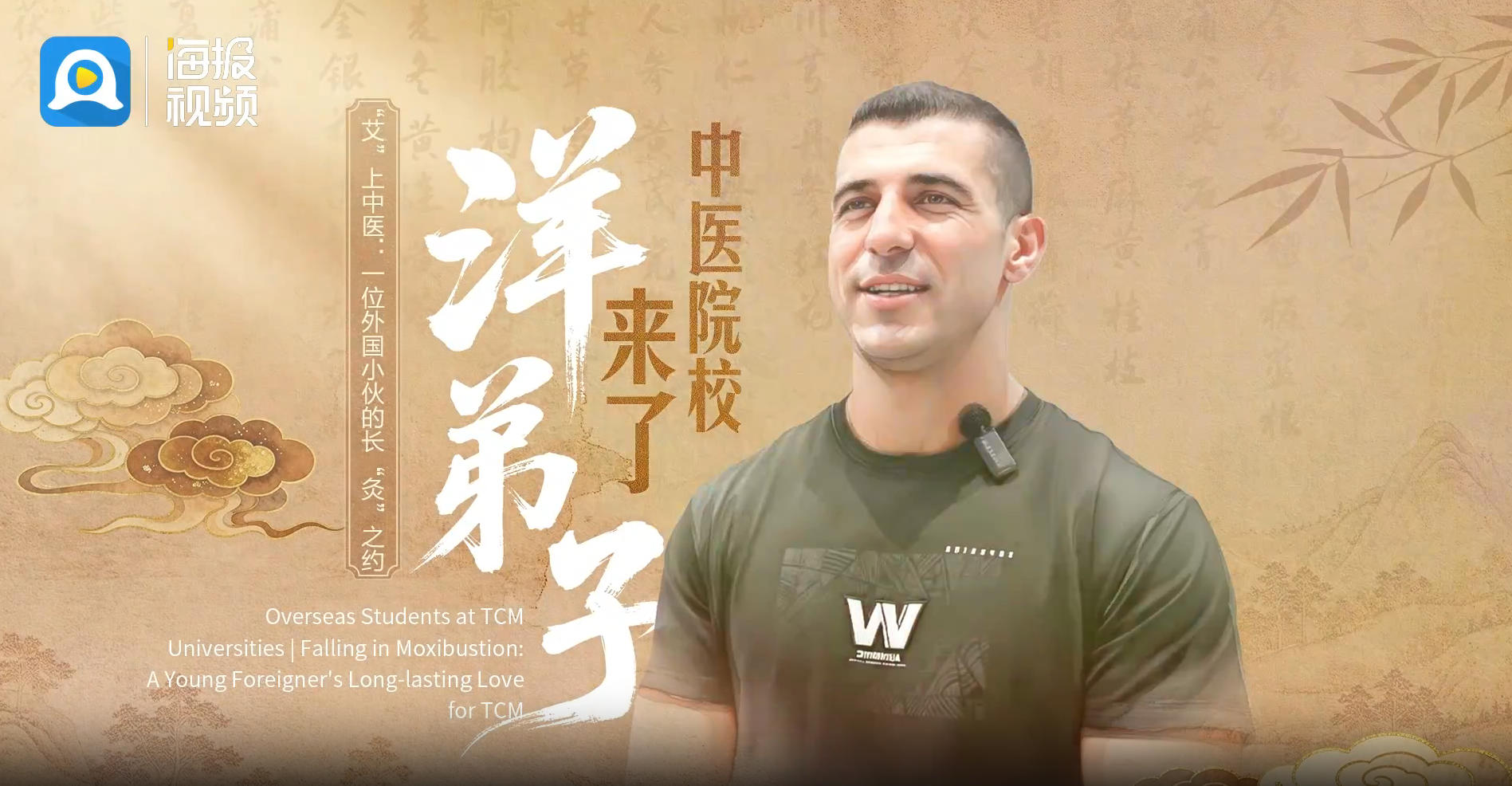
A wisp of rising smoke, warm and soothing. A small leaf of Chinese Mugwort (Artemisia argyi), in the hands of the Chinese, is not merely an herb to repel insects and purify the air, but also a potent medicine to warm the meridians and dispel cold. And in the classrooms of Shandong University of Traditional Chinese Medicine, Miller, a young man from Algeria, is exploring the mysteries of Eastern medicine through aburning moxa stick, preparing to bring this unique "Chinese warmth" back to distant North Africa.
Miller's real name is Hamam Hamza, an international student at Shandong University of Traditional Chinese Medicine. He earned bachelor's and master's degrees in civil engineering in Algeria. After graduation, he joined China Railway Construction Corporation Limited (CRCC) and participated in major infrastructure projects in Algeria, including a hundred-kilometer highway, schools, and railways. He worked outdoors year-round— the humidity of the northern coastal areas and the drastic temperature swings between day and night in the southern deserts gradually left him with heavy, sluggish legs and waist, and a persistent sense of fatigue. He didn't know this was called "dampness"(shi); he only knew that something felt wrong throughout his entire body.
During his time at China Railway Construction Corporation Limited (CRCC), Miller forged a deep bond with China. In 2025, he came to Shandong University of Traditional Chinese Medicine, transforming from a civil engineer into a student of traditional Chinese medicine. He began studying Chinese diligently, and later encountered TCM in his language classes. He said, "Although I haven't been exposed to it for long, TCM is incredibly rich in content—using natural plants as medicine, such as ginseng, goji berries, ginger, and jujubes; and therapies like acupuncture and moxibustion."
Where Chinese Mugwort Burns, Dampness Disperses
Yang Jiguo, Dean of the School of Acupuncture, Moxibustion and Tuina, Shandong University of Traditional Chinese Medicine, explained that this international student's background in civil engineering often exposed him to damp environments. Over time, this commonly leads to symptoms such as excessive dampness in the body, along with pains in the waist and legs. Moxibustion is precisely the right treatment for this — it warms the meridians, dispels cold, promotes blood circulation, and removes stasis.
When Miller experienced moxibustion for the first time, the warm medicinal energy slowly penetrated his body, and the stuffiness and swelling dissipated. He sighed that if he had had access to moxibustion on construction sites in Algeria, perhaps he wouldn't have had to tough it out for so long.
Dean Yang said, "He (Miller) wants to bring our moxibustion to his country—I think this is a wonderful idea. Because moxibustion is not only effective in treating illness; it is also very important for daily health maintenance." From the construction sites of steel and concrete to the herbal-scented classrooms, what he crosses is not merely a career boundary, but a journey to heal himself and others in an entirely different way.
Once Building Roads, Now Healing People
Civil engineering and traditional Chinese medicine may seem like entirely different fields, yet in Miller's heart, they share a common original purpose. "Civil engineering builds roads on the ground—highways, railways. These things help people to travel faster and more conveniently. Traditional Chinese Medicine repairs the roads inside the body—unblocking the meridians, harmonizing qi and blood, and eliminating dampness." In his view, these two pursuits are fundamentally the same: both are about "building roads," and both strive to protect a better life.
Miller's unique cross-disciplinary insight has also won recognition from his teachers at the university. Mu Ge, Section Chief, Admissions & Academic Programs Section, School of International Education, Shandong University of Traditional Chinese Medicine, said that this analogy is remarkably vivid and aligns perfectly with TCM theory. "Engineering emphasizes systems, structure, and flow, while TCM focuses on meridians, qi and blood, and their balance. Transferring his capabilities from his familiar field into the study of TCM, this interdisciplinary analogy will help him get startedparticularly quickly."
Miller has always firmly believed that the roots of TCM lie in China, and that only by returning to the source and studying at its origin can one truly master the authentic wisdom of TCM. Today, to overcome the challenges of his limited Chinese proficiency and the abstruse medical theories, he studies diligently day after day, steadily growing through his immersion in the culture of traditional Chinese medicine. When speaking of the future, his direction is already set. He hopes that after completing his studies and returning home, he will bring moxibustion — this convenient and practical TCM wellness therapy — back to Algeria, and share more of China's traditional health wisdom with his family and friends back home.
Once he built roads to connect mountains and seas; now he is learning to healpeople, bringing warmth to body and soul. Chinese Mugwort (Artemisia argyi) may be small, yet it can warm the meridians and promote blood circulation—just like this young man from Algeria, who is carrying the warmth of Traditional Chinese Medicine to places far and wide.



 Medicine