

 i_need_contribute
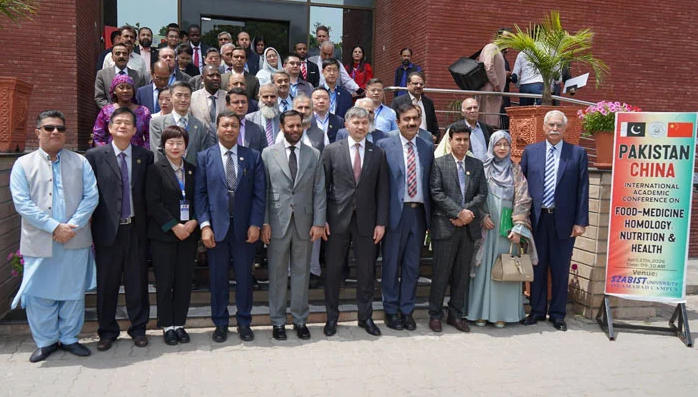
Federal Health Minister Syed Mustafa Kamal is seen in a group photo after the Pakistan-China International Conference on Food-Medicine Homology, Nutrition and Health, inaugurated at Shaheed Zulfiqar Ali Bhutto Institute of Science and Technology (SZABIST) Islamabadon April 27, 2026. — Facebook@OIC.Comstech
Islamabad: Federal Health Minister Syed Mustafa Kamal on Monday urged OIC-COMSTECH to actively promote traditional medicine, stressing that Pakistan’s healthcare system needs to prioritise prevention so that people remain healthy instead of relying primarily on treatment after falling ill.
He was speaking as chief guest at the Pakistan-China International Conference on Food-Medicine Homology, Nutrition and Health, inaugurated at Shaheed Zulfiqar Ali Bhutto Institute of Science and Technology (SZABIST) Islamabad.
The conference brought together scientists, policymakers, regulators and industry experts from Pakistan and China to enhance cooperation in health sciences, nutrition and traditional medicine.
Calling the conference a timely initiative, the minister said Pakistan could emerge as a leading country in adopting and promoting herbal and traditional medicine if the sector is given structured support and proper patronage.
Mustafa Kamal said despite having strong indigenous traditions in herbal healing, the sector has remained underdeveloped due to weak institutional backing, lack of investment and poor marketing.
Muhammad Iqbal Choudhary, Coordinator General COMSTECH, said the concept of food-medicine homology highlights the dual role of food as both nutrition and a tool for disease prevention and health promotion.
He described Pakistan-China collaboration in traditional medicine and biomedical sciences as an example of effective scientific diplomacy, adding that China’s expertise in traditional medicine combined with Pakistan’s biodiversity and medicinal plant resources offers significant opportunities for innovation and industry development.
He said COMSTECH is committed to promoting evidence-based traditional medicine through joint research centres, technology transfer and cross-border pharmaceutical and nutraceutical collaboration.
Liu Xinmin, a member of the WHO Expert Advisory Panel on Traditional Medicine and chief scientist at Ningbo University, said the conference reflected long-standing scientific cooperation between the two countries.
He highlighted over two decades of joint work in herbal medicine, food nutrition, drug discovery and space medicine, including the establishment of joint research centres, training of Pakistani professionals in China and regulatory approvals of Chinese healthcare products in Pakistan.
The conference continued with technical sessions focusing on medicinal plants, clinical research, food safety regulations, pharmaceutical partnerships and nutrition-based healthcare solutions.
The inaugural session began with the national anthems of Pakistan and China, followed by a recitation from the Holy Qur’an and an introduction to the event by Atia-ul-Wahab of the Panjwani Center for Molecular Medicine and Drug Research at the University of Karachi.



 Medicine