

 i_need_contribute
The hype has spawned a global industry of cold-plunge tubs, recovery clubs and social media challenges.
According to Danish scientist Susanna Soberg, a leading researcher on cold-water immersion, the benefits of deliberate cold exposure are real – but often misunderstood.
Her research synthesises decades of clinical trials and points to three clear physiological effects of regular cold exposure:
.It activates brown adipose tissue (BAT) – a type of fat that burns energy to generate heat. It can increase resting energy expenditure by as much as 15 per cent, supporting weight management and glucose metabolism.
.It triggers a release of the hormones norepinephrine and dopamine, leading to improved focus, alertness and mood. Dopamine levels can rise by 250 per cent, with effects lasting several hours.
t reduces pro-inflammatory cytokines, which may help with chronic inflammation and post-exercise muscle soreness.
Several places in Hong Kong offer ice baths, including Re:set by Pure in Causeway Bay, ASAP (Alternate Sauna And Plunge) and Acme Wellness, both in Central, 10x Longevity in Admiralty, Float Co in Mid-Levels, and The Ice Bath Club in Kennedy Town.
But Andrew Collins, founder of The Ice Bath Club – which has opened three dedicated recovery spaces in Singapore since 2024 and will soon add another to its Hong Kong portfolio, on Stanley Street – says Hong Kong still has a long way to go.
“If the most developed market might be at a 10, Singapore is at about a seven. Hong Kong is probably at two,” Collins says. “It really hasn’t been a trend at all until maybe last year, when a lot of these places opened up.”
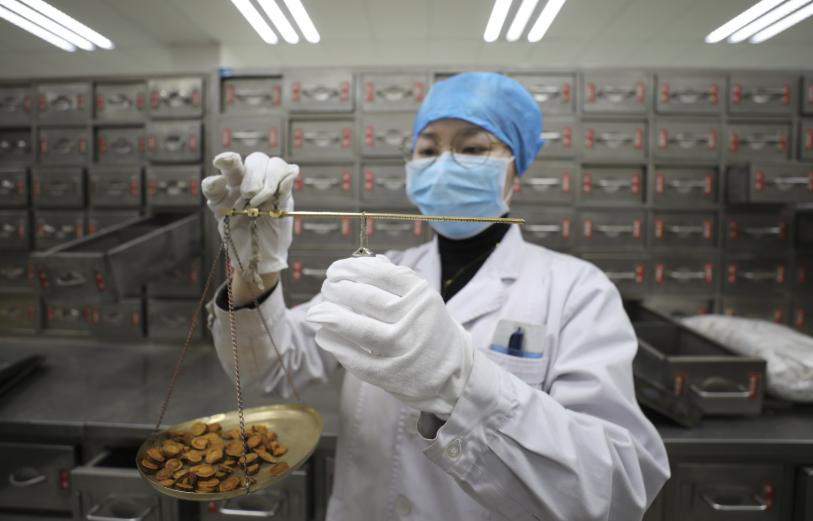
One possible cultural counter-current in Hong Kong could be traditional Chinese medicine (TCM) practices, which warn against cold as one of the “Six Evils” disrupting the body’s balance. It is why you often see people in the city drinking hot water even in stifling summer heat.
Ancient TCM scripts teach that prolonged exposure to cold disrupts yang energy – the body’s internal fire responsible for metabolism, vitality and immune function. Repeatedly dousing that fire with ice, the theory goes, has a negative effect on a person’s overarching qi, or life energy.
The core concern is that excessive or prolonged exposure to cold allows what TCM calls “wind, cold and damp pathogenic factors” to enter the meridians (the energy channels through which qi and blood flow). Once these pathogens take hold, they obstruct circulation, leading to blood stasis, stiffness, pain and delayed healing.
While Western sports medicine sees inflammation as something to suppress, TCM sees it as a natural response that should be managed through dispersion and movement – not frozen in place.
For traumatic injuries, the Western approach is often to use the RICE protocol: rest, ice, compression, elevation. The classical TCM approach involves heat therapy, blood-activating and stasis-resolving herbal remedies, topical plasters, and acupuncture.
The principle is “warming to unblock the meridians” – using heat to promote circulation and accelerate repair, rather than using cold to constrict blood vessels and slow everything down.
In the TCM view, applying ice to an injury causes swelling and pain to “congeal” at the site, preventing rapid dissipation and ultimately hindering tissue repair.
Addie Chan, a dual-qualified physiotherapist and TCM practitioner in Hong Kong, occupies an unusual middle ground. He understands the Western rationale for cold therapy in acute injury management and does not entirely reject it.
“I would use ice therapy for my patients at their acute sprain injury for the first three to seven days,” he explains. After that initial window, he transitions to contrast baths – alternating hot and cold – in the second week, and then purely hot baths from the third week onwards.
For chronic pain conditions or the later stages of an injury, Chan is clear: applying ice is counterproductive.
“In chronic pain or the later stages of an injury, applying ice is thought to drive wind, cold and dampness deeper into the bones, worsening joint stiffness and pain.”
But when the conversation turns to deliberate cold plunges – full-body immersion in near-freezing water for wellness or recovery – Chan’s stance is more sceptical.
“I think that would only be good to those athletes who had just finished a vigorous contact sport like rugby, which could [result in] lots of injuries on different parts of the body on a high-temperature day.”
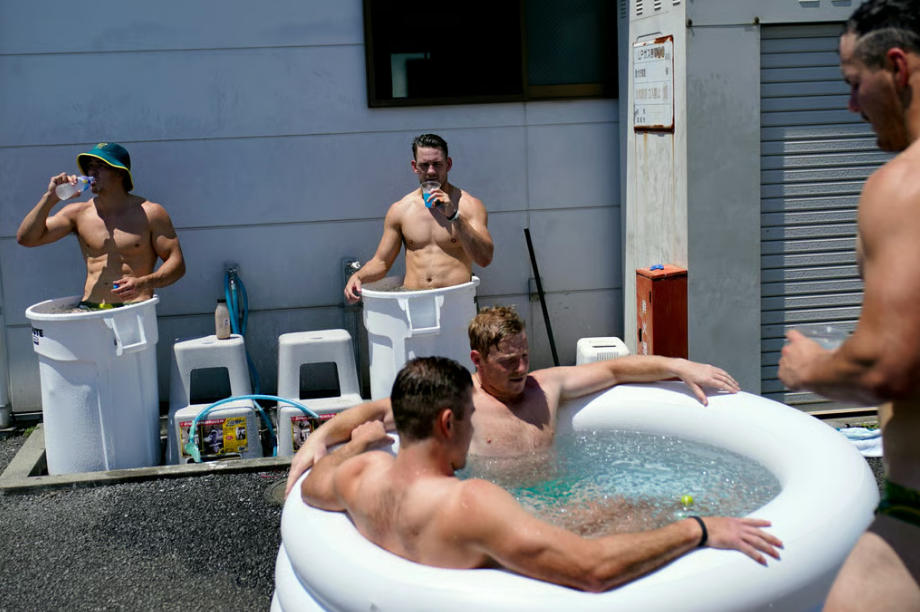
Members of Australia’s men’s rugby sevens team soak in ice baths following practice in the midday heat at the Tokyo 2020 Olympics. Photo: AP
Outside that scenario, he is unconvinced of the benefit, with one exception: using extreme cold as a deliberate stimulus to train the body’s resilience and make it better at enduring cold weather.
One of the most surprising claims from cold exposure enthusiasts is its effect on the immune system. Soberg’s research states that regular cold showers have been linked to a 29 per cent reduction in sickness absence from work.
Collins goes further: “When you do an ice bath in a controlled way, you’re building resilience internally for your immune system. It’s like going to the gym to protect yourself from a cold or flu.”
He contrasts this with traditional Chinese attitudes. “I used to live in [mainland] China for over a decade. They don’t really love cold stuff. But the irony is, the more I take a cold bath, the less sick I get.”
While Collins views cold plunges as a “gym for the immune system”, Chan offers a TCM caveat: this inoculation only works if one’s “yang condition” is robust enough to withstand the assault.
It is a sentiment echoed by Amin Ashraf, a personal trainer at the Hong Kong Cricket Club.
He explains that high-intensity training results in the micro-tearing of muscle fibres and that an ice bath helps decrease inflammation and soreness after a workout. But for the casual exerciser, it is unnecessary.
More importantly, Ashraf warns of the physical toll. He points to the inherent danger of “contrast therapy” – the popular practice of moving between extreme heat and cold. Those with high blood pressure or who have a family history of heart issues should not do this, he says.
His caution is born of experience: he recalls an incident in which a club member suffered a cardiac event after transitioning from the heat of the sauna to the shock of the cold plunge.
Known as a cold shock response, a person’s heart rate spikes when their body hits freezing water, and blood vessels instantly constrict.
Collins, despite his role as an industry advocate, is the first to preach moderation. For him, the ice bath is not a test of grit, but a lesson in biological control.
“No one’s forcing you to be there,” he says. “You can get out whenever you want.”
As potential proof that Hong Kong’s icy scepticism is thawing, he recalls seeing a group of local women in their 60s – a demographic highly likely to adhere to the TCM “Six Evils” philosophy – sharing a laugh in the tubs.
For those not quite ready to take the full plunge, there is another option.
“You don’t even need a bath,” Collins says. “Start with a cold shower.”
The goal, he emphasises, is resilience, not suffering. When you are ready, find a bath “that’s uncomfortable, but not excruciating”.



 Health