

 i_need_contribute
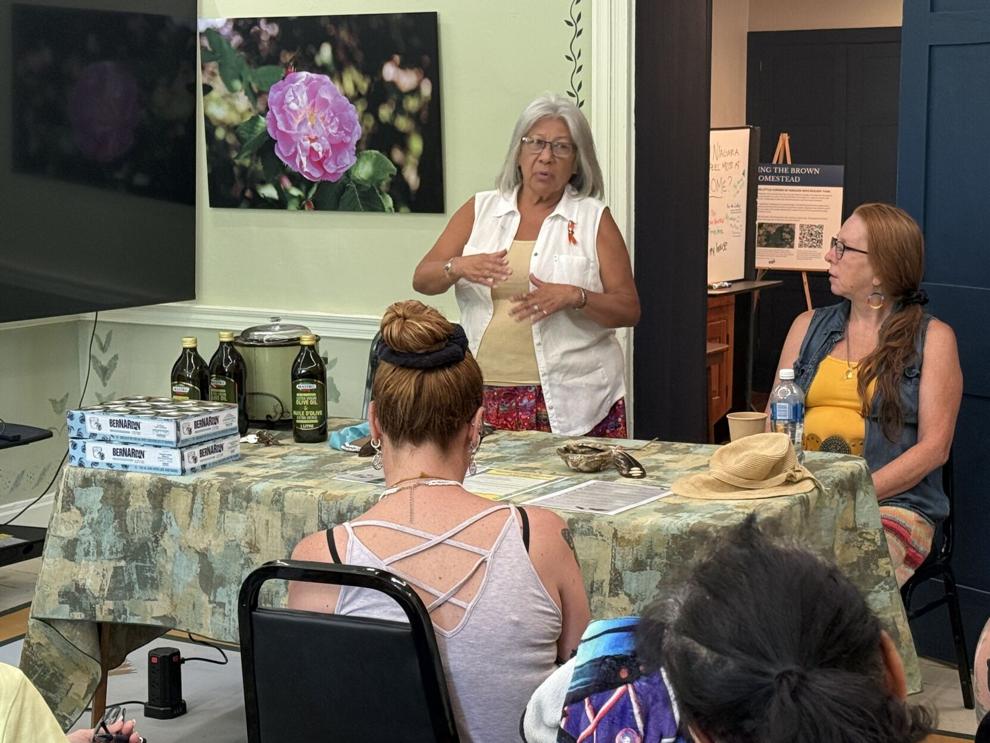
Jackie Labonte (left) and Marie Louise teach people about traditional Indigenous medicines during a workshop at the Brown Homestead on Saturday. Matthew P. Barker/St. Catharines Standard
Wisps of sage smoke circled around the dozen people inside the Brown Homestead, who were taking part and learning about Indigenous medicines.
The Saturday seminar led by Jackie Labonté and Marie Louise, both Mohawk women, taught people how Indigenous medicines have helped the people of Turtle Island (North America) for millennia.
The lecture-style event at the homestead, located at 1317 Pelham Rd., ran from 10 a.m. until noon and allowed participants to make a traditional salve, which they could take home.
Labonté opened the morning workshop with the Thanksgiving Address.
Labonté said the address is a responsibility of the Haudenosaunee people, during which they take the time to acknowledge all the important beings. It begins with those closest to the ground and moves up to the stars.
Theresa Felicetti, Brown Homestead director of programming, said the workshop provided “non-Indigenous people the opportunity to learn but also encourages more participation from the Indigenous community.
“We want this to be a space where people can all come together and learn from one another,” she said.
The first Indigenous medicines workshop was held last year and was “really well received,” said Felicetti.
“It was an opportunity to bring people together. It’s a little bit more lecture style, with people learning about the different medicines, how they’re used (with an) opportunity to ask questions and create dialogue,” she said.
Indigenous plant medicines in Niagara region are rooted in the teachings of the Anishinaabe and the Haudenosaunee peoples and focus on four sacred medicines: tobacco, sage, cedar and sweet grass. These items are used in many ceremonies, smudgings and healings.
Some of the medicines can be found steps from the Brown Homestead.
“We don’t want to ever make it feel like we’re just sharing the Indigenous history, as a small tidbit of the site (rather) we’re actively engaging in lessons and knowledge from the Indigenous community,” Felicetti said.
“The Indigenous medicines … a lot of them can be found on the property or in Short Hills Provincial Park (adjacent to the homestead) … so, it brings it full circle and makes you realize this is still being practised and it has so much value today.”
Louise spoke on Sunday after the workshop about its success and the future for others.
“They’re growing. Every year it’s getting bigger and bigger. So we’ve been in talks about maybe offering two (workshops) over the summer,” she said.
“(We) have been holding various workshops at the Brown Homestead. We start off in the (spring) with opening the (homestead’s) garden and then now it’s the Three Sisters: the corn, beans and squash.”
The Three Sisters create a symbiotic ecosystem: the corn provides stalks, which the beans need to grow; the beans provide essential nitrogen for the soil and squash provides ground cover, moisture retention and prevents weed growth.
Louise said the reception to the workshops has been overwhelming.
“There’s a wait-list (some) people didn’t show up … but we always have a wait-list or a full capacity, that’s why we started the registrations,” she said.
Louise stressed the medicine is more than just the plants, it’s the environment and the people.
“When (Labonte) did those words before all about that connection and relationship to all of creation, that’s important,” she said.
Louise credits the Brown Homestead for being open and willing to provide space for the many First Nations initiatives being launched in the Niagara region.
“The Brown Homestead is continuing the work and growing with the work they’re doing outside of the plant medicines,” she said.
“When looking at that historic piece and the work they’re doing with Tim Johnson (president, Niagara Academy for Indigenous Relations) and the history that Pelham Road was originally (the Mohawk trail), I applaud them.”
To Louise, these spaces are important to continue to amplify and share the First Nations People’s voices and history.
“We need more safe spaces like this we can come to and share with Indigenous and non-Indigenous people. We are all treaty people — that diversity and equality is very important,” she said.



 Medicine