

 i_need_contribute
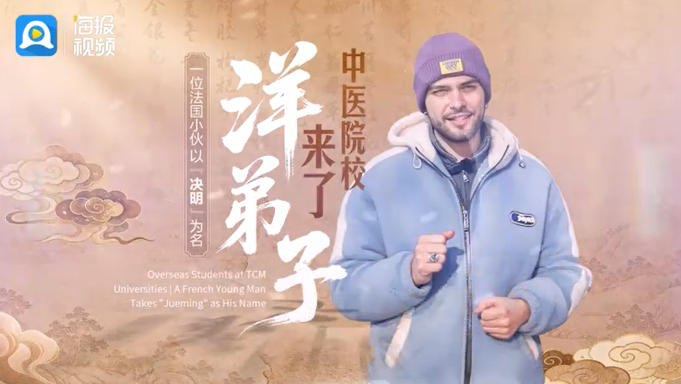
Lin Jueming studied traditional Chinese medicine courses in France for five years. Yet he quickly realized that in France, TCM often felt more like an "intellectual system"—he learned through textbooks about the natures, flavors, and meridian tropisms of herbs, and memorized their actions and indications, but he had never actually touched the herbs with his hands or smelled them with his nose. "In France, I already had a basic understanding of traditional Chinese medicine. Only after coming to China did I begin to understand the culture and philosophy behind it. Traditional Chinese medicine is not merely a medical practice; it is the way the Chinese people perceive the world."
At Shandong University of Traditional Chinese Medicine, Lin Jueming headed for the hundred-drawer cabinet. His fingers traced across the labels—"Goji Berry" "Chrysanthemum Flower" "Chinese angelica"—before finally rested on "Cassia Seed". He pulled open the drawer, took out a small handful, cupped it in his palms, and breathed in its scent gently. "In France, it was a paragraph in the textbook. Here, it is something real and tangible." He recalled the line he had memorized over the past five years—"Cassia seed is cold in nature and enters the Liver meridian"—and only now did he truly understand it: he had smelled its fragrance, seen the soil where it grew, and grasped why the Chinese say it "clears the Liver"—for in this culture, the "Liver" is not merely an organ, but a vessel for emotion.
He later learned that the small yellow flowers of the cassia plants were described by the Tang dynasty poet Du Fu as "leaves covering the branches like emerald-feathered canopies, blossoms innumerable as golden coins." And that the Northern Song dynasty poet Huang Tingjian, who lived nearly a thousand years ago, personally planted cassia, made it into a medicinal pillow, and wrote: "A pillow sack to rest where once my arm would lie. In tranquil sleep I breathe its fragrance deep. These aging eyes still hold their will on high. That reading on may be my lifelong keep." Lin Jueming said that Chinese people had been using cassia seed for a very long time, and Huang Tingjian's practice and poems made him realize that there was culture behind the medicinal herb. That was something he had not expected at first.
What amazed Lin Jueming even more was how traditional Chinese medicine integrates health into daily life. He put cassia seeds into a sachet and hung it by his bedside, and brewed a tea of cassia seeds, goji berries, and chrysanthemum flowers for his Chinese classmates. "Drinking a cup of tea, wearing a sachet — this isn't 'taking medicine.' It's a form of self-care as natural as breathing. TCM doesn't just see a disease; it sees a person's entire way of living."
Professor Wang Jiafeng from Shandong University of Traditional Chinese Medicine was very pleased with this: "Lin Jueming approaches cassia seed from an international student's perspective, combining his own cultural background to understand it…He has not only grasped its core effects of clearing the liver and improving eyesight but also recognized the philosophy of life in traditional Chinese medicine behind it— the homology of medicinal materials and food —as well as the auspicious meaning of "improving eyesight" in its name. This understanding goes beyond simply memorizing its effects and applications; it touches upon the profound ideas in TCM culture: the harmony between form and meaning, and the unity of manand nature."
Chen Zhan, Deputy Dean of the International Education College at Shandong University of Traditional Chinese Medicine, said that seeing more and more international students come to China to study TCM is very encouraging to him, as it is a vivid illustration of the rising global popularity of TCM culture.
From France to Shandong, China — from textbooks to real life, the distance Lin Jueming traveled is not eight thousand kilometers, but the distance from "knowing" to "understanding". Understanding always begins with seeing — behind a single herb lies a civilization's way of looking at the world. Lin Jueming said, "I want people to see that traditional Chinese medicine is a bridge — connecting the body and the nature, connecting the East and the West, and connecting ancient wisdom with modern life."



 Education