


 i_need_contribute
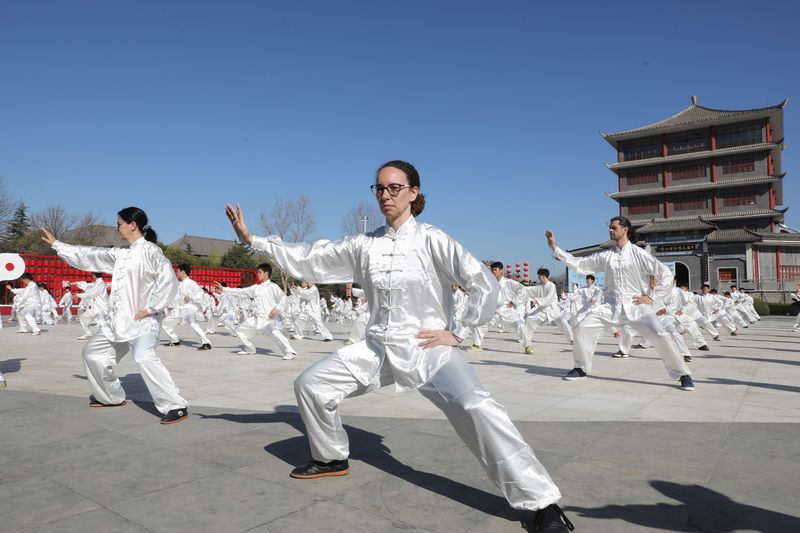
Typically, I might begin a fitness trend piece with something like, “This isn’t your grandfather’s workout.” Except, this time, it actually might be. Tai chi has been around for over 1,000 years, during which time the ancient Chinese martial art has grown to become one of the most popular fitness activities in the world. According to a 2025 paper published in the journal Frontiers in Public Health, tai chi is practiced by about 300 million people globally. And in the United States, where an estimated 1.5 million people take part, tai chi is poised to follow in pickleball’s footsteps as the next fitness trend to go through the senior-village-to-West-Village pipeline, nudged along by the internet’s recent Chinamaxxing obsession.
“Over the last fifty years, tai chi has become one of the most popular mind and body exercises for health,” says Dr. Paul Lam, director of the Tai Chi for Health Institute. As more and more people seem to be trading high-impact HIIT workouts for comparatively holistic and intentional modes of fitness that also serve to lengthen their healthspan, it makes perfect sense that tai chi would be gearing up for a major moment. “Overall, the world seems to be trending towards living a healthier life for longevity,” says Sharon Heller, a tai chi instructor at Life Time. “And tai chi certainly falls into that camp.”
While there are many forms of tai chi, the practice generally combines slow, fluid movement with mindful breathing and the use of mental imagery to bring the body and mind into closer alignment. “In a way, it's like a moving meditation,” says Dr. Lam.
Based in traditional Chinese medicine, or TCM, tai chi is intended to support the free flow of qi, or energy. “It was created to balance and regulate the energy in the body,” says Heller. “In traditional Chinese medicine, if the energetic pathways in your body are flowing freely and they're balanced, it means you're healthy. As soon as things get clogged up or imbalanced, you become unhealthy.”
This isn’t woo-woo wellness. Tai chi’s health benefits have been validated by hundreds of clinical trials. "Just because you're moving slow, that doesn't mean that you're not getting a tremendous health benefit out of it,” Heller says. Scientific studies have found tai chi to improve sleep and cognitive function, protect against conditions ranging from Parkinson’s to depression, and much more.
Tai chi can also help round out your fitness, whether you’re new to working out or already crushing multiple strength training and cardio sessions a week. “It looks almost effortless from the outside, but there's a lot of exercise value, physically,” says Dr. Lam. Tai chi has been shown to improve balance, increase aerobic capacity, and build lower-body strength.
“Because you're coordinating movement with breath, you start to breathe deeper and more slowly, and it actually improves your body’s capacity to absorb oxygen,” says Heller. "Meanwhile, you're enhancing your ability to move from your core, which is only going to enhance your ability to do strength training.”
Not at all, actually. While tai chi and yoga might look similar on the surface, they approach movement in totally different ways. One isn’t inherently better than the other; they just offer different benefits.
"Whereas a lot of the yoga postures bring you to a pause before moving on to the next pose, the emphasis in tai chi is not the posture itself but the transition from one posture to the other,” says Heller.
While working towards mastering various yoga poses can greatly improve your mobility, balance, and more, tai chi’s focus on fluidity and constant motion makes it more conducive to maintaining a flow state and locking into the mental aspect of the practice. “It's really what makes tai chi, tai chi,” says Heller.
“It enables you to bring more of yourself to what it is you're doing, and really understand, ‘Oh, for this posture, I'm going to be thinking about the bottoms of my feet, so I can feel connected to the ground while I take a step,’” she says. “While you're drawing shapes with your arms, you might be thinking of your arms as being hoses with water or paint coming out of them. Or if I'm taking a step forward, I'm thinking about a wind blowing from behind me. Those are just a few examples.”
Tai chi also offers a lower barrier to entry for beginners, with form playing a less consequential role when starting out, not to mention a lower risk of injury overall. "It's very safe, and can give you health benefits relatively quickly,” says Dr. Lam. “Hour for hour, tai chi is probably the better activity for health, mentally and physically.”
If this were an article about how to deadlift or build bigger arms, we’d just describe those exercises and send you on your way. However, because of tai chi’s inherently kinetic nature, we’d be doing you a disservice to even attempt written instructions. The best way to get started is to simply sign up for a tai chi class, or watch this free lesson from Dr. Lam, which has garnered more than 10 million views on YouTube.
Either way, both Heller and Dr. Lam recommend starting slow and focusing on familiarizing yourself with just a small handful of basic movements at first. “It's like anything else,” Dr. Lam says. “You can do something very fast and not really learn anything, or you can take your time to really feel it and get the full benefit. That's what makes tai chi so enjoyable.”
“You can take one posture in tai chi and make that an activity on its own,” says Heller. “What I usually tell my students is, ‘I'm going to throw a lot of things at you today; you'll remember some of them, and some of them you'll forget. But whatever you remember, you can take home and play with.’”





 Medicine