

 i_need_contribute
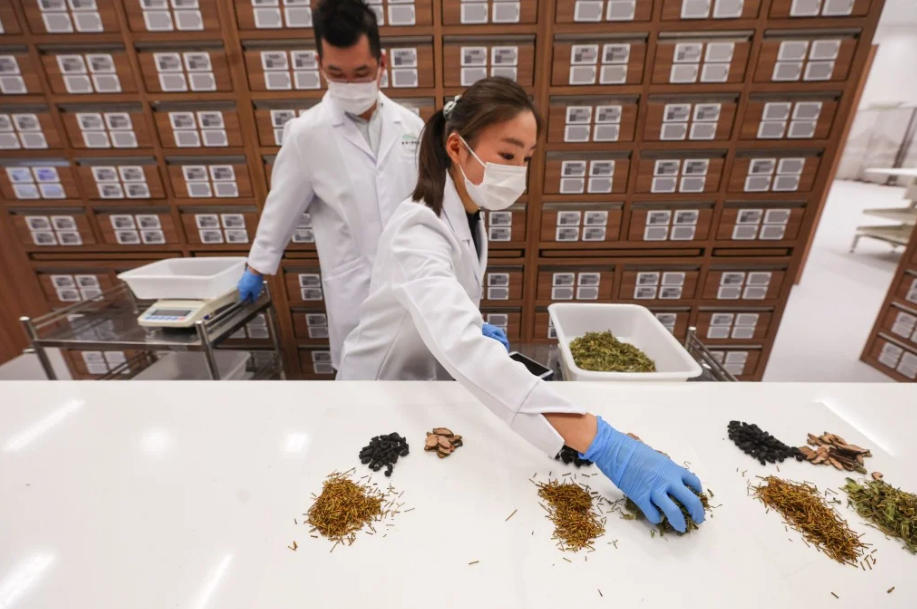
The pharmacy at the Chinese Medicine Hospital of Hong Kong, the city’s first hospital in the field. Photo: Edmond So
About 40 per cent of Hongkongers struggle to distinguish between proprietary Chinese medicines and health supplements, according to a survey by a think tank that has developed a tool to assess public literacy in the traditional discipline.
Our Hong Kong Foundation on Thursday released the findings of a survey conducted last August, using the tool to poll 800 residents.
The think tank said the survey revealed a moderate overall level of Chinese medicine health literacy among respondents, who scored 69.8 out of 100.
The results showed that 85.3 per cent of the respondents could apply Chinese medicine health advice, such as environmental or dietary adjustments, to improve their physical well-being.
But 40.2 per cent of those surveyed found it difficult to distinguish proprietary Chinese medicines from health supplements, according to the findings.
The think tank said the results showed significant room for improvement in the public’s understanding of the fundamental concepts and treatment methods of Chinese medicine.
“The results of the survey indicate that Hong Kong residents’ overall health literacy of Chinese medicine is only at a moderate level,” said Jane Lee Ching-yee, president of Our Hong Kong Foundation.
“We need to deepen the understanding and application of Chinese medicine among residents and medical professionals through various aspects, including policies, services, training and public outreach, so that the development of Chinese medicine can have a better direction.”
The think tank said it had developed the city’s first Chinese medicine health literacy scale in collaboration with Polytechnic University, with sponsorship by the Chinese Medicine Development Fund.
Professor Angela Leung Yee-man of the university’s school of nursing said residents’ health literacy was measured based on their answers to 16 questions, covering regulations and service delivery, fundamental concepts, lifestyle and treatment.
Respondents were asked whether they could apply Chinese medicine health advice to improve their physical condition and if they understood the name and dosage of prescribed medication, among other questions.
According to the findings of the survey, 32.9 per cent of the respondents were unclear about how to obtain a legally valid sick leave certificate issued by a Chinese medicine practitioner.
The results also showed that 26.4 per cent of the respondents were unaware that they could give feedback or lodge complaints about consultation services to relevant institutions, such as the Chinese Medicine Council of Hong Kong.
The think tank proposed several recommendations for Hong Kong to enhance the public’s understanding of Chinese medicine, which it said would play a crucial role in the city’s efforts to further develop the sector.
Dicky Chow Ka-chun, head of healthcare and social innovation at Our Hong Kong Foundation, said authorities should learn from mainland China’s experience and use the think tank’s tool to establish a standardised system for assessing the public’s Chinese medicine health literacy.
He said data analysis would help identify groups with low literacy levels and common knowledge gaps to achieve targeted resource allocation.
He also called for deeper collaboration between Chinese medicine practitioners and other healthcare professionals, and for the promotion of the traditional discipline in mental health services to be prioritised.
Other suggestions included improving Chinese medicine health literacy among healthcare professionals through enhanced training and stepping up education in communities and schools.
Hong Kong has been ramping up development of the Chinese medicine sector, with authorities unveiling the city’s first blueprint for the industry’s growth last month.
The blueprint outlined five key areas – services, profession, product development, culture and global expansion – along with eight goals and 20 action plans.
Authorities earlier said the new blueprint underpinned the city’s contribution to the national strategy of bringing the healing powers of Chinese medicine to the world.
The Chinese Medicine Hospital of Hong Kong, the city’s first hospital in the field, opened on December 11, aiming to provide services for more complex cases under a model that features Chinese medicine as the primary approach, integrated with Western medicine.



 Medicine