

 i_need_contribute
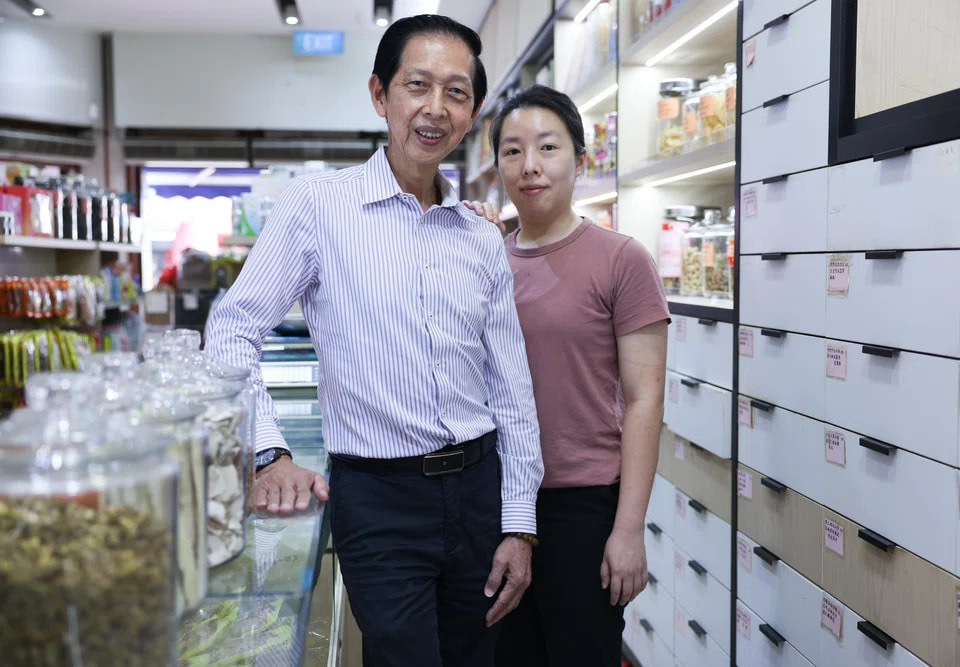
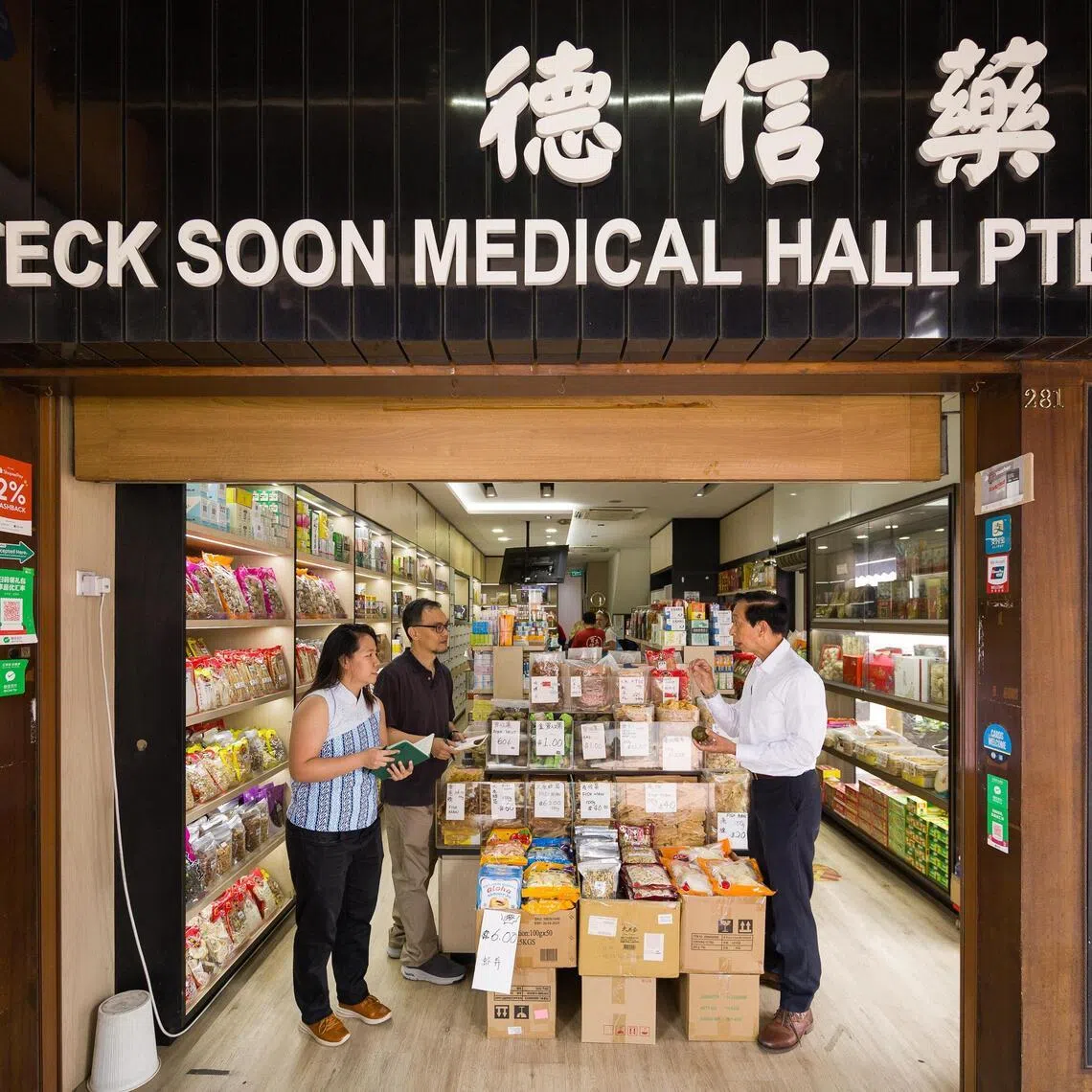
Teck Soon Medical Hall's second-generation leader Chow Khai Shui (left) with his daughter, Chow Chew Li. PHOTO: TAY CHU YI, BT
Despite the ubiquity of Western medicine, Teck Soon Medical Hall still sees a role for traditional Chinese medicine (TCM) – and hopes its modern approach can convince younger customers of this, too.
Chow Chew Li, Teck Soon Medical Hall’s third-generation owner, said: “Nowadays many people go for modern medicine, but we believe traditional Chinese medicine still has a place and can complement it.
“Our goal is to help patients improve their quality of life, and we hope TCM can fill some of the gaps that modern medicine cannot.”
This includes how to build up one’s health after having recovered from a prolonged illness, and how to tackle chronic pain conditions such as rheumatoid arthritis.
Aiding Teck Soon’s ambitions are government moves to improve the TCM industry.
Chow noted that the Ministry of Health aims to integrate TCM into the national health system and is evaluating 18 proposals for evidence-based TCM treatments in a sandbox initiative.
Even as Teck Soon modernises, the family hopes to preserve the traditions and knowledge of TCM for future generations.
That is why Chow and her father Chow Khai Shui – the second-generation leader – applied for the National Heritage Board’s (NHB) SG Heritage Business Scheme.
Last October, Teck Soon was among 42 home-grown businesses recognised in the inaugural batch. It now displays the SG Heritage Business mark outside its shopfront.
Such recognition confers greater legitimacy, said Chow. “Some tourists who come into our shop are afraid of getting scammed or upsold things they don’t need.”
“So this heritage (status) assures new customers that we’ve been around for a long time.”
The medical hall was opened in 1963 by Chow’s grandfather, Chow Chee Yik. It occupied just half of a rented shophouse on Sago Lane.
In 1969, urban renewal in Chinatown forced the business to relocate to 281 South Bridge Road, where its flagship branch remains. By 1990, Teck Soon had been passed down to Chow’s father and his seven siblings.
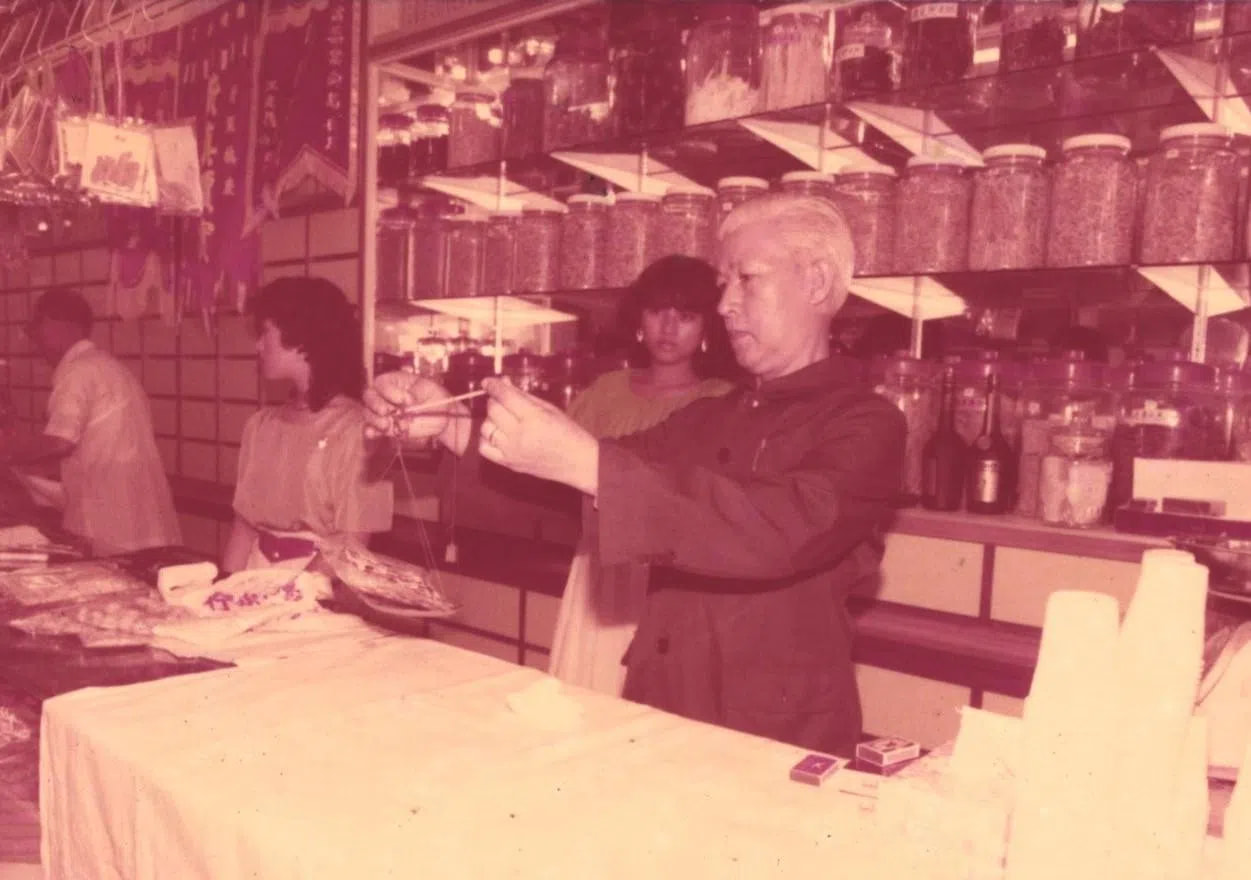
Chow’s grandfather, Chow Chee Yik, weighing herbs at Medical Hall on Sago Lane. PHOTO: CHOW CHEW LI
Today, Teck Soon has four outlets across Singapore. Its flagship branch is run by Chow and her father – both registered TCM practitioners – while the other three are run by her relatives.
Tourists account for a growing share of customers: about 20 per cent now, up from 10 per cent in 2019.
Since 2023, the business has seen even more tourists from mainland China, as well as customers from the United States and Europe who have learnt about TCM through TikTok and are seeking “more natural” remedies, said Chow.
“From what we see, some people from the US feel that their only options from hospitals or pharmacies are pills or painkillers,” she said.
“But many of them who come into our shop ask us for, say, herbs or flowers to make into teas. They may have conditions such as insomnia or anxiety, while some just want to boost their constitution or stamina.”
Still, Chow acknowledges that TCM has its detractors, with some believing it is only for those who are “superstitious”. “They feel that TCM has no grounding in the real world due to terms like yin and yang, which can seem very abstract.”
To help customers better understand the benefits of TCM, Chow and her staff explain concepts by relating them to familiar terms in modern medicine.
For instance, the TCM concept of “heatiness” can be likened to inflammation, which is marked by symptoms such as redness or swelling.
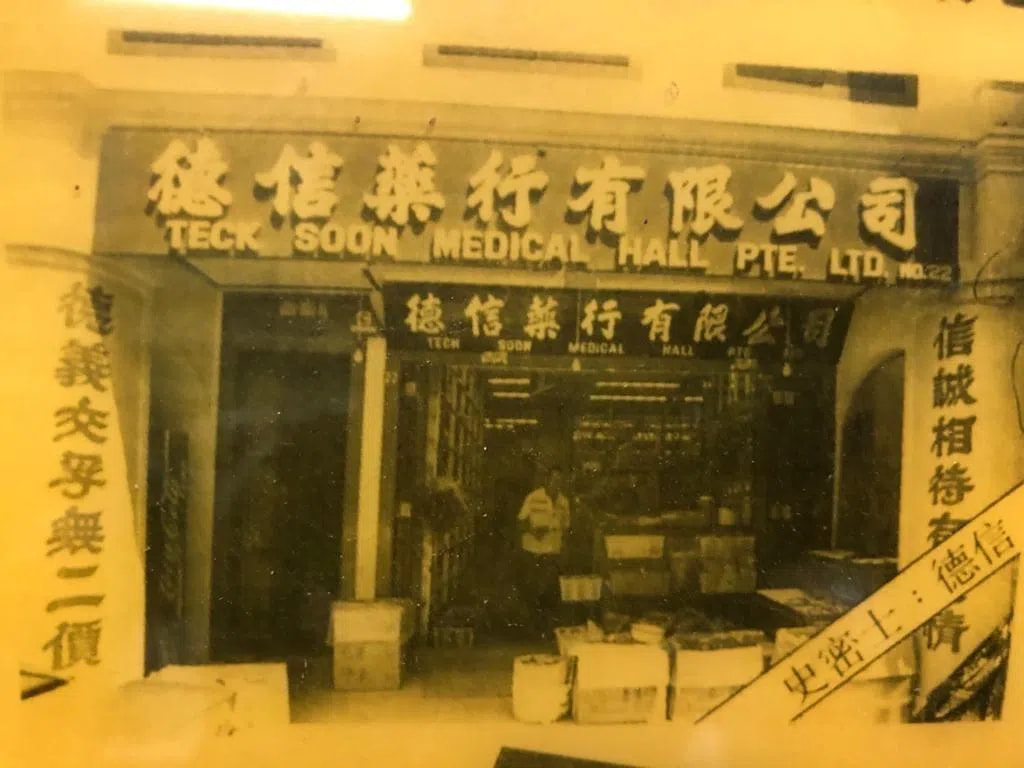
Teck Soon Medical Hall in the 1970s. PHOTO: CHOW CHEW LI
Today, about 30 per cent of Teck Soon’s customers are in their 20s and 30s, up from less than 10 per cent some five or six years ago. Most customers are still aged above 40.
This increase is partly driven by patients seeking relief from long-Covid symptoms that could not be resolved after visiting “many doctors”, Chow said.
But the business has also reached new customers by refreshing its old-school image and going digital.
In 2019, its flagship branch at South Bridge Road underwent a S$300,000 revamp to modernise its interior and improve visual merchandising.
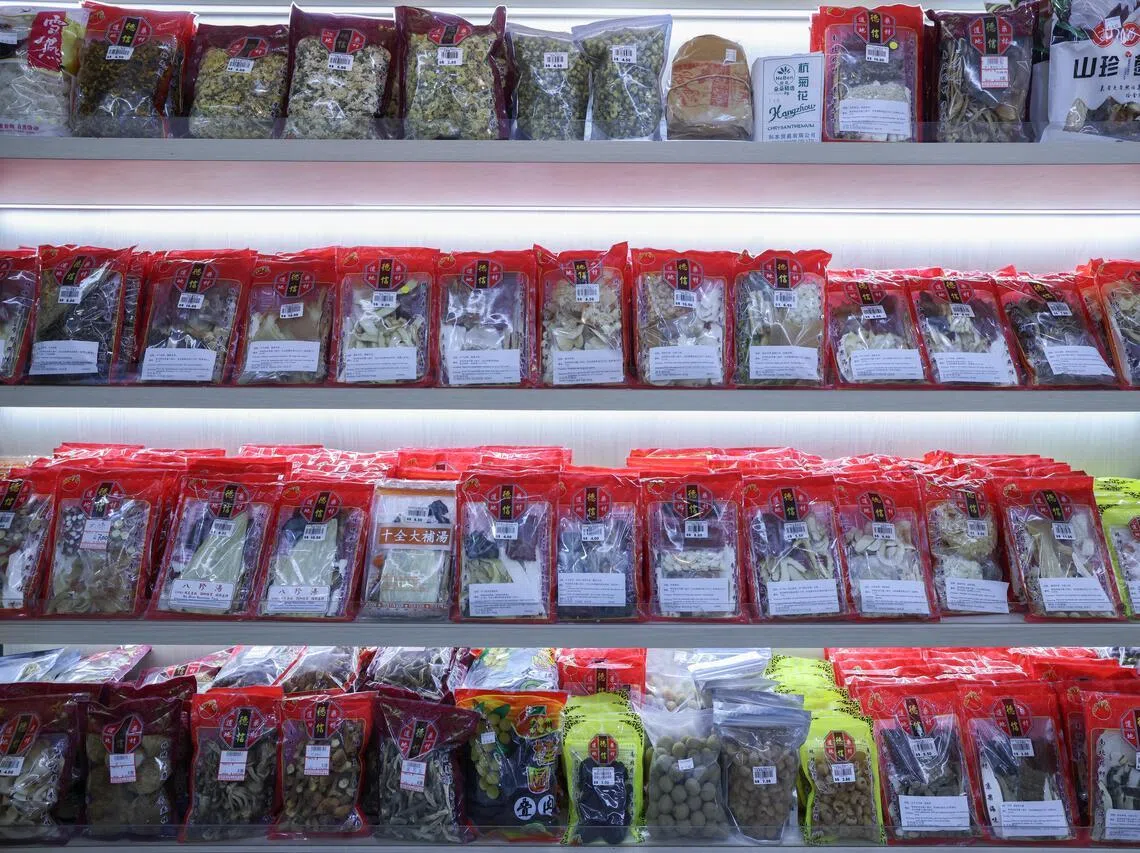
This included displaying more products on shelves – rather than in baskets on the floor – and enhancing the store’s lighting. A second consultation room was also added to accommodate more patients.
“We wanted the store to look brighter, cleaner and appear more welcoming, especially for those with no prior exposure to traditional Chinese medicine,” said Chow.
Since its renovation, the store has experienced a 10 to 15 per cent increase in sales each year.
Teck Soon Medical Hall’s flagship branch underwent a S$300,000 revamp in 2019. PHOTO: BT FILE
In 2019, Teck Soon also launched its own e-commerce website and set up accounts on Facebook and Instagram to expand its reach.
The management had realised that the stores’ relatively early closing time of 6.30 pm could make it challenging for working customers to visit, and that some stores lacked onsite parking.
The online store has been a hit with younger working adults, particularly mothers, said Chow.
It also proved timely, as the Covid-19 pandemic hit soon afterwards. During the pandemic, customers became accustomed to online purchases and having herbs delivered to their homes – a practice that has continued even today.
To communicate more efficiently with customers and handle direct requests, Teck Soon set up a WhatsApp Business account in 2021.
This allows staff to help customers remotely, such as by sending photos of products to them for comparison.
Customers can also submit herbal prescriptions through WhatsApp to get price estimates first, then make a purchase and arrange for pick-up or delivery.
TCM may be traditional, but it is not stagnant. Staying relevant also means keeping up to date with emerging trends and new medicines.
To that end, Chow and her father regularly attend accredited TCM seminars and webinars, and go on business trips to China and Hong Kong to study their TCM markets.
TCM trends may even emerge on social media. Platforms such as XiaoHongShu have popularised certain herbs previously considered “obscure”, noted Chow.
Another trend is that of growing interest in confinement TCM practices, especially from Singaporeans and Malaysians. This has prompted Teck Soon to offer the option of customised confinement soups.
Its physicians can now create such herbal prescriptions for customers after a consultation, with the recipes tailored for their body type and constitution. Previously, the store only offered a small range of pre-made soups.
Teck Soon’s physicians can now create customised confinement soups for customers after a consultation. PHOTO: TAY CHU YI, BT
The business has no immediate plans to open more branches, with Chow citing manpower constraints and the difficulty of finding a suitable location.
A priority is keeping the business within the family to preserve Teck Soon’s brand of “hospitality and neighbourliness”, which has been a constant since her grandfather’s time.
“We do talk to our customers and try to get to know them as people, so we can understand where they come from, what they need,” she explained.
“Business is important, but building relationships with people is equally important – we don’t want to become too commercialised.”
But growth could take a different form. A longer-term goal is to open a wellness experience centre, offering services from massages to TCM treatments such as cupping and scraping. It could also sell Teck Soon’s ready-made herbal teas and soups.
Chow’s father got the idea after visiting similar TCM wellness centres in China, where he observed customers being given health reports before and after TCM treatments.
“If you feel very stressed, you could come to the centre to get a massage (or) drink some hot tea to relax,” said Chow, adding that she hopes the centre can support Singapore’s growing ageing population.
She and her father plan to do further research before committing to a timeline for the centre’s opening, with the earliest possibility being 2030.



 Medicine