

 i_need_contribute
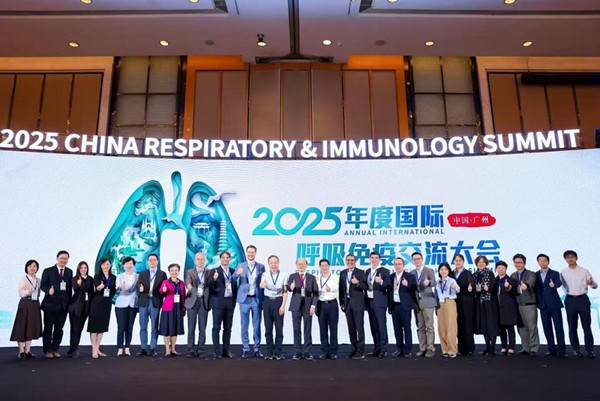
Attendees to the 2025 International Respiratory Immunology Summit in Guangzhou, Guangdong province, try to chart a new blueprint for respiratory health to benefit Healthy China. [Photo provided to chinadaily.com.cn]
Chen Rongchang from the First Affiliated Hospital of Guangzhou Medical University stressed that the rapid development of respiratory immunology has provided crucial insights into the underlying mechanisms of chronic airway diseases, and the shift from symptom relief to addressing the mechanisms causing the progression of the disease offers new hope for altering disease trajectories.
Chen spoke on Nov 15 at the 2025 International Respiratory Immunology Summit in Guangzhou, Guangdong province, hosted by the Beijing Association for the Prevention and Treatment of Chronic Diseases with Integrated Traditional Chinese and Western Medicine and supported by Sanofi China.
The summit, bringing together leading domestic and international experts to address critical challenges in respiratory health, aims to promote the advancement of precision diagnosis and treatment of chronic respiratory diseases, and design a new blueprint to benefit the grand vision of "Healthy China 2030".
Dr Tong Yu, head of medical affairs at Sanofi Greater China, said that chronic airway diseases, particularly Chronic Obstructive Pulmonary Disease (COPD) and asthma, have imposed a significant burden on patients, their families, and society.
"In recent years, there has been a deeper understanding of type 2 inflammatory mechanisms, which play a crucial role in disease progression and have emerged as a key interventional target," Tong said.
Speaking during the morning session, professor Kian Fan Chung, from Imperial College London, stated that asthma and COPD share common type 2 inflammatory mechanisms, primarily driven by IL-4 and IL-13, which can lead to airway remodeling.
Professor Chen Rongchang from the First Affiliated Hospital of Guangzhou Medical University affirmed that in the era of precision medicine, the evaluation of type 2 inflammation has become central to the management of chronic airway diseases. Recognizing type 2 inflammatory comorbidities and employing co-treatment strategies with biologics can maximize individual patient benefits, Chen added.
Professor Frederik Trinkmann from Heidelberg University, Germany, emphasized that lung function assessment plays a crucial role not only in screening and diagnosing, but also in predicting long-term prognosis for patients with asthma and COPD.
Speaking at the afternoon session, Professor Matteo Bonini from Sapienza University of Rome, Italy, stressed that early initiation of biologic therapy enables more comprehensive control of airway inflammation, preserves lung function, reduces exacerbations, and provides patients with long-term benefits, potentially leading to "clinical remission".
Bonini clarified that asthma patients with elevated type 2 inflammatory biomarkers, poorer lung function, the presence of mucus plugs, comorbidities of other type 2 inflammatory diseases, or are younger in age, often face a heavier disease burden and poorer prognosis, making them prime candidates for early biologic therapy.

Speakers at the 2025 International Respiratory Immunology Summit join a lively discussion. [Photo provided to chinadaily.com.cn]
Professor Guo Yanfei from Beijing Hospital stated that COPD treatment has now formally entered a new era of biologic therapy.
Professor Wen Fuqiang from West China Hospital of Sichuan University emphasized that early intervention and precision therapy are fundamental to achieving optimal quality of life and favorable long-term outcomes for patients.
He highlighted that breakthroughs in disease mechanism research and the emergence of novel targeted therapies have reshaped the approach to disease management.
"With the widespread application of biologics, the field has now entered a new era of precision medicine," he said, expressing his confidence that these advances would benefit broader patient populations in the near future.
The summit served as a significant platform for fostering collaboration and exchange in the field of respiratory immunology, both in China and internationally, helping improve the quality and standardization of care for asthma and COPD in China, and expanding precision targeted treatment for type 2 inflammatory airway diseases.
As a global leader in healthcare, Tong said, Sanofi remains committed to developing innovative therapies that provide patients with improved treatment options, upholding its mission to "Chase the Miracles of Science to Improve People's Lives", and contributing to the ambitious vision of "Healthy China 2030".



 Medicine