

 i_need_contribute
The mere mention of Traditional Chinese Medicine tends to yield one of two responses: an unwavering obsession with the 5,000-year-old practice and multiple evidence-based examples of how herbs and or acupuncture positively address issues ranging from anxiety to infertility. Or, curiosity met by ambivalence and perhaps a fear of needles, but open to information and education. I fall into the former.
Having seen my acupuncturist for over a decade, I credit her and the herbs she prescribed me in 2011, plus regular acupuncture visits timed to my menstrual cycle, with helping me conceive after over a year of trying unsuccessfully. I evangelize traditional Chinese medicine at every chance I get and am often surprised that more people haven’t tried some form of it.
There are the obvious barriers. It’s an Eastern practice existing in our Western society, and it’s not readily accessible (a blind spot for me, having lived between wellness epicenters like San Francisco, New York, and Los Angeles my entire life). So, when I learned about Elix, I was immediately intrigued.
Elix is a company making Chinese herbal medicine and wisdom more accessible to everyone. Founded by Lulu Ge in 2020, the company provides personalized Chinese herbal formulas utilizing ancient ingredients like jujube, lotus seed, and motherwort that address digestion, hormonal imbalance, anxiet,y and immunity.
In episode 6 of the ‘Live & Well’ podcast, Ge and I discussed her impetus for starting Elix and how her vision for scaling the benefits of Traditional Chinese Medicine (TCM) begins with a thorough online assessment followed by organic herbal remedies delivered directly to your door.
While Ge has become an engaging spokesperson for her brand and TCM in general, it took years before she was able to fully embrace the benefits of a practice that had surrounded her entire life. Ge describes herself as a type A career-oriented person who grew up as an immigrant, just wanting to fit in.
She had been skeptical of TCM, but after years of stress-induced hormonal imbalance, illness, and fatigue, she consulted her mother, who connected her with an old family friend and Chinese medicine doctor.
The doctor gave Ge an assessment, starting with looking at her tongue and asking her a series of specific questions ranging from her sleep to the foods she was eating and the regularity of her bowel movements. The in-depth and highly personal assessment intrigued Ge, who, until that point, was accustomed to an unsuccessful approach of attempted quick fixes and prescriptions given to her by her internist.
Ge told me she hears a lot of comments like “Does Chinese medicine actually work?” and “How do we know?” She goes on to explain that, “Traditional Chinese Medicine has been around for almost 5,000 years. There are literally cave drawings where ancient Chinese civilization talked about different herbs. It’s the oldest longitudinal human study of pharmacopia. A lot of these herbs, like we use Elix, have been around for thousands of years and have been used by millions of people.”
The basic principle of Chinese medicine, Ge says, comes down to yin and yang. “It’s this principle of food as thy medicine…” She explains. “How are we tuning into our emotions and healing?” she asks. She continued to share that it’s about reconnecting with ourselves, the natural world, “...and using these more gentle methods to bring our bodies back to homeostasis.”
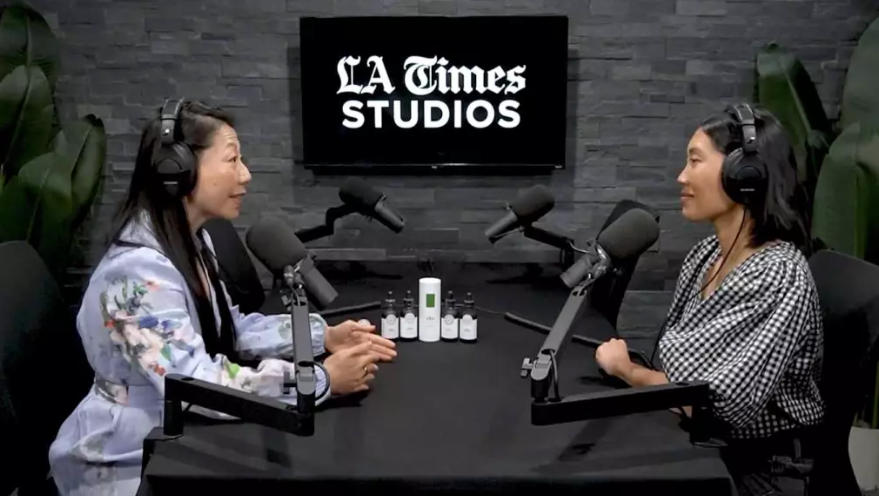
Episode 6 of the ‘Live & Well’ Podcast With Lulu Ge
(LA Times Studios)



 Medicine