

 i_need_contribute
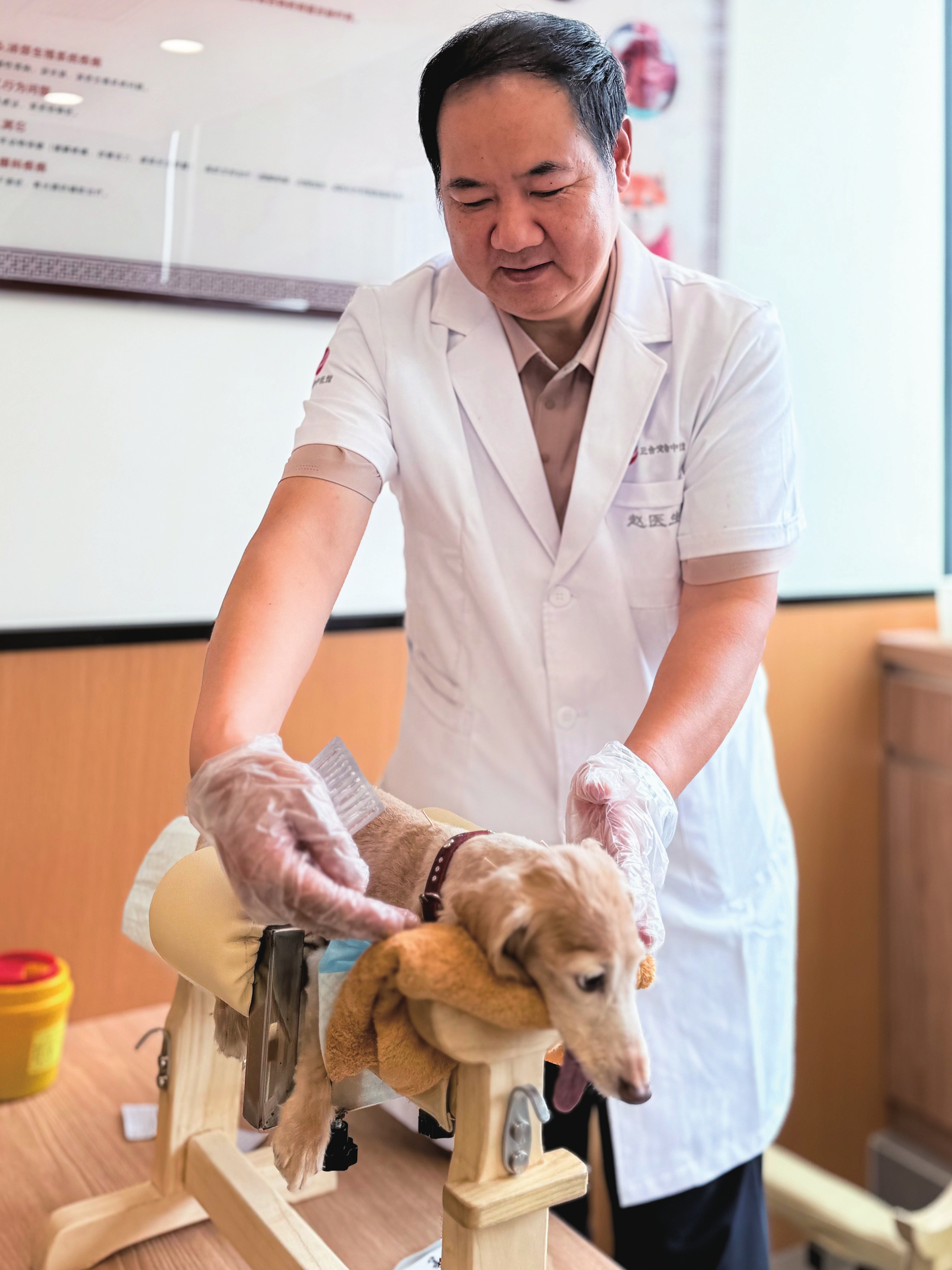
Zhao Qingdong administers acupuncture to a dachshund. Photo: Courtesy of Zhao Qingdong
Twelve-year-old border collie "Biaobiao" used to be bubbly and an excellent frisbee catcher, but due to a long-term back pain, he has become increasingly quiet, often lying in the corner and sometimes unable to put a paw on the ground because of the pain. For a dog, Biaobiao is already considered elderly, and his condition worries his owner, who calls herself "Biaoma."
"My 'fur baby' [a popular nickname for pets in China] is already old, and chronic illness is a torment for the elderly," Biaoma told the Global Times.
Although Biaobiao had already been to the hospital for X-rays and pain medication, the rapid relief offered by such medical means came with potential liver and kidney harm, which concerned his owner.
She felt torn, until she recently discovered a new medical trend for pets: traditional Chinese veterinary medicine (TCVM).
Targeted measures
Just as traditional Chinese medicine (TCM) has benefited humans, TCVM includes acupuncture, moxibustion, tuina, or therapeutic massage, and more.
In Chengdu, Sichuan Province, a TCVM clinic for pets was established in March.
Even though it has only been open a few months, it already has many customers due to its signature acupuncture service.
Short-legged dachshund and corgis, large border collies, British blue cats, and more are all patients here. They are usually placed on a custom-made, elevated table. Two soft armrests support their body, and a soft strap secures the animal in place on the table.
Slender silver needles are gently inserted into the acupuncture points of the pets.
Some of these needles are connected to an electroacupuncture device, and the vet will adjust current intensity as needed.
While this may sound somewhat graphic, the sensation of acupuncture is "like an insect sting," the clinic's head Zhao Qingdong told the Global Times.
"If the needles are placed in the correct points, it shouldn't be painful at all. The magic of TCM works on animals too," Zhao remarked.
Including Zhao, the clinic has a total of six animal doctors. They specialize in different treatments. For example, Zhao is best at TCM food therapy. The bond between owners and their fur babies means the vets have heard many memorable stories.
Zhao still remembers a cat that couldn't wake up post-surgery and couldn't breathe without ventilator support.
Animal surgeons attempted emergency electro-acupuncture, which eventually helped the cat regain breathing.
"This case surprised many people," Zhao noted. "Most aren't aware that TCM, which is often seen as a gentle and gradual process, can also be life-saving in emergency situations."
"The sense of accomplishment from saving an animal's life is our greatest joy," Zhao told the Global Times.
Compared to Western veterinary treatments, the greatest advantage of TCVM is how it addresses functional issues, such as aging organs and chronic diseases.
The Chinese philosophy behind TCM, such as balancing yin and yang, is also reflected in TCVM treatments. For instance, donkey-hide gelatin is used to boost animals' vigor, while ingredients like duck meat and bitter gourd can clear heat from their bodies.
Beyond treating illnesses, TCVM also helps animals develop healthy habits, such as avoiding picky eating.
"Western medicine focuses on resolving focused pathologies, whereas TCVM enhances the overall functions and health of the animal's entire body," Wang Mian, an expert in veterinary medicine, told the Global Times.
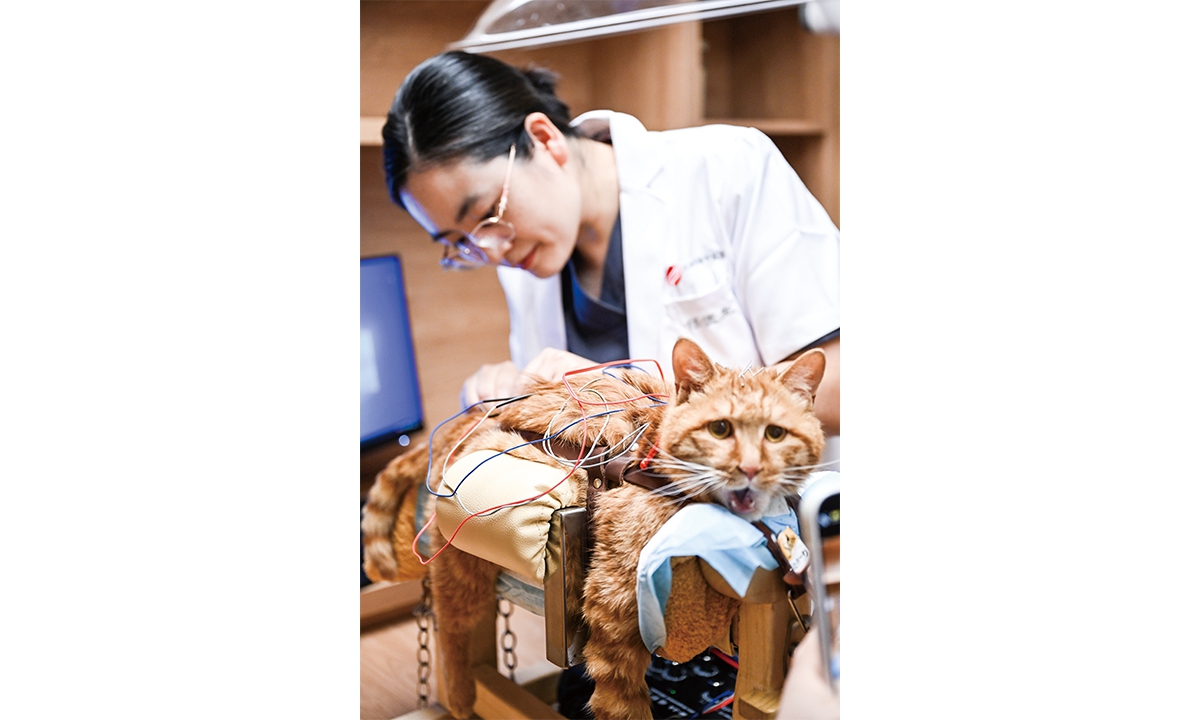
An animal doctor administers acupuncture to a cat at a pet Chinese medicine clinic in Chengdu, capital city of Southwest China's Sichuan Province, on June 23, 2025. Photo: VCG
Not a case, but a trend
This has not been limited to Chengdu. Clinics specializing in TCVM are emerging nationwide to become an animal-care trend. Over 2,000 veterinary hospitals across the country have also established departments related to TCVM.
"Senior customers [with their pets] still make up the biggest portion of our patients," Liu Manman, a nurse at a Beijing TCVM clinic, told the Global Times.
Why TCVM is favored by older customers seems to be due to the fact that the "principles of TCM are more deeply rooted in the hearts of the older generation," said Wang.
Meanwhile, although TCVM has recently become a trend, its history is long. As far back as the Western Zhou Dynasty (1046BC-771BC) there are records of the profession of "vet."
In the 1980s and 1990s, TCVM was still widely practiced in rural areas, treating working animals such as horses, cattle, donkeys, and mules.
With the changes of the time, particularly driven by Chinese society's growing enthusiasm for keeping pets, TCVM, once primarily used for work animals, has gradually been adapted for companion animals, providing a specialized service branch to meet the huge demand of the pet market.
To call the Chinese pet market expansive would be no exaggeration. According to a report released by KPMG, China's pet market value is projected to exceed 800 billion yuan ($112.5 billion) by the end of 2025.
By 2027, the market for dogs and cats in Chinese cities and towns alone is expected to surpass 400 billion yuan. This burgeoning market will drive development across various sub-sectors, including healthcare, pet food, and services.
Among this group, the rising number of young pet owners is reshaping the market, and inspiring the traditionally offline pet industry to go digital. Taking the Beijing clinic as an example, a staff member told the Global Times that alongside their senior clientele, a growing number of young people are now finding the clinic through social media.
"One young lady came to us. She mentioned she learned about TCVM on the social media platform Xiaohongshu and wanted to bring her dog in to try it out," said the staff member.
"The focus should not be entirely on digital promotion, but rather on advancing our medical expertise. For instance, we are exploring ways to integrate TCVM with technology, such as developing AI-powered consultation capabilities," Zhao, head of the Chengdu clinic, told the Global Times.




 Medicine