

 i_need_contribute

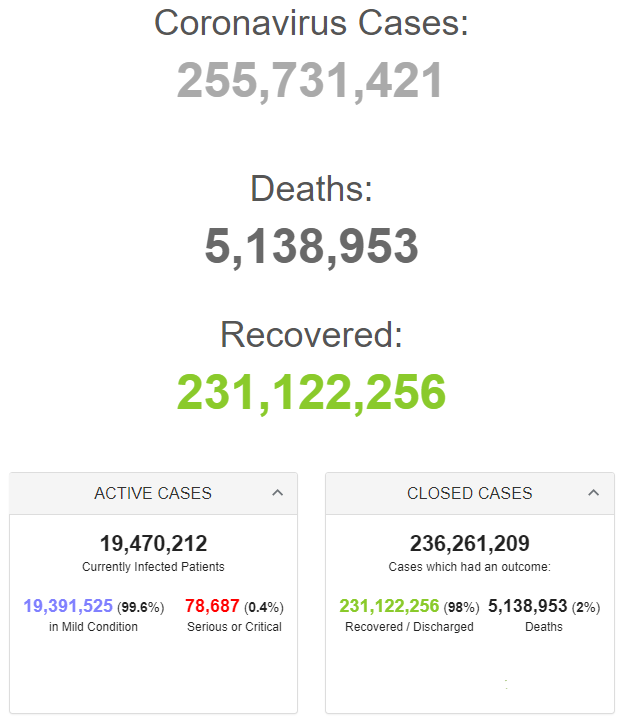
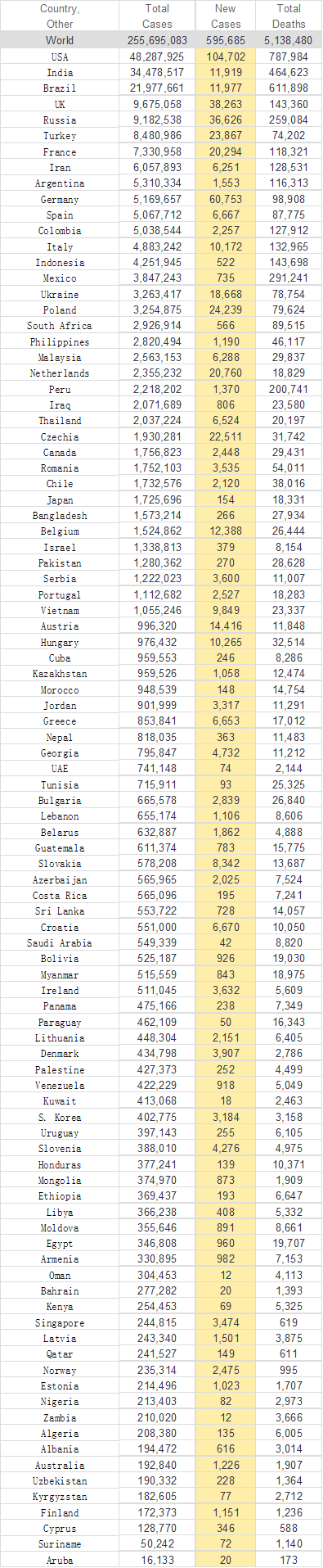
Retrieved from: https://www.worldometers.info/coronavirus/
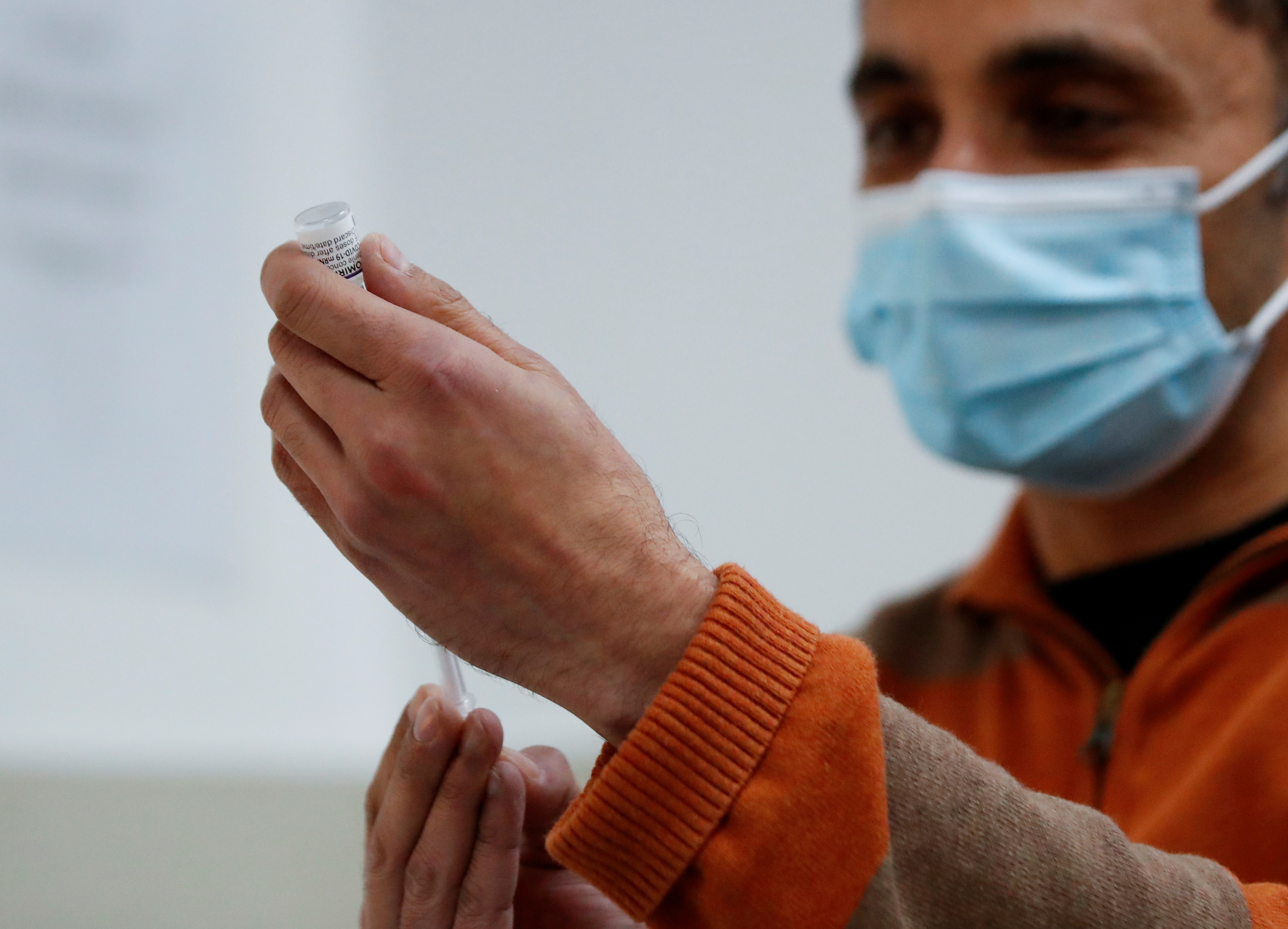
A pharmacist prepares a COVID-19 vaccine in Northampton, Britain, October 21, 2021. REUTERS/Andrew Boyers
The UK Health Security Agency (UKHSA) said on Wednesday that children aged between 12 and 15 should delay getting a COVID-19 vaccine if they've recently had COVID to at least 12 weeks after they were infected.
The advice brings guidance for 12 to 15-year-olds into line with that for 16 and 17-year-olds, who were advised to wait 12 weeks after infection before getting a shot when officials gave a go ahead for second doses for that age group. read more
Currently, 12 to 15-year-olds are only advised to get an initial shot of Pfizer's (PFE.N) COVID-19 vaccine, which has been associated with rare, mild and usually short-lived side effect of heart inflammation known as myocarditis.
The UKHSA said that the increase in the gap, from previous guidance of a 4-week interval, could cut rare cases of myocarditis further.
"The COVID-19 vaccines are very safe. Based on a highly precautionary approach, we are advising a longer interval between COVID infection and vaccination for those aged under 18," Dr Mary Ramsay, Head of Immunisations at UKHSA, said in a statement.
"This increase is based on the latest reports from the UK and other countries, which may suggest that leaving a longer interval between infection and vaccination will further reduce the already very small risk of myocarditis in younger age groups."
Children have had some of the highest rates of infection in England since schools went back at the start of September, although prevalence has fallen from its peak since a half-term school holiday at the end of October.
UKHSA said that current advice for at-risk children between 12-17 was unchanged, owing to their higher risk from COVID which would outweigh any benefit from delaying the shots.
Retrieved from: https://www.reuters.com/business/healthcare-pharmaceuticals/uk-health-agency-extends-gap-between-infection-shots-children-2021-11-17/
By Steve Scherer

Passengers arrive at Toronto's Pearson airport after mandatory coronavirus disease (COVID-19) testing took effect for international arrivals in Mississauga, Ontario, Canada February 1, 2021. REUTERS/Carlos Osorio
Canada is set to announce on Friday that it is no longer obliging Canadian travelers returning from short foreign trips to take expensive molecular COVID-19 tests, a government source said on Wednesday.
The travel industry complains that the requirement to take PCR (polymerase chain reaction) tests, the most reliable commonly-used method of detecting COVID-19, is deterring tourism.
Canadians who make trips of 72 hours or less to the United States will no longer need a PCR test when they return home, said the source, who requested anonymity.
The news was first reported by the Canadian Broadcasting Corporation.
The requirement was decried as a major impediment by business and travelers on both sides of the U.S.-Canada border because it deterred short trips by cross-border day trippers, many looking for shopping deals.
U.S. Congressman Brian Higgins, whose district includes Buffalo and Niagara Falls, New York, near the border said that he met with Canadian Prime Minister Justin Trudeau on Wednesday in Washington along with about a dozen other lawmakers.
Higgins said he was told the testing would be dropped for Americans in a second phase.
The delay for ceasing testing for Americans "makes no sense," Higgins said in a statement. "Testing is not only unnecessary, it is prohibiting a cross-border exchange critical to fostering economic recovery in both nations."
Trudeau is in Washington for a meetings on Thursday with U.S. President Joe Biden and Mexican President Andres Manuel Lopez Obrador.
Three-quarters of Canadian trips to the United States in 2019 were by car, according to Statistics Canada. That year, Canadians made 21.5 million car trips across the border that involved less than a day's stay.
On Nov. 8, the United States lifted an early 2020 travel ban in response to the coronavirus pandemic that barred access to most non-U.S. citizens traveling from 33 countries and restricted overland entry from Mexico and Canada.
Most travelers are required to show proof of vaccination in both directions but Canada had also required a negative PCR test.
Retrieved from: https://www.reuters.com/business/healthcare-pharmaceuticals/canada-drop-pcr-covid-19-test-some-returning-travelers-source-2021-11-17/

The Christmas market in Munich in 2013. It has been canceled for a second straight year.Credit...Marc Mueller/European Pressphoto Agency
The Munich Christkindlmarkt, one of Germany’s oldest and biggest Christmas markets, has been canceled for the second consecutive year, as another coronavirus wave sweeps through the country.
It’s the largest German Christmas market to be canceled so far, as the events struggle to survive the country’s fourth virus surgeafter being mostly shuttered last year.
“It is bitter news that I have today for all Munich residents, and especially for the stall owners. However, the extreme situation in our hospitals and exponentially rising infection rates leave me no other choice,” said Mayor Dieter Reiter.
Germans have gathered at outdoor markets in the weeks before Christmas since the 14th century, when vendors first built their stands in city centers to sell their wares to people coming from church services. They offer an array of foods, artisanal gifts and other provisions for the coming celebrations and the long winter months.
Germany’s roughly 3,000 Christmas markets are an important economic boon to many communities. Local restaurants, breweries, bakeries and artisans depend on the annual holiday fairs for a substantial amount of their income.
The Munich market is famed for its stalls offering traditional gingerbread, grilled sausages, mulled wine and hand-painted trinkets, according to Lonely Planet.
A combination of factors has propelled Germany’s latest virus surge, among them wintry temperatures, a slow rollout of booster vaccines, and an even more pronounced spike in neighboring eastern European nations like the Czech Republic.
Experts say the unvaccinated are driving the wave of cases that are filling up hospitals across Germany.
For the Christmas markets that remain open, only those vaccinated against the coronavirus or fully recovered from a previous infection can fully participate, Reuters reported. The unvaccinated can partake in some limited activities, such as listening to carols.
Retrieved from: https://www.nytimes.com/2021/11/17/world/munich-christmas-market-canceled.html
By John Yoon
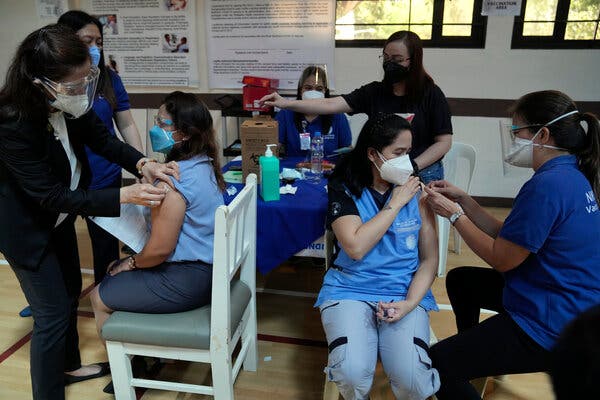
An inoculation drive in Quezon City, the Philippines, on Wednesday. The country has now approved nine vaccines for emergency use.Credit...Aaron Favila/Associated Press
The Philippines granted emergency use authorization for Novavax’s Covid-19 vaccine on Wednesday for people 18 and older, becoming only the second country after Indonesia to authorize the shots.
The vaccine was developed by the Maryland-based company and will be manufactured by Serum Institute in India.
Novavax’s chief executive, Stanley C. Erck, said in an announcement that the shot would “contribute substantially to increased vaccination rates” in the Philippines, where only about 35 percent of the population is fully vaccinated.
The Philippines has already approved eight other vaccines for emergency use, according to Dr. Rolando Enrique Domingo, the director of the Philippine Food and Drug Administration: Pfizer-BioNTech, Moderna, Johnson & Johnson, AstraZeneca, Sinovac, Sinopharm, Gamaleya Sputnik V and Bharat Biotech.
Vince Dizon, an adviser to the Philippine president, has said that because of unequal vaccine distribution throughout the world, the country needed to approve as many vaccines as it could.
“There is a really big problem with the global supply of vaccines, because many of these vaccines are in rich countries,” he said. “We need to be vaccinated quickly.”
Novavax’s vaccine proved highly effective in clinical trials, but the company fell behind other manufacturers even after receiving $1.75 billion from the United States government. The company had struggled to ramp up its manufacturing and demonstrate the purity of its vaccines to regulators. In August, it announced that the federal government would not pay for further production of its vaccine until it resolved regulators’ concerns about its work.
The vaccine involves two doses, given at least 21 days apart, the company said. But it differs from the vaccines now authorized in the United States in that it involves viral proteins assembled into nanoparticles, mixed with an immune-boosting compound called an adjuvant.
Indonesia approved Novavax’s vaccine for emergency use earlier this month. The company said it had also submitted applications for emergency use in India and with the World Health Organization.
Retrieved from: https://www.nytimes.com/live/2021/11/17/world/covid-vaccine-boosters-mandates/philippines-approves-emergency-use-of-novavaxs-covid-vaccine
By Megan Specia
Ireland’s bars and nightclubs will be required to close at midnight starting on Friday as part of measures that the government is imposing to curb the spread of the coronavirus as a surge of cases has left hospitals overwhelmed and officials scrambling for solutions.
The measures, which the country’s leader, Micheal Martin, announced on Tuesday night, also include a request that people work from home when possible and a requirement that they show a vaccine pass before entering theaters.
“The surge that we are now experiencing is a dramatic reminder of what this virus can do and the threat that it continues to represent,” Mr. Martin said. “We need to act now to deal with this surge.”
In the last week, Ireland has experienced its second highest rate of hospital admissions in 2021, Mr. Martin said, a situation that is putting hospitals nationwide under significant pressure.
But even as the measures were announced, Mr. Martin acknowledged that “continued progress in the journey to normal conditions is not inevitable.”
He said that he could not rule out further measures to curb the spread of the virus, but that the country’s successful vaccination program meant that a large-scale lockdown could be avoided at least for now.
Stephen Donnelly, the health minister, said that “stark new modeling” on the number of predicted cases was behind the rationale for the new measures.
Speaking to RTE Radio, the public broadcaster, he said on Tuesday that the models showed that without mitigation measures, Ireland’s intensive care units would see an influx of 200 to 450 patients by Christmas. The country has just over 300 permanent intensive-care beds.
“That would be something we have to avoid, so we are making some changes,” Mr. Donnelly said.
Retrieved from: https://www.nytimes.com/live/2021/11/17/world/covid-vaccine-boosters-mandates/ireland-adds-new-restrictions-including-early-pub-closings
By Nada Rashwan
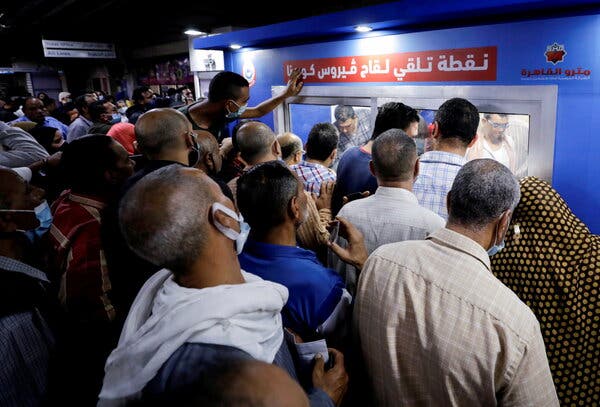
People waiting to receive a Covid-19 vaccine at the Sadat Metro Station in Cairo on Sunday.Credit...Mohamed Abd El Ghany/Reuters
Egypt is on the verge of passing a law that would allow people to be prosecuted if they publish something deemed to be fake news during an epidemic, an ostensible attempt to control disinformation in the coronavirus era. But critics fear the law could instead be used to repress those who challenge government policies during public health crises.
The legislation awaits ratification by President Abdel Fattah el-Sisi, a mere formality given that he has overwhelming support in the Parliament, which approved the bill on Tuesday. It grants the prime minister extraordinary powers to manage epidemics and pandemics, and it allows the prosecution of people who violate any regulation or mandate imposed by the government to manage such a crisis.
It would set prison sentences of up to one year and a fine of around $635 as punishment for “anyone who deliberately publishes or spreads false news or tendentious rumors related to the situation of an epidemic, with the purpose of disturbing public safety or spreading panic among people.” Only journalists would be exempt from prosecution under the bill.
That would leave everyone else — including health care workers, researchers and millions of social media users — subject to imprisonment in what critics said would be a breach of the Constitution, which prohibits imprisonment for the act of publication.
Proponents of the bill said the pandemic had shown the need for a firm response to the spread of disinformation in critical times.
“Some women have refused vaccination because of a post on Facebook that warned that it is dangerous for women who are planning on getting pregnant within a year,” the lawmaker Ayman Abol Ela said in a televised interview. “That is an immediate threat to national security.”
But critics said the prison sentences would be primarily used to control the expression of dissent on social media in a country where security services keep a tight grip on traditional media and public spaces and where the authorities often see any opposition as a threat. Doctors, journalists and social media users have been prosecuted on charges of spreading false news after they criticized the government’s handling of the pandemic or questioned the stated number of infections on social media.
“The reality is that hundreds have been thrown behind bars for social media posts, and fake news did not stop,” said Khaled Elbalshy, an Egyptian journalist. “Rumors thrive in an environment where the truth is withheld. Fake news and rumors are fought with upholding freedom of information, not with prison.”
The movement of the legislation comes weeks after prosecutors launched a mysterious, high-profile investigation within the health ministry. Prosecutors announced last month that some health officials had been questioned over allegations that have yet to be detailed. The health minister, Hala Zayed, went on sick leave around the time of the announcement after reportedly having been hospitalized for a heart attack. Reports from local news media outlets saying that the inquiry involved corruption allegations were taken down.
Under the new legislation, the prime minister would also have the power to enforce lockdowns, impose vaccine mandates, ban demonstrations, suspend court sessions, close off places of worship and set limits on the prices of commodities and private health care services.
The bill would grant the country’s top officials many powers that had previously been available to them only under a state of emergency. Egypt lifted a four-year state of emergency last month but quickly passed laws transferring similar powers to the government and the military, raising doubts over the country’s seriousness about easing a ruthless crackdown on dissent that has put its human rights record under international scrutiny.
Egypt is facing a fourth wave of Covid that is adding to the 345,848 cases and 19,636 deaths that the government has reported since the start of the pandemic, though the actual figures are believed to be much higher.
Retrieved from: https://www.nytimes.com/2021/11/17/world/egypt-leaders-epidemics-powers.html
By Lynsey Chutel and Declan Walsh
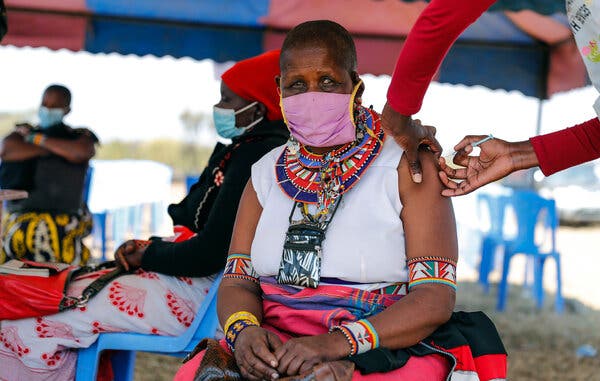
A Maasai woman receiving a dose of the AstraZeneca coronavirus vaccine, in Kimana, Kenya, in August.Credit...Brian Inganga/Associated Press
Kenya will be the pilot country for a new U.S. effort to accelerate Covid vaccinations in Africa, a program that enlists private company expertise to overcome “last mile” delivery delays, America’s top diplomat said Wednesday.
Secretary of State Antony J. Blinken announced the decision in Kenya, on the first full day of his three-day, three-country trip to East and West Africa.
While Mr. Blinken’s visit is aimed largely at efforts to solve crises threatening Ethiopia and Sudan, the Covid-19 pandemic’s ravaging of Africa, and what wealthy countries like the United States are doing about it, is a powerful sub-theme.
Speaking in Nairobi, Mr. Blinken reiterated American support for Africa’s struggle to curb the spread of the coronavirus. The continent lags global vaccination efforts, with just 6 percent of its population vaccinated, according to the Africa Centers for Disease Control and Prevention.
In Kenya, only 3 percent of the eligible population is vaccinated.
During a joint news conference with his Kenyan counterpart, Raychelle Omamo, Mr. Blinken announced that Kenya would become the first country to benefit from the new White House initiative aimed at overcoming the logistical hurdles that hinder Covid-19 vaccine delivery around the world.
Under the initiative, called the Global Covid Corps, private sector companies work pro bono to help countries streamline their vaccine distribution, such as managing supply chains and storage of the doses. Mr. Blinken first announced the initiative last week, during a virtual meeting of foreign ministers.
“What we found is the so-called last-mile challenges, including delivery and logistical hurdles, can make it difficult to turn vaccines into vaccinations, in other words actually getting shots into arms,” Mr. Blinken said.
Slow vaccination rates increase the risk of vaccine-resistant variants of the virus, experts say. Poor infrastructure to deliver doses of vaccines is a major challenge, further complicated by problems such as a shortage of syringes.
Mr. Blinken’s announcement was the latest in the White House’s vaccine diplomacy, in which the United States has tried to persuade other wealthy nations to balance domestic requirements with a global need. The Biden administration also has encouraged Moderna, one of the leading vaccine makers, to prioritizedelivering 15 million doses to Africa ahead of its commitments to the United States.
These steps have followed criticism from activists around the world who accuse wealthy nations of hoarding vaccines, to the detriment of poorer nations. Many critics remain upset over what they call inadequate help for initiatives like Covax, the United Nations-backed vaccine program, and the African Union’s African Vaccine Acquisition Trust. Both are meant to deliver doses to countries that cannot afford to strike large-scale deals with vaccine manufacturers.
Emphasizing what the United States has done, Mr. Blinken pointed to the more than 50 million doses it donated to 43 African countries, as well as $1.9 billion in funding distributed to Africa for Covid-19 relief.
In a thinly veiled allusion to the Covid-19 vaccine aid offered by China, which has enormous economic interests in Africa, Mr. Blinken said the American generosity had been delivered “with no political strings attached.”
Mr. Blinken has previously criticized what he called the ties between China’s vaccine distribution and its geopolitical interests, a criticism that Chinese leaders have rejected.
Among the delegation accompanying Mr. Blinken is Gayle E. Smith, who was appointed as the State Department’s Global Covid Response and Health Security Coordinator. Ms. Smith, a former head of United States Agency for International Development and security aide to former President Barack Obama, was appointed in April.
Here’s a round-up of the day’s leading Covid stories:
· The US is set to boost vaccine manufacturing and produce at least a billion doses a year. The Biden administration is planning to dedicate billions of dollars to build up vaccine manufacturing in the US to produce at least a billion doses each year, in an effort to shore up global Covid-19 supply for poorer countries while also pre-empting future pandemics.
· The Australian state of Victoria is set to ditch restrictions for fully vaccinated people from midnight on Thursday.
· The Covid Delta variant offshoot is ‘less likely’ to cause symptoms, researchers have revealed – although experts say the finding requires further scrutiny.
· Europe is the only region with increasing Covid deaths, the World Health Organization reports. Covid deaths rose 5% in the last week as deaths in all regions other than Europe remained stable or declined, and totalled 50,000 worldwide last week. Of the 3.3 million new infections reported, 2.1 million came from Europe.
· Spain has approved the use of a Covid-19 booster shot for people between 60-69 years old and for health workers, as part of an effort to combat an uptick in infections.
· The Czech Republic and Slovakia both reported record daily new coronavirus cases on Wednesday, a day before the two European Union countries plan to approve new restrictions for unvaccinated people in response to rising infections.
· A fourth Covid wave is hitting Germany with ‘full force’, Merkel says. Germany reported 52,826 new infections on Wednesday - up by a third from a week ago and another daily record, while 294 people died.
· Belgium tightened its coronavirus restrictions, mandating wider use of masks in indoor settings and enforcing work from home, as cases rose in the country’s fourth Covid wave. The country has one of the highest cases per capita rates in the EU.
· The UK reported another 38,263 Covid infections and a further 201 deaths within 28 days of a positive test.
· Mandatory vaccine passports are set to be introduced in Northern Ireland.
· Covid deaths have decreased 17% in the Americas over the past week, but the most populous countries like the US, Brazil and Colombia are seeing a levelling of new infections after weeks of declining trends, the Pan American Health Organization (PAHO) said on Wednesday.
· Hungary reported 10,265 new Covid-19 infections, its highest daily tally since the end of March.




 Medicine