

 i_need_contribute

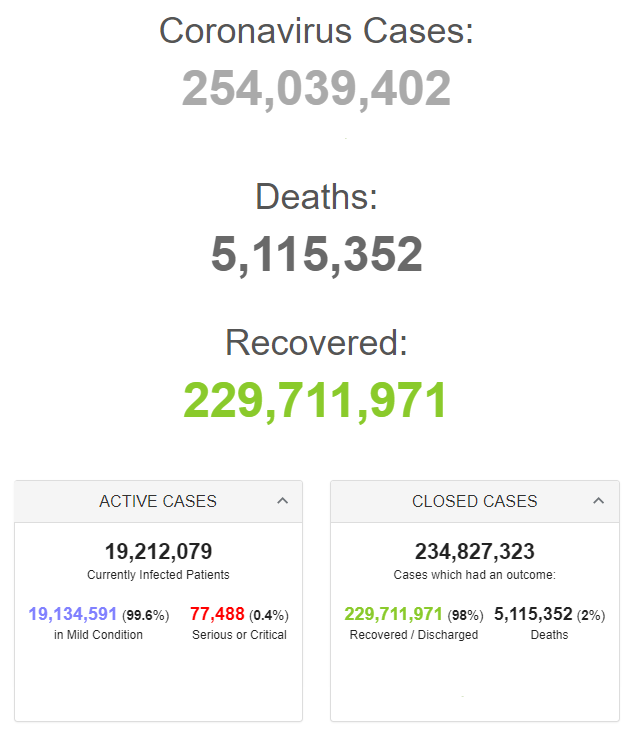

Retrieved from: https://www.worldometers.info/coronavirus/
By Francois Murphy
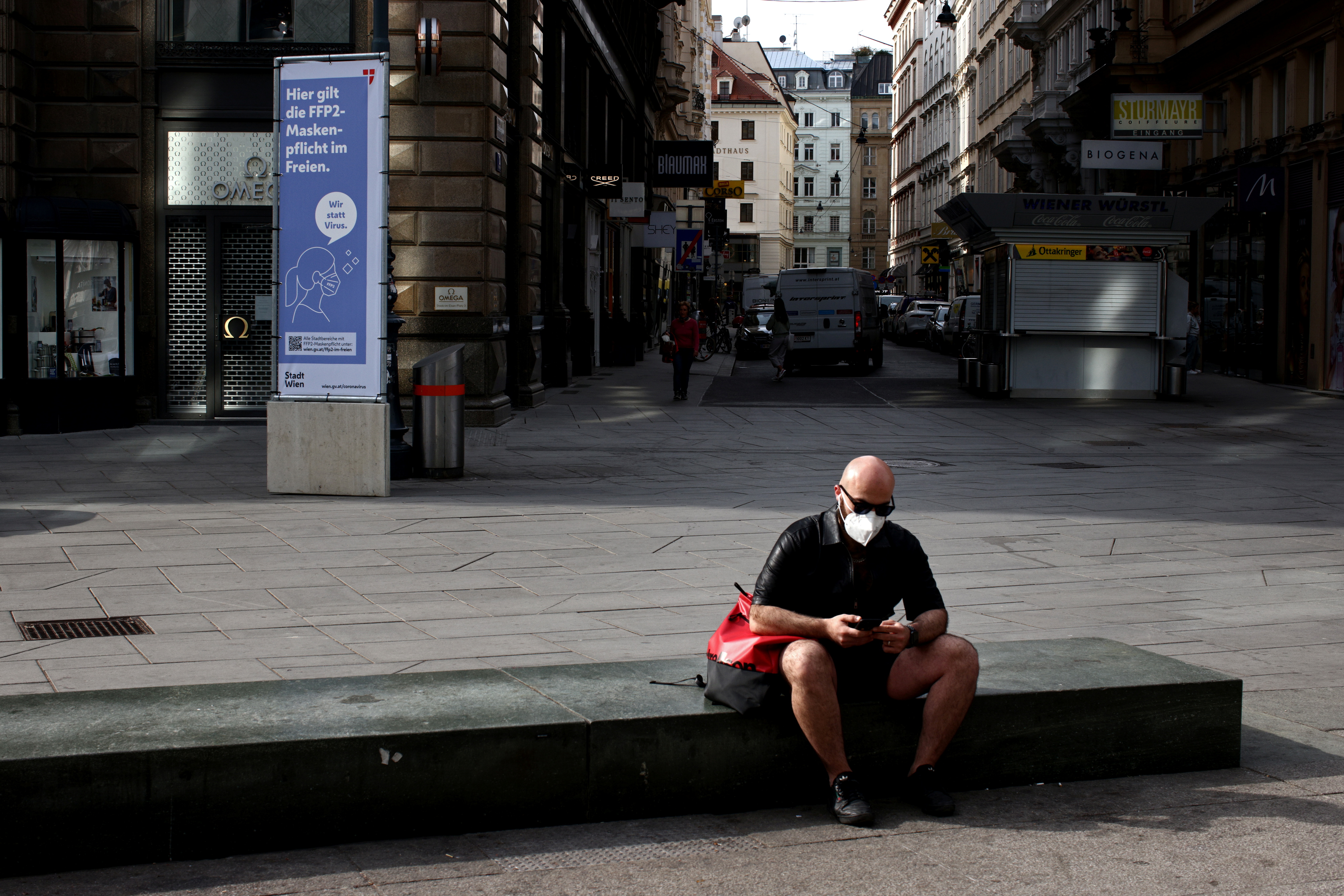
A person wearing an FFP2 mask sits at St. Stephen's square amid the coronavirus disease (COVID-19) outbreak in Vienna, Austria, April 1, 2021. REUTERS/Lisi Niesner
Austria is placing millions of people not fully vaccinated against the coronavirus in lockdown as of Monday to deal with a surge in infections to record levels and the growing strain on intensive-care units, the government said on Sunday.
Europe is the epicentre of the COVID-19 pandemic again, prompting some governments to consider re-imposing unpopular lockdowns. Austria has one of the continent's highest infection rates, with a seven-day incidence of 815 per 100,000 people.
Austria is the first European country to reinstate the same restrictions on daily movements that applied during national lockdowns before vaccines were rolled out, though this time they only affect a minority of the population.
"We are not taking this step lightly but it is necessary," Chancellor Alexander Schallenberg told a news conference announcing the new measure, under which the unvaccinated can only leave their homes for a limited number of reasons like going to work or shopping for essentials.
Roughly 65% of Austria's population is fully vaccinated against COVID-19, one of the lowest rates in western Europe. Many Austrians are sceptical about vaccines, a view encouraged by the far-right Freedom Party, the third biggest in parliament.
The measures on Monday will extend those brought in a week ago which banned the unvaccinated from places including restaurants, hotels, theatres and ski lifts.
While the Netherlands is dealing with its surge in cases by imposing a partial lockdown that applies to all, Austria's conservative-led government wants to avoid imposing further restrictions on those who are fully vaccinated.
"In reality we have told one third of the population: you will not leave your apartment anymore apart from for certain reasons. That is a massive reduction in contacts between the vaccinated and the unvaccinated," Schallenberg said.
In Germany, the federal government and leaders of Germany's 16 states are due to meet next week to discuss tightening measures. Germany has already classified Austria as a high-risk area, meaning people arriving from there have to go into quarantine, a blow to Austria's winter tourism industry.
Targeted measures have recently been introduced in Australia, where 83% of people aged 16 and above have been fully inoculated. Some states have mandated vaccinations for some occupations and barred the unvaccinated from activities such as dining out, leading to demonstrations.
Singapore, where 85% of the population has been fully vaccinated, has said those who remained unvaccinated by choice would have to foot their medical bills from next month. read more
Austria's lockdown, which does not apply to the under-12s or people who have recently recovered from COVID-19, will initially last 10 days, Health Minister Wolfgang Mueckstein said.
POLICE CHECKS, STIFF FINES
Many officials, including within Schallenberg's conservative party and the police, have expressed doubts this lockdown can be properly enforced as it applies to only part of the population.
Interior Minister Karl Nehammer said there will be thorough police checks and fines of up to 1,450 euros ($1,660) for breaches, and all interactions with the police will include checking people's vaccination status.
"As of tomorrow, every citizen, every person who lives in Austria must be aware that they can be checked by the police," Nehammer told the news conference.
Showing an official COVID pass proving that you have been vaccinated, recovered from COVID-19 or recently tested has been required for months in various places including restaurants, theatres, cafes and hairdressers.
Such passes continue to be required in those places; as of last week the unvaccinated are longer allowed in. As of Monday non-essential shops, where no such passes are required, will be off-limits to the unvaccinated, but the only checks will be spot checks by the police, Nehammer said.
Retrieved from: https://www.reuters.com/business/healthcare-pharmaceuticals/austria-orders-non-vaccinated-people-into-covid-19-lockdown-2021-11-14/

Protesters rally against coronavirus disease (COVID-19) restrictions and vaccine mandates in Wellington, New Zealand, November 9, 2021. REUTERS/Praveen Menon
A Māori tribe that claims New Zealand's most famous haka as its heritage on Monday told anti-vaccine protesters to stop using the traditional performance to promote their message.
Vaccine protesters have performed the "Ka Mate", a Māori haka composed in about 1820 by Te Rauparaha, war leader of the Ngāti Toa tribe, at their rallies over the past few weeks against vaccine mandates and pandemic restrictions. read more
"We do not support their position and we do not want our tupuna or our iwi associated with their messages," the Ngati Toa tribe, or "iwi" in Māori, said in a statement, referring to the tribe's ancestry or "tupuna".
"Our message to protesters who wish to use Ka Mate is to use a different haka. We do not endorse the use of Ka Mate for this purpose."
Although there are many forms of haka composed by different tribes for various uses and occasions, the "Ka Mate" is the most widely known because it has been performed by the All Blacks at international rugby test matches for decades.
It involves a fearsome display of rhythmic foot-stamping and chanting, eye-rolling and sticking tongues out.
New Zealand, which has among the lowest rates of COVID-19 in the world, has struggled to fight off the highly infectious Delta variant of the coronavirus this year, forcing Prime Minister Jacinda Ardern to move from a strategy of elimination through lockdowns to living with the virus with higher vaccinations.
Ardern has set a target of vaccinating 90% of those eligible before ending lockdowns.
About 81% of the eligible population has received two vaccine doses but Ardern said on Monday that health authorities were struggling to reach some young Māori due to misinformation about vaccines.
"So it's not just an access issue. We are trying to overcome much more than that and from the provider conversations I've had, that is one of the things we're all struggling with," Ardern told state broadcaster TVNZ, referring to disinformation.
As of Nov. 13, 76% of Māori have received one dose of a vaccine while 60% were fully vaccinated.
Authorities reported 173 new COVID-19 cases on Monday taking New Zealand's total number of infections to more than 8,500.
Retrieved from: https://www.reuters.com/world/asia-pacific/new-zealands-mori-ask-anti-vaccine-protesters-stop-using-haka-2021-11-15/
By Manuela Andreoni
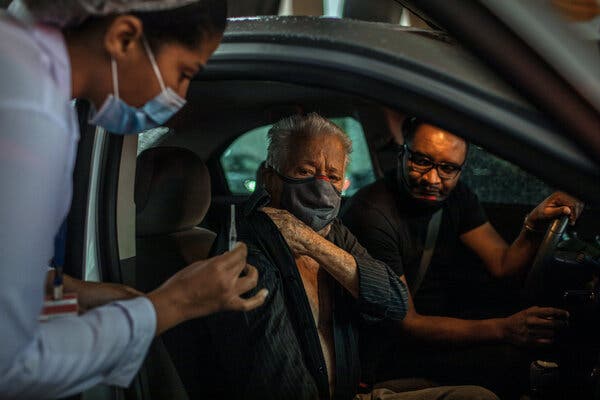
A drive-through coronavirus vaccination site in São Paulo, Brazil, in February.Credit...Victor Moriyama for The New York Times
RIO DE JANEIRO — Once a pandemic hot spot, Brazil has edged past the United States in fully vaccinating its people against the coronavirus, with over 60 percent of the Brazilian population fully immunized. The U.S. rate for full vaccination stands at 59 percent.
The achievement contrasts with Brazil’s much derided handling of the pandemic under President Jair Bolsonaro, who refused to get vaccinated himself. It also reflects the extent of the public’s trust in a robust health care system with a track record of responding quickly to such crises.
Under a government that consistently dismissed the threat of the virus, Brazil faced a lack of coronavirus tests, masks, hospital beds and even oxygen. These shortages at times pushed its known daily death toll to be the highest in the world. Over 600,000 Brazilians are known to have died of Covid-19, a number eclipsed only by the United States.
In the United States, 59 percent of the population is fully vaccinated. Early this year, as the campaign to vaccinate Americans began, millions were inoculated each day. But since mid-April, vaccinations have been lower in comparison, in part because of political opposition or because of fears over the safety of the doses available for use.
The vaccine rollout in Brazil has been much slower than in the United States, and critics of Mr. Bolsonaro say that was a consequence of the government’s resistance toward the vaccines.
“Some people say I’m giving a terrible example,” Mr. Bolsonaro said in July of opponents who admonished him for his refusal to get inoculated. “What if I turned into an alligator?”
But his skepticism did not quell Brazilians’ enthusiasm toward the vaccines. As doses became available, social media was flooded with pictures of Brazilians getting shots in their arms with signs praising public health and criticizing the government. Many dressed as alligators for the occasion to mock the president.
Even Mr. Bolsonaro’s close relatives and allies gave in. “I took the vaccine in secret,” Luiz Eduardo Ramos, his former chief of staff, was recorded saying at a closed meeting. “Like any human being, I want to live, damn it.”
Daniel Soranz, who heads the public health department in Rio de Janeiro, said his city could have vaccinated its citizens three times faster if doses had arrived earlier. Its current vaccination rate, 70 percent, is higher than New York City’s.
“People in Rio are fighting to get the vaccine,” he said. “This antivaccine discourse doesn’t really stick with people here.”
Mr. Soranz and other experts say Brazil’s public health system and its decades-old immunization program made a difference in the vaccine rollout, even as the national government’s plan to fight the pandemic was mired in chaos. The country has tens of thousands of permanent vaccination posts, and city officials coordinate annual immunization campaigns each year.
Many believe a government that did not disregard scientific expertise would have done a better job, as other Latin American countries, such as Chile and Uruguay, did. Brazil’s Health Ministry went through four ministers during the pandemic, and continued political infighting has rendered Brazil’s national immunization program leaderless for months.
Mr. Temporão said the government had stepped up its efforts to buy vaccines after a congressional inquiry started asking tough questions. The group of lawmakers overseeing the inquiry recently accused Mr. Bolsonaro of crimes against humanity over his response to the pandemic.
But poorer states are still struggling to vaccinate people. Many states in the Brazilian Amazon, where some cities can be reached only by boat, have vaccination rates below 50 percent.
Still, many in Brazil think the worst of the pandemic is behind them. Rio, for one, is preparing for big celebrations in the coming months. Mr. Soraz, who leads the health department, said: “We are planning the biggest carnival in our history.”
Coronavirus deaths in Europe rose 10 percent in the first week of this month and made up over half of the 48,000 coronavirus deaths reported globally in that time, even as new cases and deaths dropped or remained stable in the rest of the world, according to World Health Organization figures released this week.
The highest number of deaths were recorded in Russia, which has reported record Covid tolls in recent weeks, followed by Ukraine and Romania. The numbers of new infections were highest in Russia, Britain and Turkey, according to the W.H.O. figures.
Europe accounted for about two-thirds of the world’s 3.1 million new reported cases that week, the agency’s report said, and officials in hard-hit countries are weighing new restrictions to try to quell the outbreaks as winter approaches.
In Germany, where about 67 percent of the population is fully vaccinated against the virus, tens of thousands of new cases are being reported every day, the country’s highest caseloads since the pandemic began. Several of its states are now working on new regulations to introduce mask mandates and require proof of vaccination or past infection for entry to some venues.
Health experts in the Netherlands, where about 68 percent of people are fully vaccinated, have also called for more coronavirus restrictions as cases there put hospitals under strain. This month, the authorities reimposed requirements for the wearing of face masks in indoor public spaces and required coronavirus passes detailing vaccine status or past infections for entry.
In Romania, where only about 40 percent of the population is fully vaccinated, coronavirus deaths have hit record levels and intensive care units have been left strained.
Several deadly fires at the country’s hospitals have also added to the tragedy. On Thursday, two patients died when a blaze broke out at a hospital that was treating Covid patients in the city of Ploiesti, officials said, adding that the cause of the fire was not yet known. At least 20 people have died in such blazes at Romania’s hospitals since the pandemic began.
And in England, where the government is accelerating a program of booster vaccination shots in the hopes of stemming rising case numbers, the government has mandated vaccines for frontline health workers starting next spring. Officials have pushed back against calls for another lockdown, but said that they would consider imposing more coronavirus restrictions if necessary.
The trend in Europe is at odds with the trajectory of other regions: The rate of new reported Covid deaths worldwide decreased 4 percent in the first week of November, according to the W.H.O., while the rate of new infections remained stable.
In total, over 249 million cases and more than five million Covid deaths have been reported since the pandemic began.
Retrieved from: https://www.nytimes.com/live/2021/11/14/world/covid-vaccine-boosters-mandate/covid-brazil-vaccine
By Chantal Da Silva
As Europe finds itself at the center of the Covid-19 pandemic once again, experts say it should serve as a warning to the U.S. and other countries about the coronavirus’s unremitting nature.
Case numbers have soared across the continent — more than 50 percent last month — and the worrying trend has continued this month as winter begins to bite.
Dr. Hans Kluge, the director of the World Health Organization’s Europe region, warned Nov. 4 that the region was "back at the epicenter of the pandemic," and his words proved prescient.
The WHO said Friday that nearly 2 million cases were reported across Europe in the previous week — the most the region has had in a single week since the pandemic began.
In recent weeks, Germany reported record daily numbers of new infections, with more than 50,000, according to data from Johns Hopkins University.
The Netherlands also reported more than 16,000 cases — the country’s most since the pandemic began — prompting the government to begin a partial lockdown Saturday that is set to last at least three weeks.
As case numbers surged toward the end of last month, Belgium reimposed some Covid restrictions, including a requirement to wear masks in public places. People also have to show the country’s Covid-19 pass to enter bars, restaurants and fitness clubs. The passport shows that they have been fully vaccinated, have had recent negative tests or have recently recovered from the disease.
The country nonetheless recorded more than 15,000 daily cases last Monday.
Despite the surge, daily death rates in all three countries have remained relatively stable compared with past spikes, and experts have credited high vaccine uptake for weakening the link between the numbers of cases and hospitalizations and deaths.
Retrieved from: https://www.nbcnews.com/news/world/covid-surging-europe-experts-say-s-warning-us-rcna4666
Germany is preparing a return to working from home, as the country tries to tackle an unprecedented new wave of coronavirus cases.
The measure is being reintroduced under draft legislation seen by AFP on Sunday, after the home working restriction was lifted at the beginning of July.
Employers in Germany would be forced to offer the option to work from home in the absence of a “compelling business reason” to come to the office.
Anyone going into work would also be asked to show they have protection against the virus either through antibodies or vaccination or have tested negative.
Infections and deaths have been climbing steeply since mid-October, in a fourth wave blamed on Germany’s comparatively low vaccination rate of just over 67%.
At 289 cases per 100,000 people, the recorded incidence of the virus reached a new high in Europe’s most populous country on Sunday, according to the Robert Koch Institute (RKI) health agency.
Ahead of a “Covid summit” of federal and state leaders on Thursday, new measures to curb rising infections are being debated. The chairmen of the three so-called traffic light parties, the SPD, the Greens and the FDP, want to tighten the Infection Protection Act again, and restrictions on contact for unvaccinated people are also being discussed, Handelsblatt reports.
“The coming wave will overshadow all the previous waves,” Saxony state premier Michael Kretschmer, whose region is currently amongst the worst hit, told German weekly Bild am Sonntag.
The legislation will be presented to the Bundestag, the lower house of the German parliament, for approval on Thursday, before being signed off by the upper house on Friday.
Here’s a round-up of the day’s leading Covid stories:
· Britain expected to extend Covid booster programme to under 50s.
· Brazil reports lowest end of week Covid death toll in over a year.
· Egypt’s national research body said on Sunday that it will start clinical trials for a domestically made coronavirus vaccine.
· UK firm to trial T-cell Covid vaccine that could give longer immunity against Covid-19. An Oxfordshire-based company Emergex will soon start clinical trials of a second-generation vaccine against Covid-19, an easy-to-administer skin patch that uses T-cells to kill infected cells and could offer longer-lasting immunity than current vaccines.
· UK officials have compiled a ‘Covid exit strategy’ from Aprilcalled Operation Rampdown, leaked documents reveal. Under the plan, the government could wind down testing and people would no longer be forced to isolate if they are ill from April, leaked documents reveal.
· Three snow leopards died of complications from Covid-19 at the Lincoln children’s zoo in Nebraska.
· Germany to return to work from home amid rising infections. The measure is being reintroduced under draft legislation seen by AFP on Sunday, after the home working restriction was lifted at the beginning of July.
· In the UK more than two million people received their Covid-19 booster in the past week, with health officials describing the numbers as record-breaking. NHS England said 2.1 million boosters were delivered between November 6-12, an increase on the 1.7 million boosters given out during the previous seven days.
· China donated 500,000 doses of Covid-19 vaccine on Sunday toSyria, which has one of the world’s lowest inoculation rates and what the UN called an alarming rise in cases.
· Japan’s economy has shrunk much faster than expected as supply shortages hit and global production bottlenecks pose increasing risks to the export-reliant nation.
· Outcry in China after Covid health workers kill a pet dog while owner was in quarantine.
· China reported 52 new confirmed coronavirus cases for 14 November compared with 89 a day earlier, its health authority said on Monday. There were no new deaths, leaving the death toll unchanged at 4,636.
· Cambodia reopened its borders to fully vaccinated travellers on Monday, two weeks earlier than originally planned, as it emerges from a lengthy lockdown bolstered by one of the world’s highest rates of immunisation against Covid-19.





 Medicine