

 i_need_contribute

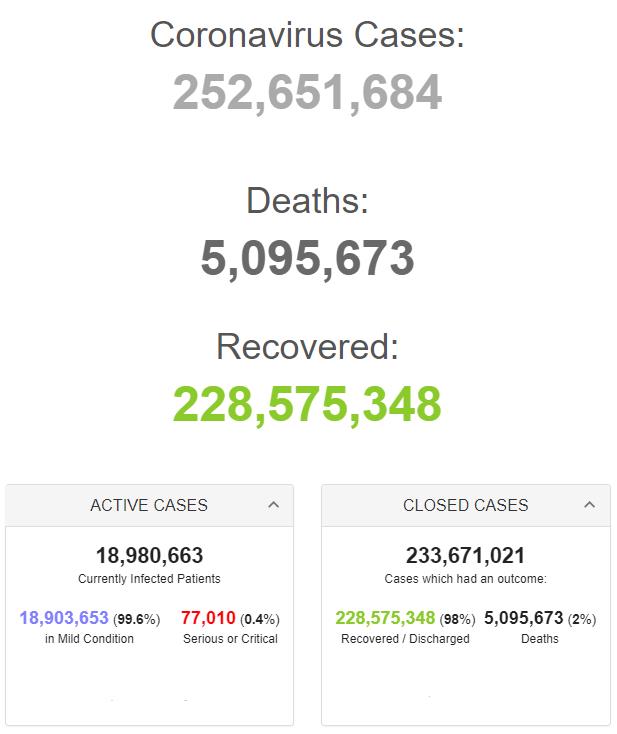
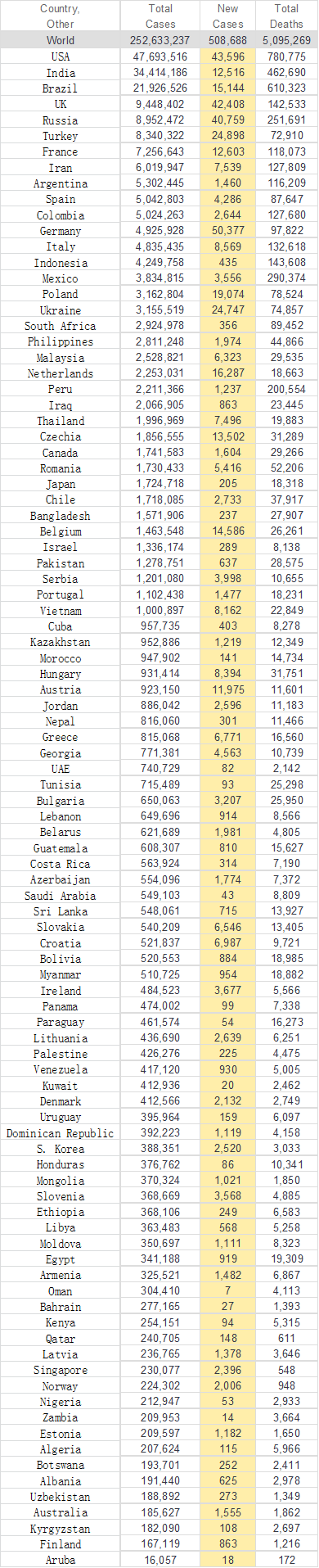
Retrieved from: https://www.worldometers.info/coronavirus/
The Dutch government on Thursday was considering whether to impose Western Europe's first partial lockdown since the summer, as new coronavirus cases jumped to the highest level since the start of the pandemic.
A surge in infections that started when social distancing measures were lifted late September has put pressure on hospitals throughout the country, forcing them to scale back regular care to treat COVID-19 patients.
New coronavirus infections in the country of 17.5 million have roughly doubled in the last week and hit a record of around 16,300 in 24 hours on Thursday.
To contain the outbreak, the government's pandemic advisory panel on Thursday recommended imposing a partial lockdown, shutting down theatres and cinemas, scrapping large events and closing cafes and restaurants earlier, broadcaster NOS reported.
Caretaker Prime Minister Mark Rutte's cabinet will discuss the advice during an emergency meeting on Thursday night, and will announce its decisions during a televised press conference scheduled for Friday 1800 GMT.
The government often follows the expert panel's recommendations.
After a partial lockdown of around two weeks, during which schools would remain open, entrance to public places should be limited to people who have been fully vaccinated or have recently recovered from a coronavirus infection, according to the advice.
Even as infections spike to record levels, many developed countries have taken the view vaccine rollouts mean lockdowns are unnecessary.
Britain is relying on booster shots to increase immunity and to try to avoid overwhelming its healthcare system.
The Netherlands has so far provided booster shots to a small group of people with weak immune systems. It will start offering them to people aged 80 years and older in December, while extra shots will eventually be available for anyone older than 60.
Around 85% of the adult population in the Netherlands has been fully vaccinated against COVID-19.
Last month, roughly 56% of Dutch COVID-19 patients in hospitals and 70% of those in intensive care were unvaccinated or only partially vaccinated.
Unvaccinated COVID-19 patients in Dutch hospitals had a median age of 59, compared to 77 years for vaccinated patients, data provided by the Netherlands' Institute for Health (RIVM) showed.
Last week, the Netherlands re-introduced masks and expanded the list of venues that require a "corona pass" that demonstrates vaccination or a negative test result, to gain access.
Retrieved from: https://www.reuters.com/world/europe/dutch-experts-recommend-western-europes-first-lockdown-since-summer-2021-11-11/

The exterior of EMA, European Medicines Agency is seen in Amsterdam, Netherlands December 18, 2020. REUTERS/Piroschka van de Wouw
Europe's drug regulator has recommended two COVID-19 antibody therapies - one from American-Swiss partners Regeneron-Roche and another from South Korea's Celltrion, as the region builds up its defence against surging cases.
Approval by the European Commission would mark the first for any COVID-19 treatment on the continent since Gilead's (GILD.O) remdesivir last year.
Reuters reported earlier this week that the European Medicines Agency's (EMA) endorsement of the two drugs was imminent. read more
Regeneron-Roche's (REGN.O), (ROG.S) antibody cocktail, Ronapreve, was backed by the EMA's human medicines committee for treating adults and children over 12 with COVID-19 who do not require oxygen support and are at high risk of severe disease.
Celltrion's (091990.KQ) Regkirona was recommended only for adults with similar conditions.
Ronapreve can also be used for preventing COVID-19 in people over 12 weighing at least 40 kilograms, the EMA said.
The two treatments are based on a class of drugs called monoclonal antibodies that mimic natural antibodies produced by the human body to fight infections.
While the potential approval process is ongoing, the two drugs are already available to some patients in the European Union as the EMA assisted member states on early use in some cases.
Regeneron's antibody cocktail was granted emergency authorisation in the United States last year, and in August received conditional marketing authorisation in Britain.
The EU has secured about 55,000 courses of the therapy, a European Commission spokesperson said in June.
The bloc has no supply deal with Celltrion, whose antibody treatment has so far been approved only in South Korea.
Thursday's recommendation comes after Eli Lilly (LLY.N) last week withdrew its application for EU approval of its antibody-based treatment, citing a lack of demand from EU member states as the bloc focuses on other suppliers.
Retrieved from: https://www.reuters.com/business/healthcare-pharmaceuticals/eu-regulator-backs-approval-covid-19-drugs-regeneron-roche-celltrion-2021-11-11/

The Beijing 2022 logo is seen outside the headquarters of the Beijing Organising Committee for the 2022 Olympic and Paralympic Winter Games in Shougang Park, the site of a former steel mill, in Beijing, China, November 10, 2021. REUTERS/Thomas Peter
Two foreign athletes have tested positive for COVID-19 during test events for the Beijing 2022 Winter Games, Huang Chun, an official of the Games organising committee, said on Friday.
Both are lugers of the same nationality and have been transferred to quarantine hotels, he told a news briefing in the Chinese capital.
Retrieved from: https://www.reuters.com/business/healthcare-pharmaceuticals/two-foreign-athletes-test-positive-covid-19-run-up-beijing-winter-olympics-2021-11-12/
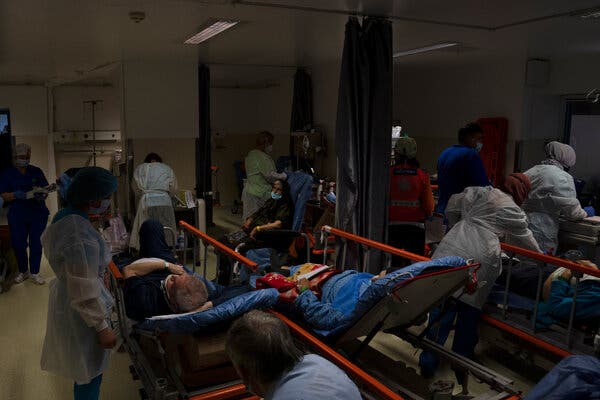
An emergency unit at a hospital in Bucharest, Romania, this month.Credit...Cristian Movila for The New York Times
Coronavirus deaths in Europe rose 10 percent in the first week of this month and made up over half of the 48,000 coronavirus deaths reported globally in that time, even as new cases and deaths dropped or remained stable in the rest of the world, according to World Health Organization figures released this week.
The highest number of deaths were recorded in Russia, which has reported record Covid tolls in recent weeks, followed by Ukraine and Romania. The numbers of new infections were highest in Russia, Britain and Turkey, according to the W.H.O. figures.
Europe accounted for about two-thirds of the world’s 3.1 million new reported cases that week, the agency’s report said, and officials in hard-hit countries are weighing new restrictions to try to quell the outbreaks as winter approaches.
In Germany, where about 67 percent of the population is fully vaccinated against the virus, tens of thousands of new cases are being reported every day, the country’s highest caseloads since the pandemic began. Several of its states are now working on new regulations to introduce mask mandates and require proof of vaccination or past infection for entry to some venues.
Health experts in the Netherlands, where about 68 percent of people are fully vaccinated, have also called for more coronavirus restrictions as cases there put hospitals under strain. This month, the authorities reimposed requirements for the wearing of face masks in indoor public spaces and required coronavirus passes detailing vaccine status or past infections for entry.
In Romania, where only about 40 percent of the population is fully vaccinated, coronavirus deaths have hit record levels and intensive care units have been left strained.
Several deadly fires at the country’s hospitals have also added to the tragedy. On Thursday, two patients died when a blaze broke out at a hospital that was treating Covid patients in the city of Ploiesti, officials said, adding that the cause of the fire was not yet known. At least 20 people have died in such blazes at Romania’s hospitals since the pandemic began.
And in England, where the government is accelerating a program of booster vaccination shots in the hopes of stemming rising case numbers, the government has mandated vaccines for frontline health workers starting next spring. Officials have pushed back against calls for another lockdown, but said that they would consider imposing more coronavirus restrictions if necessary.
The trend in Europe is at odds with the trajectory of other regions: The rate of new reported Covid deaths worldwide decreased 4 percent in the first week of November, according to the W.H.O., while the rate of new infections remained stable.
In total, over 249 million cases and more than five million Covid deaths have been reported since the pandemic began.
Retrieved from: https://www.nytimes.com/2021/11/11/world/europe/eu-covid-deaths.html
By Ruth Maclean
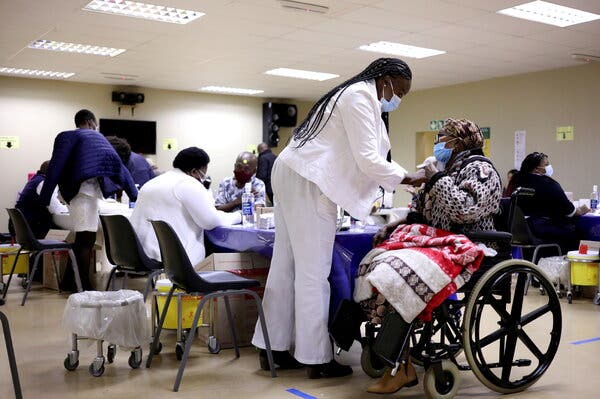
Receiving a coronavirus vaccine outside Johannesburg this spring.Credit...Siphiwe Sibeko/Reuters
Covid-19 patients in Africa are significantly more likely to die if they have diabetes, the World Health Organization said on Thursday, a worrisome trend on a continent where diabetes rates are rising and where the condition remains undiagnosed in many.
Over 10 percent of patients with diabetes died when they caught Covid-19, compared with 2.5 percent for Covid-19 patients overall, according to an evaluation of data from 13 African countries carried out by the W.H.O. The study focused on underlying conditions in Africans who tested positive for Covid-19, and also found a higher fatality rate in patients with H.I.V. and hypertension.
In recent years, the prevalence of diabetes has grown rapidly in Africa — and 70 percent of people with the condition there are not aware that they have it, according to the W.H.O.
“Fighting the diabetes epidemic in Africa is in many ways as critical as the battle against the current pandemic,” Dr. Matshidiso Moeti, the agency’s regional director for Africa, said in a statement on Thursday.
“The Covid-19 pandemic will eventually subside, but Africa is projected in the coming years to experience the highest increase in diabetes globally,” she said. “We must act now to prevent new cases, vaccinate people who have this condition and, equally importantly, identify and support the millions of Africans unaware they are suffering from this silent killer.”
Changes in lifestyle and eating habits, rapid urbanization and a growing and aging population are some of the factors that have increased the prevalence of diabetes on the continent. Most of the cases in Africa are Type 2 diabetes.
The findings cited on Thursday echo those of studies done elsewhere in the world, which have shown that people with Type 2 diabetes are at higher risk of being hospitalized, admitted to intensive care and dying if they catch the coronavirus.
By Johnny Diaz

New Covid-19 cases have been surging in Austria recently. Cars lined up last week at a drive-through coronavirus testing station in Innsbruck.Credit...Jan Hetfleisch/Getty Images
New lockdown restrictions for Austria’s unvaccinated population are likely because reports of new coronavirus cases in the country are rising rapidly, Chancellor Alexander Schallenberg said on Thursday.
Though such restrictions would be a “very harsh measure,” they appear to be necessary and “probably inevitable,” the chancellor said at a news conference.
The Austrian national health agency has reported an average of 760 coronavirus cases a day for every 100,000 people over the past week, a rate that has more than doubled since late October.
About 64 percent of the country’s population has been fully vaccinated against the coronavirus so far — a larger share than in the United States or in Austria’s neighbors to the east, but smaller than in most Western European nations, according to government figures collated by the Our World in Data project.
The Austrian government said last week that it would ban people who are not fully vaccinated from entering places like restaurants and hair salons; that measure took effect on Monday. A lockdown like the one Mr. Schallenberg warned about would be much more restrictive.
“The situation in Austria and other European countries is serious,” Mr. Schallenberg said in a statement, noting that hospital intensive care units were filling up faster than expected.
The chancellor has been talking about the worsening picture in Austria for some time. “We are about to stumble into a pandemic of the unvaccinated,’’ he told The Associated Press last month.
At a news conference following a meeting with state governors last Friday, Mr. Schallenberg urged Austrians to get their shots.
“With a vaccination, we protect not only ourselves, but also our friends, family and colleagues,” he said, adding, “It is simply our responsibility to protect the people of our country.”
Retrieved from: https://www.nytimes.com/2021/11/11/world/europe/austria-chancellor-lockdown-unvaccinated.html
By Musinguzi Blanshe
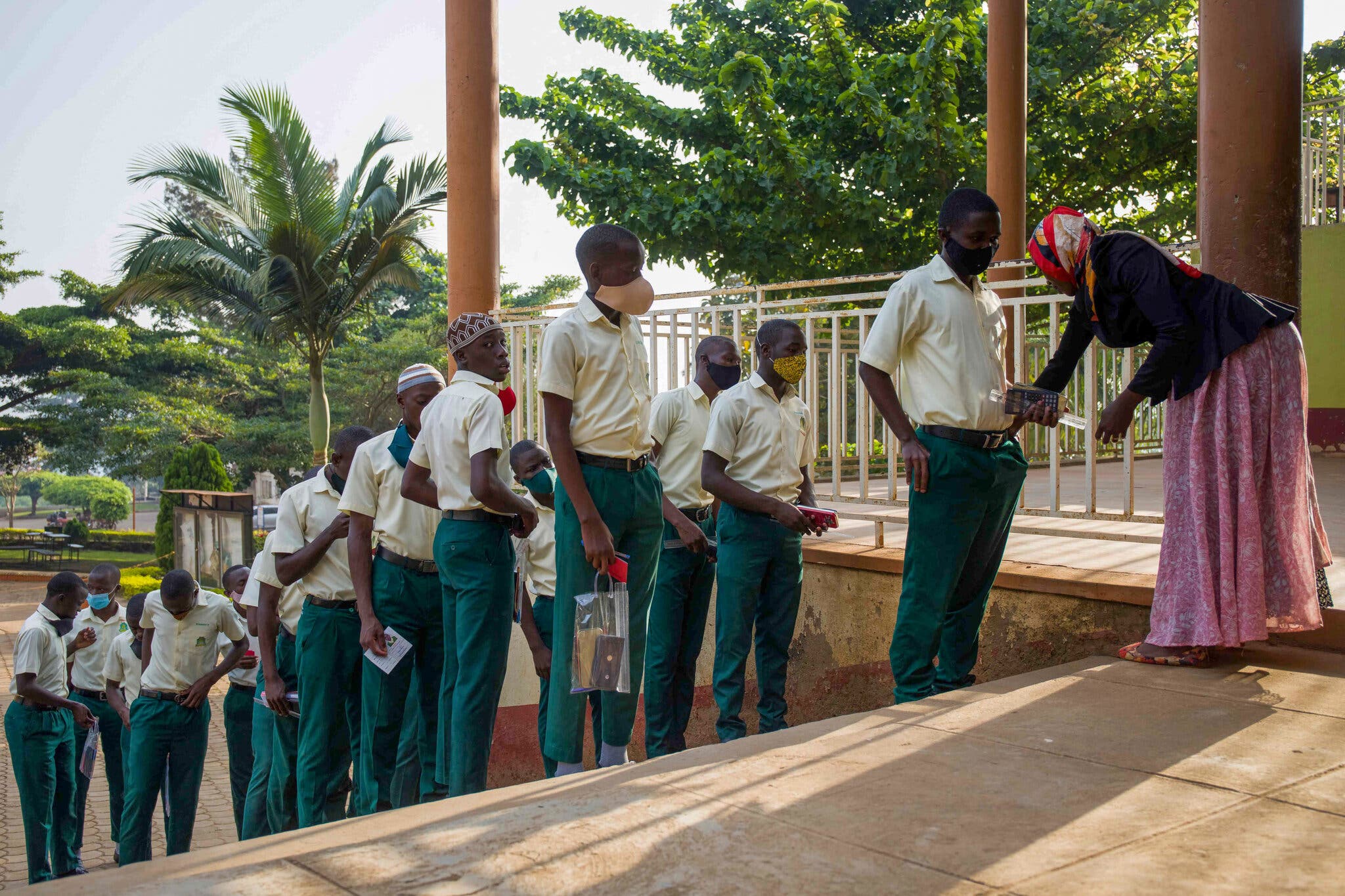
Lining up for inspection in March before final examinations at Mbogo Mixed Secondary School, Wakiso, Uganda.Credit...Badru Katumba/Agence France-Presse — Getty Images
As much of the world moves closer to fully opening schools, at least one nation has stuck to keeping them fully or partly closed: Uganda.
Eighteen months into the pandemic, officials in the country have kept more than 10 million primary and secondary school students at home, with no plans to reopen their classrooms soon. And while Uganda’s leaders say that the policy is the safest option, on the ground, the effects of the closures are stark.
The “government has not left schools closed to punish you, but rather, to protect you from harm,” the education minister, Janet Museveni, who is also the country’s first lady, said on Twitter in September. She said that the government did not want to risk having parents become infected by students, who “would become orphans — just like H.I.V./AIDS did to many of our families.”
President Yoweri Museveni said in a televised address last month that parents should expect schools to reopen in January, along with other small businesses like bars, hair salons and recreational centers.
In the meantime, however, young women, abandoning hopes of going to school, are getting married and starting families instead. School buildings are being converted into businesses or health clinics. Teachers are quitting, and disillusioned students are taking menial jobs like selling fruit or mining for gold.
“The government has failed to strike a balance between the lives they are saving and the lives they are losing,” said Filbert Baguma, general secretary of the Uganda National Teachers’ Union.
He noted that public spaces like markets and churches had been allowed to reopen, thus exposing the same students to the coronavirus. “Students are not any better off in terms of protection than when they were in their learning institutions,” he said.
Even Uganda’s government has concluded that the sweeping closures have had a devastating effect.
A report released in August by the National Planning Authority, a government agency, found that “30 percent of the learners are likely not to return to school forever” and that 3,507 primary and 832 secondary schools in the country were likely to close.
In June, the Delta variant contributed to a surge in cases and overwhelmed hospitals, pushing the authorities to suspend gatherings and impose a 42-day lockdown. But the country now has a relatively low infection rate, recording just 67 deaths in October, and is now averaging 372 new cases per day, according to Johns Hopkins University data.
The Education Ministry has tried to compensate by distributing home learning materials and broadcasting radio programs to help children learn remotely.
But Mary Goretti Nakabugo, the executive director of Uwezo, an education organization, said that only 20 percent of families contacted in a recent poll had received the materials. Even those families who had received them rarely made use of them, she said.
Bwengye Elia, a mathematics and physics teacher in the Wakiso district of central Uganda, said that few students could afford to meet school costs on their own.
“Data is expensive, which further limits the percentage of students who can afford to continue learning online,” he said. “Barely any students are learning at all.”
Many students have dropped out to seek work instead.
Mukasa Nicholas, 18, said that he had waited six months for classes to start before moving to Kampala, the capital, to find a job. He now sells medical masks on the street, bringing in about $2 a day.
“If my parents ask me to return to school,” he said, “I will reject them.”
Retrieved from: https://www.nytimes.com/2021/11/11/world/africa/covid-uganda-schools.html
BERLIN — The University Hospital of Giessen, one of Germany’s foremost clinics for pulmonary disease, is at capacity. The number of Covid-19 patients has tripled in recent weeks. Nearly half of them are on ventilators.
And every single one is unvaccinated.
“I ask every patient: Why didn’t you get vaccinated?” said Dr. Susanne Herold, head of infectious diseases, after her daily round on the ward on Thursday. “It’s a mix of people who distrust the vaccine, distrust the state and are often difficult to reach by public information campaigns.”
Patients like hers are the main drivers of a fourth wave of Covid-19 cases in Germany that has produced tens of thousands of new daily infections — more than the country has had at any point in the pandemic.
For Germany it is a startling turnabout. At the onset of the pandemic, Germany had set an example for how to manage the virus and keep the death toll low. It was quick to put in place widespread testing and treatment, expand the number of intensive care beds and had a trusted leader in Chancellor Angela Merkel, a trained scientist, whose government’s social distancing guidelines were widely observed.
But today, a combination of factors has propelled a new surge, among them wintry temperatures, a slow rollout of booster vaccines, and an even more pronounced spike in infections in neighboring eastern European nations like the Czech Republic. The fact that Germany is in a kind of political limbo as it transitions between governments has not helped.
“What we are experiencing is above all a pandemic of the unvaccinated,” the minister of health, Jens Spahn, said earlier this month.
Retrieved from: https://www.nytimes.com/live/2021/11/11/world/covid-vaccine-boosters-mandates/germanys-fourth-covid-wave-is-a-pandemic-of-the-unvaccinated
Here’s a round-up of the day’s leading Covid stories:
· The Netherlands recorded more than 16,364 new coronavirus infections in 24 hours, the highest number since the start of the pandemic. Dutch health experts have called on the government to impose a partial lockdown to fight the increase in cases.
· Germany’s chancellor-in-waiting Olaf Scholz has pushed ahead with a plan to phase out a state of national emergency by the end of the month, despite the country recording a record-high number of 50,196 new daily coronavirus cases on Thursday.
· Australia passes the 90% first dose vaccination milestone for those aged 16 and over.
· Brazil reports 188 Covid deaths in past 24 hours and 15,300 new cases of the coronavirus.
· Sweden has seen a sharp decline in Covid testing this month after its health agency said vaccinated Swedes no longer need to get tested, even if they have symptoms.
· Russia reported 1,237 Covid deaths, close to a record one-day toll recorded the previous day, amid a nationwide surge in cases. Authorities said they are preparing new restrictions.
· Protests continue in Zagreb, Croatia, for the fourth day against obligatory certificates for the public sector as the country’s Covid-19 cases hit a record high.
· The UK reported another 42,408 Covid cases and a further 195 deaths within 28 days of a positive test.
· Morgues are filling up in Romania and Bulgaria as the countries record the EU’s highest daily death rates from Covid-19, after superstition, misinformation and entrenched mistrust in governments and institutions combined to leave them the least vaccinated countries in the bloc.
· EU drug regulator lists rare spinal condition as side-effect of Johnson & Johnson Covid shot. The European Medicines Agency (EMA) said it was also assessing reports of a rare blood condition known as capillary leak syndrome (CLS) following inoculation with Moderna’s vaccine.
· Moderna has offered to sell its vaccines to the African Union at $7 a shot, the head of the Africa Centres for Disease Control said.
· Covaxin, the first Covid-19 vaccine developed in India, is “highly efficacious” and presents no safety concerns, according to a recent study published in the Lancet.
· Austria saw a record high of daily infections as intensive-care units are increasingly strained. About 65% of Austria’s population is fully vaccinated against the coronavirus, the lowest rate of any western European country apart from Liechtenstein.
· The UK government’s vaccine mandate for care home workers came into effect as about 50,000 care home staff have not been fully vaccinated in England and will not be allowed to work from Thursday.
· Israel holds world’s first “war game drill” in case of an outbreak of a new lethal variant of Covid-19. Israeli Prime Minister Naftali Bennett and senior aides holed up in a nuclear command bunker to simulate an outbreak, describing such an eventuality as “the next war”.




 Medicine