

 i_need_contribute

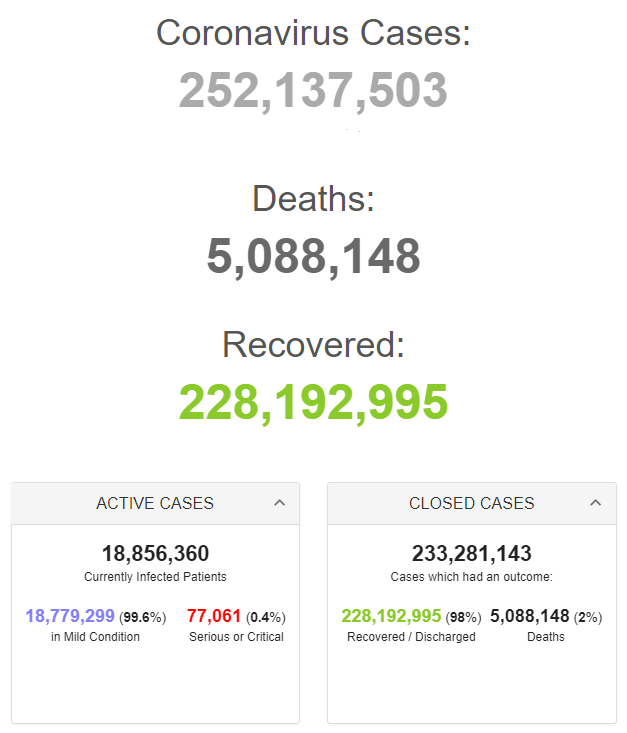
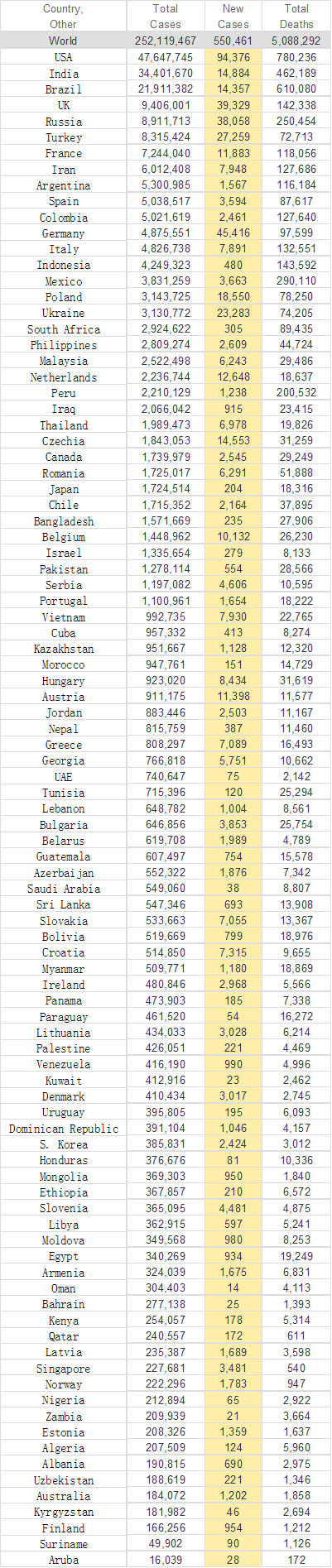
Retrieved from: https://www.worldometers.info/coronavirus/
Many markets have already announced they will not be going ahead amid record case numbers

Visitors stroll among stalls at the annual Christmas market at Breitscheidplatz in Berlin in 2019. Photograph: Sean Gallup/Getty Images
Soaring coronavirus rates in Germany are threatening plans for a rollout of the country’s famous Christmas markets, due to open in about a week’s time.
There had been considerable fanfare over municipalities’ plans to stage the markets this year after they were called off a year ago.
Hopes that the vaccine campaign – which started in Germany on 27 December last year – would have enabled markets to go ahead have been thwarted by a low uptake rate – only about 67% of Germans are fully vaccinated – and the spread of the more infectious Delta variant.
On Wednesday, Germany registered a record number of cases for a third day in a row, with just under 40,000 new infections, predicted to reach 100,000 in the next 10 days, while 236 deaths were registered, and hospital authorities warned intensive care units were in danger of reaching capacity before Christmas.
Berlin’s Charité hospital announced it was cancelling all non-urgent operations in order to free up beds for a growing number of Covid-19 patients.
With tens of thousands of Germans expected to travel at Christmas time, the fear is that case numbers will increase further over the holiday period.
Politicians have been under mounting pressure to announce the pandemic is nearing an end after an optimistic few months over the summer and autumn. The reopening of the markets is part of that narrative, even as data shows the health emergency is far from over.
Tighter controls had been announced to allow Christmas markets to go ahead, with organisers expected to monitor visitors’ entry in some cases by putting fencing around venues, and with many markets due to insist on vaccine certificates or proof of recovery from coronavirus.
Market stalls are to be erected with more distance between them, and the numbers allowed in are to be restricted. Organisers and health authorities have issued appeals for visitors to use common sense, keep their distance from other market-goers and to wear masks.
But now authorities from Bavaria in the south to Saxony and Thuringia in the east have begun announcing the cancellation of many scheduled markets, saying a rising infection rate means it would be irresponsible for them to go ahead.
Berlin’s Charlottenburg Palace market was cancelled after its operator said enforcing mask-wearing, as well as an alcohol ban in place owing to its location in a public park under the German capital’s infection protection law, made the event impossible to hold.
The market’s Tommy Erbe told German media: “Once again, politics has failed to create clear and real conditions for organisers in time.”
Nuremberg, one of the country’s most popular markets, is due to go ahead but its opening ceremony will only take place online. Other cities such as Dortmund have cancelled their Christmas lights ceremonies, arguing that health and safety regulations had made events too costly to hold.
Holger Zastrow, the head of the Augustustmarkt in Dresden, due to open on 24 November, said he remained optimistic it would go ahead. “At 500 metres long, our market has the longest promenade of any in Germany, and we will open,” he told German media. “Everything is so spread out that it is not necessary to carry out controls, whether of tests or vaccine passports.”
Germany’s Weihnachtsmärkte do not only contribute to the seasonal spirit – offering families and parties of office workers up and down the country the chance to get into the festive mood with everything from Glühwein and roast chestnuts to a range of arts and crafts and fairground amusements – they are also huge business. Typically they attract more than 150 million visitors a year, including many tourists from abroad, and generate about €3bn (£2.6bn) in revenue annually. They normally open from mid- to late November until just before Christmas.
The virologist Christian Drosten, a leading German voice throughout the pandemic, warned in his regular podcast on coronavirus on Tuesday, in an episode titled SOS – Iceberg Ahead, that Germany faced an escalation that would be hard to control and lead to tens of thousands of additional deaths if authorities did not reintroduce tighter measures, including contact restrictions.
“We need to be able to control infection activity again, and testing is not an adequate way of doing that. The tests are viewed as an emergency brake, to break the wave, but there is no way they will do that.”
Previous waves, Drosten said, had shown that the only way to lower the incidence rate was a change in the behaviour of the entire population. “When people change their behaviour and take the threat more seriously, that has an effect,” he said. “We are in an emergency situation.” He said the most effective way of ending the pandemic was for the entire population to have received three vaccination shots, though he admitted it was an unrealistic prospect.
There has been much focus in Germany in recent days on neighbouring Denmark, which had announced its pandemic was over last month but which has reintroduced restrictions this week over a rise in cases, and on Austria, which has managed to considerably boost the number of people willing to receive a vaccine by introducing strict so-called 2G rules, meaning that only those who are vaccinated or recovered can take part in many activities such as visiting cinemas or hairdressers. Germany is also debating a mandatory vaccine for people working in certain fields such as care homes and hospitals.
Retrieved from: https://www.theguardian.com/world/2021/nov/10/germany-christmas-market-closures-covid-rates-soar
By Ahmed Aboulenein
/cloudfront-us-east-2.images.arcpublishing.com/reuters/OCFFW5IXZ5K77FEVAJWHJYGXTI.jpg)
U.S. President Joe Biden delivers remarks on the authorization of the coronavirus disease (COVID-19) vaccine for kids ages 5 to 11, during a speech in the Eisenhower Executive Office Building’s South Court Auditorium at the White House in Washington, U.S., November 3, 2021. REUTERS/Evelyn Hockstein/File Photo
Ten Republican state attorneys general sued on Wednesday to stop the Biden administration's requirement that millions of U.S. health workers get vaccinated against the coronavirus, saying it would worsen staff shortages.
President Joe Biden, a Democrat, said last Thursday he will enforce the mandate starting Jan. 4.
The attorneys general of Missouri, Nebraska, Arkansas, Kansas, Iowa, Wyoming, Alaska, South Dakota, North Dakota, and New Hampshire jointly filed a lawsuit in the U.S. District Court for the Eastern District of Missouri in St. Louis.
"Placing this additional mandate on healthcare facilities and employees will exacerbate this problem and will likely lead some facilities – particularly those in underserved, rural areas – to close due to an inability to hire sufficient staff," Kansas Attorney General Derek Schmidt said in a statement.
The lawsuit said the federal mandate intruded on states' police power and is unlawful under the Administrative Procedures Act because there was no comment period before its release.
On Nov. 4, the Centers for Medicare & Medicaid Services (CMS), the regulator for the two federal health programs, issued an interim final rule it said covers over 10 million people and applies to around 76,000 healthcare providers including hospitals, nursing homes, and dialysis centers.
An interim final rule is effective immediately without the standard comment period that follows publication. There is a 60-day comment period following its publication, however.
Providers that fail to comply with the mandate could lose access to Medicare and Medicaid funds. Medicare serves people 65 and older and the disabled. Medicaid serves the poor.
The lawsuit said the CMS rule was heavy handed and did not take local factors and conditions into account.
CMS has said there have not been widespread resignations within healthcare providers that have already mandated vaccines, including 41% of U.S. hospitals, and that applying the mandate to all healthcare settings ensures staff cannot quit one setting to seek jobs in another.
"With many employers already mandating vaccination, and with nearly all local (and distant) healthcare employers requiring vaccination under this rule, we expect that such effects will be minimized," the agency said in introducing the rule.
Retrieved from: https://www.reuters.com/world/us/ten-states-sue-biden-administration-over-covid-19-vaccine-mandate-us-health-2021-11-11/

A logo of China's vaccine specialist CanSino Biologics Inc is pictured on the company's headquarters in Tianjin, following an outbreak of the coronavirus disease (COVID-19), China August 17, 2020. REUTERS/Thomas Peter
China's CanSino Biologics Inc (6185.HK) has applied for emergency use authorization in Brazil for its COVID-19 vaccine, Brazil's health regulator Anvisa said on Wednesday.
Anvisa canceled an earlier request from CanSino in June after the laboratory cut ties with its Brazilian representative Belcher Farmaceutica Ltda.
Anvisa said the latest application had been made by Biomm, who was now representing CanSino.
CanSino's Convidecia is a single dose vaccine.
Retrieved from: https://www.reuters.com/business/healthcare-pharmaceuticals/chinas-cansino-requests-emergency-use-approval-vaccine-brazil-2021-11-10/
By Jonathan Shamir
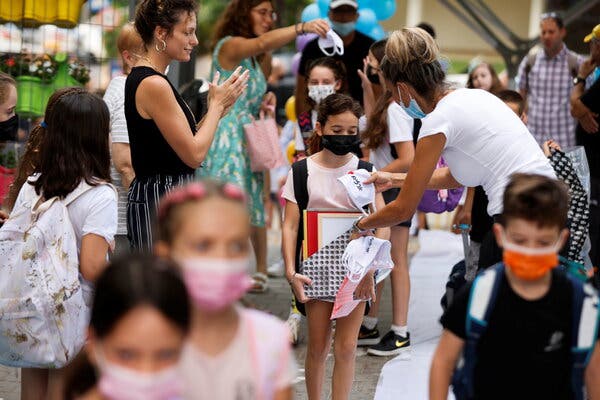
Returning to school in Tel Aviv in September. On Wednesday Israeli experts approved vaccines for children ages 5 to 11. The remaining hurdle is Health Ministry approval.Credit...Amir Cohen/Reuters
A panel of experts at Israel’s Health Ministry has approved giving the Pfizer-BioNTech vaccine to children ages 5 to 11, paving the way for the country to become one of the first after the United States to authorize the shot for children.
The decision requires the approval of the director general of the Health Ministry, Dr. Nachman Ash, before it takes effect.
All but two of the 75 Israeli experts backed the move in a vote on Wednesday evening. In a separate vote, 57 of the experts backed the vaccination of children who have already recovered from the virus.
In the United States, White House officials on Wednesday estimated that nearly a million children ages 5 to 11 have gotten shots since the Pfizer-BioNTech vaccine was cleared for use last week.
Under Prime Minister Benjamin Netanyahu, Israel was an early leader in administering the vaccine to its adult population, though its rate later fell behind that of other countries. Since taking office in June, Mr. Netanyahu’s successor, Naftali Bennett, has staked his reputation on rapid vaccine administration in a bid to avoid another nationwide lockdown.
Israel, Mr. Bennett has said, must learn to “live alongside the virus.”
In June, Mr. Bennett’s government became one of the first to vaccinate young people ages 12 to 15, and in July it authorized booster shots for people 60 and older, even before that approach was approved in the United States. Mr. Bennett allowed the rest of the population access to booster shots in August, again before most of the rest of the world.
The virus appears to be on the retreat at the moment in Israel. The country registered 147 serious cases on Wednesday, the lowest number since the end of July.
But its vaccine drive has been met with some resistance, particularly after participation in many public activities became conditional on the presentation of a vaccine passport. The Health Ministry, facing a backlash, canceled a live broadcast this week of a panel discussion about vaccinating children, and a senior health official was assigned a security detail after she received a series of threats.
Retrieved from: https://www.nytimes.com/2021/11/10/world/middleeast/israeli-covid-vaccine-children.html

Brazil has had 12,273 new cases of coronavirus reported in the past 24 hours, and 280 deaths, the health ministry said on Wednesday.
The South American country has now registered 21,909,298 cases since the pandemic began, while the official death toll has risen to 610,036, according to ministry data, in the world’s third worst outbreak outside the United States and India and its second-deadliest.
As vaccination advances, the rolling 14-day average of Covid deaths has fallen to 240 daily, compared to the toll of almost 3,000 a day at the peak of the pandemic in April.
Here’s a round-up of the day’s leading Covid stories:
· Australia is set to surpass the 90% first-dose vaccination coverage rate. Health minister Greg Hunt said the “extraordinary” achievement is expected to be reached just after midday on Thursday.
· France is at the beginning of a fifth wave of the coronavirus epidemic, Health Minister Olivier Veran said on Wednesday. “Several neighbouring countries are already in a fifth wave of the Covid epidemic, what we are experiencing in France clearly looks like the beginning of a fifth wave,” Veran said.
· New Zealand also hit a fresh Covid vaccination milestone, with 90% of Kiwis aged 12 and over having received at least one jab. Meanwhile, prime minister Jacinda Ardern’s popularity has plummeted in two new polls, as the country struggles to contain a Delta outbreak and transitions to a new era of endemic Covid.
· Moderna Covid-19 vaccine patent dispute headed to court after US National Institutes of Health scientists say they played “a major role” in developing the vaccine and intends to defend its claim as co-owner of patents on the shot, NIH Director Dr. Francis Collins told Reuters.
· Australia will share a further 7.5 million Covid-19 vaccine doses with Indonesia, bringing its total pledge to 10 million doses.
· The first case in the UK of a pet dog catching coronavirus,apparently from its owners, has reportedly been detected.
· A fifth lion at Singapore Zoo has also tested positive for Covid-19, the Animal and Veterinary Service (AVS) said on Wednesday.
· Israel to hold world’s first drill to test readiness for the possible emergence of a lethal ‘Omega’ variant. The drill, scheduled for Thursday, will take the format of a war games exercise and will test the capabilities of government departments and national agencies to respond to the emergence of the variant.
· Brazil has had 12,273 new cases of coronavirus reported in the past 24 hours, and 280 deaths, the health ministry said on Wednesday.
· France is at the beginning of a fifth wave of the coronavirus epidemic, health minister Olivier Veran said on Wednesday.
· Demand for Covid booster jabs jumped in France after Emmanuel Macron said a top-up dose would be necessary for people to retain their vaccine passes.
· The US has brokered a deal between Johnson & Johnson and the Covax vaccine-sharing program for the delivery of the company’s Covid vaccine to people living in conflict zones.
· The UK reported another 39,329 Covid cases and a further 214 deaths within 28 days of a positive test, official data showed.
· Russia’s coronavirus death toll surpassed 250,000. The country reported a record 1,239 Covid-related fatalities in the previous 24 hours, taking the official death toll to 250,454.




 Medicine