

 i_need_contribute

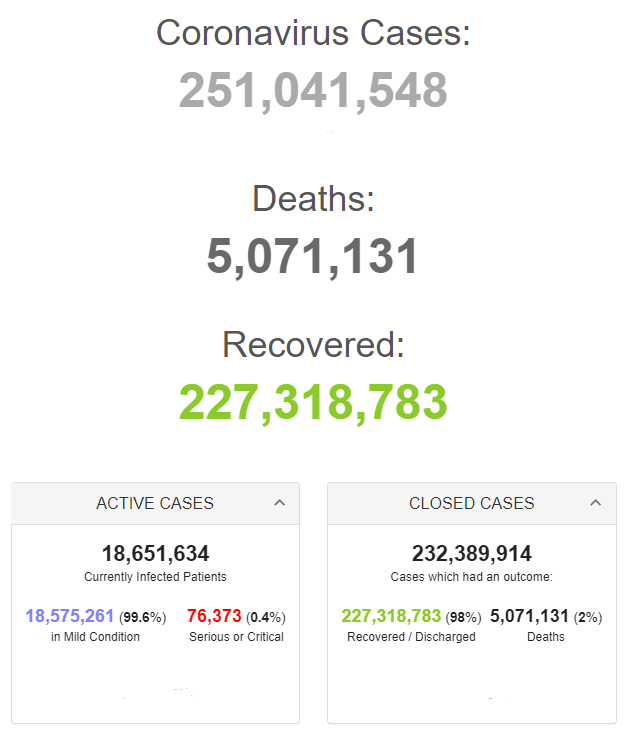

Retrieved from: https://www.worldometers.info/coronavirus/
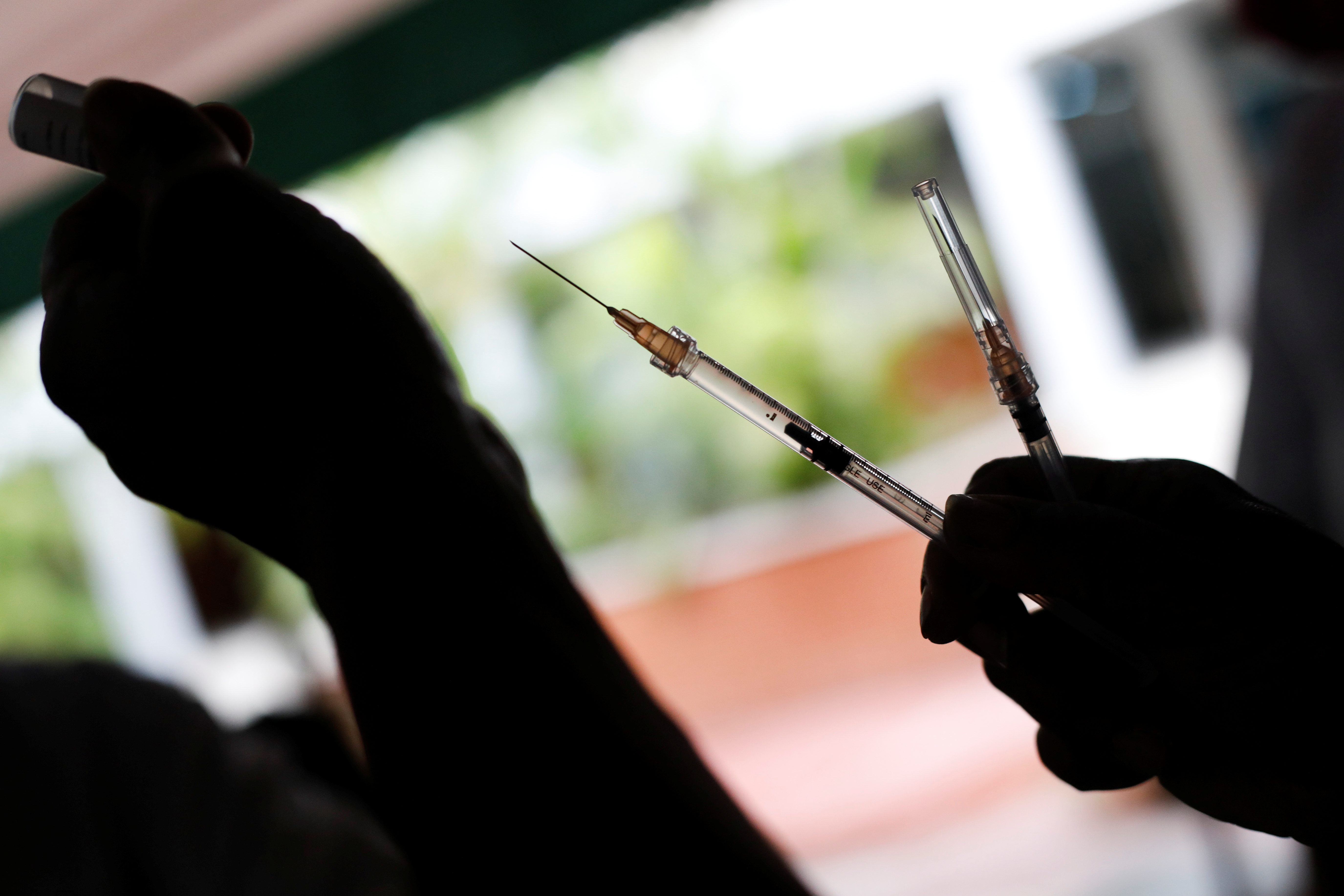
A health worker prepares a dose of the Sinopharm vaccine against the coronavirus disease (COVID-19) as part of a vaccination campaign for adolescents, in Caracas, Venezuela October 27, 2021. REUTERS/Leonardo Fernandez Viloria
Britain said it would recognise COVID-19 vaccines on the World Health Organization's Emergency Use Listing later this month, adding China's Sinovac (SVA.O), Sinopharm and India's Covaxin to the country's approved list of vaccines for inbound travellers.
The changes, which come into force from Nov. 22, will benefit fully vaccinated people from countries including the United Arab Emirates, Malaysia and India.
The travel rules are being further simplified as all people under the age of 18 will be treated as fully vaccinated at the border and will be able to enter England without self-isolating on arrival, the Department for Transport said on Monday.
Retrieved from: https://www.reuters.com/world/uk/uk-add-chinas-sinovac-indias-covaxin-approved-vaccine-list-2021-11-08/
By Eric M. Johnson
Signage of The Boeing Company in Seattle, Washington, U.S. June 29, 2020. REUTERS/Karen Ducey
The number of Boeing Co (BA.N) employees seeking a vaccine exemption on religious or medical grounds has reached more than 11,000 - or nearly 9% of its U.S. workforce - a level many times higher than executives initially estimated, people familiar with the matter told Reuters.
The widespread reluctance has left executives scrambling for a strategy that keeps employees safe and complies with President Joe Biden's vaccine mandate for federal contractors, but avoids an exodus of engineering and factory labor, the people said.
The standoff comes as the U.S. planemaker tries to muscle through industrial and certification challenges on its 787, 777X and Starliner spacecraft programs, as well as depressed demand and supply-chain shortages. read more
Late last week, the White House pushed back to Jan. 4 its deadline for employees at federal contractors to be vaccinated or be tested regularly if they receive exemptions.
Boeing on Friday then delayed its deadline by about a month to Jan. 4 for employees to take a COVID-19 vaccine, or file an exemption on religious or medical grounds, according to industry sources and a company email seen by Reuters.
"Compliance remains a condition of employment," the internal email said.
The Boeing email also said employees whose requests are approved would be required to wear a face covering, physically distance and frequently test for COVID-19.
"Anyone who has not received their final dose or been approved for an accommodation, and registered their vaccination status by Jan. 4, will be issued a final warning, and will be expected to promptly come into compliance if they wish to remain employed at Boeing," the email said.
A Boeing spokesperson declined to provide a count of vaccination exemption requests.
"Boeing is committed to maintaining a safe working environment for our employees, and advancing the health and safety of our global workforce is fundamental to our values," the spokesperson said.
EXEMPTION REQUESTS
Wearing a face mask on companywide webcasts, Boeing Chief Executive Dave Calhoun has urged employees to take a vaccine, two employees said.
Two Boeing insiders said executives initially estimated vaccine resistance from some 2% of workers, a number the company could manage. But by last week, one person familiar with the matter said more than 10,000 employees had filed religious exemptions, and a second person said the number stood at more than 11,300. Another 1,000 or so workers filed a medical exemption, another person said.
The fact that the vast majority of applications were on religious grounds has thrust one of America's largest employers into the center of a debate about the ethics of probing an employee's religious beliefs.
One person seeking a religious exemption said the company had no right to do so under the law or its own anti-discrimination policies.
Another person, a veteran engineer, said: "The long list of program issues makes it tough to have company pride. The handling of the vaccine mandate is it for many."
The issue is hitting other aerospace companies. Around 50 employees at Boeing-Lockheed Martin Corp's (LMT.N) United Launch Alliance (ULA) rocket factory in Decatur, Alabama, have already been placed on unpaid leave, or decided to retire early, after refusing to take a vaccine by a company deadline, two of the sources said.
A third person said ULA executives expect in a worst-case scenario to lose 15% of its roughly 2,600-person workforce, or as many as 390 people.
A ULA spokesperson said so far 1% of its workforce, or roughly 26 people, had permanently left the company. ULA "decided to require vaccinations to ensure the health and safety of our employees and to align with our U.S. government customer and industry direction," the spokesperson said.
The departures come after ULA executives decided to deny all employee applications for an exemption on religious grounds, deciding it would be too time-consuming to evaluate each case, among other reasons, the third person said.
"I don't conform to strong-arming or coercion," said ULA welder Brent Vandiver, 45, who was among the workers placed on unpaid leave.
Retrieved from: https://www.reuters.com/business/aerospace-defense/exclusive-boeing-us-worker-vaccine-exemption-requests-top-11000-sources-2021-11-08/
By Krishna N. Das
India could resume deliveries of COVID-19 shots to global vaccine-sharing platform COVAX in a few weeks for the first time since April, two health industry sources said, ending a suspension of supplies that has hurt poor countries.
The World Health Organization (WHO), which co-leads COVAX, has been urging India to restart supplies for the programme, especially after it sent about 4 million doses to its neighbours and partners in October.
Based on an informal approval from India, COVAX officials have started planning allocations of the Covishield shot for various countries, said one of the sources, both of whom declining to be identified pending a final agreement.
Covishield is a licensed version of the AstraZeneca (AZN.L) shot made by the Serum Institute of India (SII), the world's biggest vaccine maker.
SII has nearly quadrupled its output of Covishield to up to 240 million doses a month since April, when India stopped all exports in order to inoculate its own people during a surge of cases.
"There will need to be purchase orders confirmed to SII, labelling and packing, export authorisation granted for each of these shipments," said the source. "So the first deliveries, assuming the Indian government grants export authorisation, won't happen until a few weeks from now."
SII, the health ministry and the WHO did not immediately respond to requests for comment.
The ministry said in a statement earlier in the day that Indian states had more than 159 million unutilised doses of various vaccines, as inoculations have slowed after 79% of the country's 944 million adults got one dose and 37% got two doses.
SII CEO Adar Poonawalla told Reuters last month that the company could send 20 million to 30 million doses a month to COVAX in November and December, which would increase to "large volumes" from January once India's own needs were met.
WHO chief Tedros Adhanom Ghebreyesus said on Friday that COVAX had the money and the contracts to buy vaccines for low-income countries but "manufacturers have not played their part".
COVAX in September cut its 2021 delivery target by nearly 30% to 1.425 billion doses.
Retrieved from: https://www.reuters.com/world/india/india-could-ship-vaccines-covax-few-weeks-say-sources-2021-11-09/
Authorities say unvaccinated people make up a ‘sizeable majority’ of those needing the most intensive care
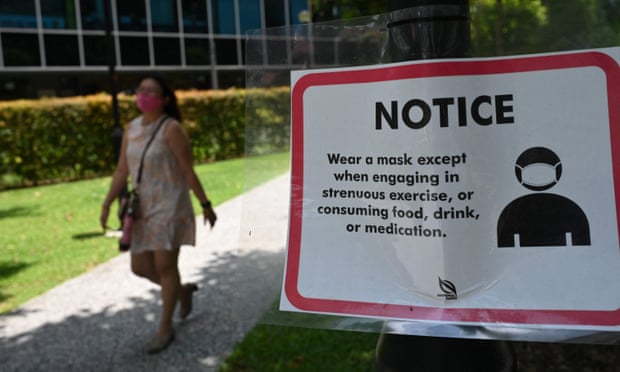
Singapore will still pay Covid-related medical bills for people who aren’t eligible for a vaccine.Photograph: Roslan Rahman/AFP/Getty Images
Singapore will no longer pay the Covid-19 medical bills for people “unvaccinated by choice”, the government said, as the country grapples with a surge in cases.
The government currently covers the full Covid medical costs for all Singaporeans, as well as permanent residents and long-term visa holders, unless they test positive soon after returning home from overseas.
However from 8 December, the government said it will “begin charging Covid-19 patients who are unvaccinated by choice”.
It said unvaccinated people “make up a sizeable majority of those who require intensive in-patient care and disproportionately contribute to the strain on our healthcare resources”.
Covid-related medical bills will still be paid for people who aren’t eligible for a vaccine. The government will also foot the bill for individuals who are partially vaccinated until 31 December, giving them time to get a second dose.
Singapore has among the highest coverage rates in the world, with 85% of the eligible population fully vaccinated.
Yet the city state is struggling with rising Covid infections and last month warned its healthcare system was at risk of being “overwhelmed” by surgingcases. It came a day after the country expanded quarantine-free travel as part of a shift in its approach to dealing with the pandemic.
The prime minister, Lee Hsien Loong, previously said the global business hub could not remain closed indefinitely, and Singapore has moved from a zero-tolerance strategy with lockdowns and closed borders to living with Covid-19.
A spike in infections after the relaxation of some restrictions prompted the island to pause further reopening in late October. Social curbs were extended for around a month in order to contain the spread of Covid and ease the pressure on the healthcare system.
On 8 November, the country reported 2,470 new cases and 14 deaths. The ministry of heath said 67 Covid cases were critically ill in intensive care.
Retrieved from: https://www.theguardian.com/world/2021/nov/09/singapore-to-start-charging-covid-patients-who-are-unvaccinated-by-choice
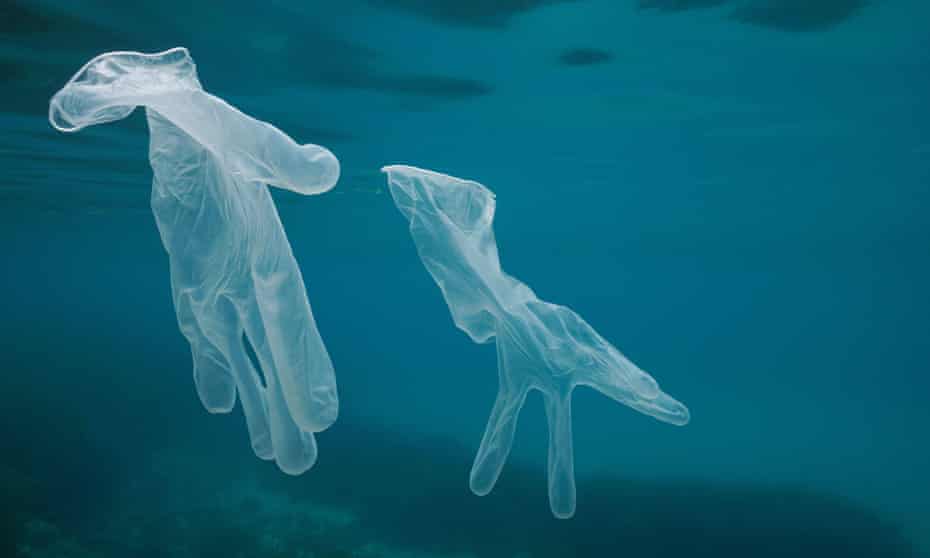
Increased use of personal protective equipment including gloves and masks during the pandemic has added to an existing problem of mismanaged plastic waste, the report found. Photograph: Seaphotoart/Alamy
Increased demand for PPE has put pressure on an already out-of-control global problem, report finds
Plastic waste from the Covid-19 pandemic weighing 25,900 tonnes, equivalent to more than 2,000 double decker buses, has leaked into the ocean, research has revealed.
The mismanaged plastic waste, consisting of personal protective equipment such as masks and gloves, vastly exceeded the capability of countries to process it properly, researchers said.
Since the beginning of the pandemic, an estimated 8.4m tonnes of plastic waste has been generated from 193 countries, according to the report, published on Monday.
“The Covid-19 pandemic has led to an increased demand for single-use plastics that intensifies pressure on an already out-of-control global plastic waste problem,” said Yiming Peng and Peipei Wu from Nanjing University, the authors of Magnitude and impact of pandemic-associated plastic wastepublished in the online journal PNAS.
“The released plastics can be transported over long distances in the ocean, encounter marine wildlife, and potentially lead to injury or even death,” they added.
A study in March presented the first case of a fish entrapped in a medical glove, encountered during a canal cleanup in Leiden, the Netherlands. In Brazil a PFF-2 protective mask was found in the stomach of a dead Magellanic penguin.
The scientists predicted that by the end of the century almost all pandemic-associated plastics will end up on either the seabed or on beaches.
The Chinese study found that 46% of the mismanaged plastic waste came from Asia, due to the high level of mask-wearing by individuals there, followed by Europe, 24%, and North and South America, 22%.
Peng and Wu said their research suggested 87.4% of the excess waste was from hospitals, rather than from individual use. PPE usage by individuals contributed only 7.6% of the total, while packaging and test kits accounted for 4.7% and 0.3% respectively.
“Most of the plastic is from medical waste generated by hospitals that dwarfs the contribution from personal protection equipment and online-shopping package material,” they wrote.
“This poses a long-lasting problem for the ocean environment and is mainly accumulated on beaches and coastal sediments.”
The thousands of tonnes of masks, gloves, testing kits and face visors which leached into the oceans from the start of the pandemic up to August this year, were transported in 369 major rivers.
Chief among these were Shatt al-Arab in south-eastern Iraq, which carried 5,200 tonnes of PPE waste to the ocean; the Indus river, which arises in western Tibet, carried 4,000 tonnes and the Yangtze river in China 3,700 tonnes. In Europe, the Danube carried the most plastic pandemic waste into the ocean: 1,700 tonnes.
The top 10 rivers accounted for 79% of pandemic plastic discharge, the top 20 for 91%, and the top 100 for 99%. About 73% of the discharge was from Asian rivers followed by European watercourses (11%), with minor contributions from other continents, the report said.
“These findings highlight the hotspot rivers and watersheds that require special attention in plastic waste management,” the authors said.
“We find a long-lasting impact of the pandemic-associated waste release in the global ocean. At the end of this century, the model suggests that almost all the pandemic-associated plastics end up in either the seabed (28.8%) or beaches (70.5%).”
The authors said the findings showed better medical waste management was needed in pandemic epicenters, especially in developing countries.
Retrieved from: https://www.theguardian.com/environment/2021/nov/08/about-26000-tonnes-of-plastic-covid-waste-pollutes-worlds-oceans-study
By Tess McClure in Christchurch
Jacinda Ardern says protests are ‘not representative’ of New Zealand as photographer harassed during Wellington protest
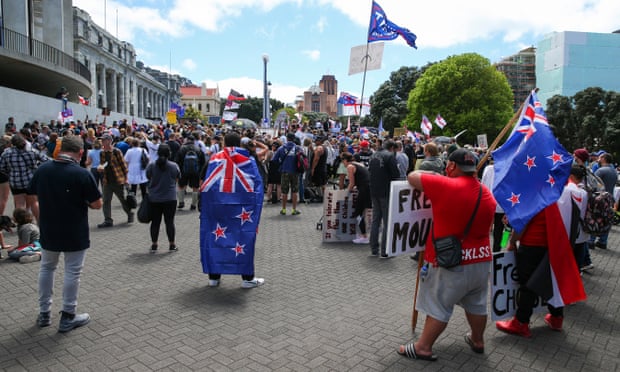
Anti-Covid vaccine mandate protesters gathered outside parliament in Wellington, New Zealand, with some threatening violence against prime minister Jacinda Ardern. Photograph: Hagen Hopkins/Getty Images
New Zealand’s parliament is on high alert after thousands of anti-vaccination mandate protesters, some threatening violence, gathered in Wellington and across the country.
As of early Tuesday, about 2,000 people had gathered in central Wellington, and almost all the gates and entrance ways to parliament had been shut off. According to Stuff,the Speaker of the house, Trevor Mallard, said it was the biggest increase in parliamentary security he had seen since his election in 1984.
In the initial stages of the protests across the country, there were attacks on both police and reporters. At the border with Auckland, which has been shut for weeks due to the Covid outbreak there, a police officer was bitten by a protester. Police said in a statement that about 50 protesters had arrived at the border, and blocked traffic for an hour.
“The actions of protesters required our staff to physically intervene to move them off the road. In the process one of our officers has been bitten by an as yet unidentified protester. Actions like this are totally avoidable and poses unnecessary risk to our staff who are simply trying do their part in preventing the spread of Covid-19,” police said in a statement.
According to Stuff, one of the country’s largest news organisations, one of their photographers was grabbed and pushed by protesters in Wellington yelling anti-media abuse.
Tuesday’s protests appeared to consist of a few thousand people, an unusually large one for New Zealand, whose government has enjoyed extremely high levels of public support for its Covid pandemic response. The prime minister, Jacinda Ardern, said that: “What we saw today was not representative of the vast bulk of New Zealanders.”
Some of the tenor of protesters’ signs and slogans had violent undertones, and echoed the Capitol riot in Washington in January – demonstrating some of the growing connections between New Zealand’s anti-vaccine mandate movement and overseas factions through social media.
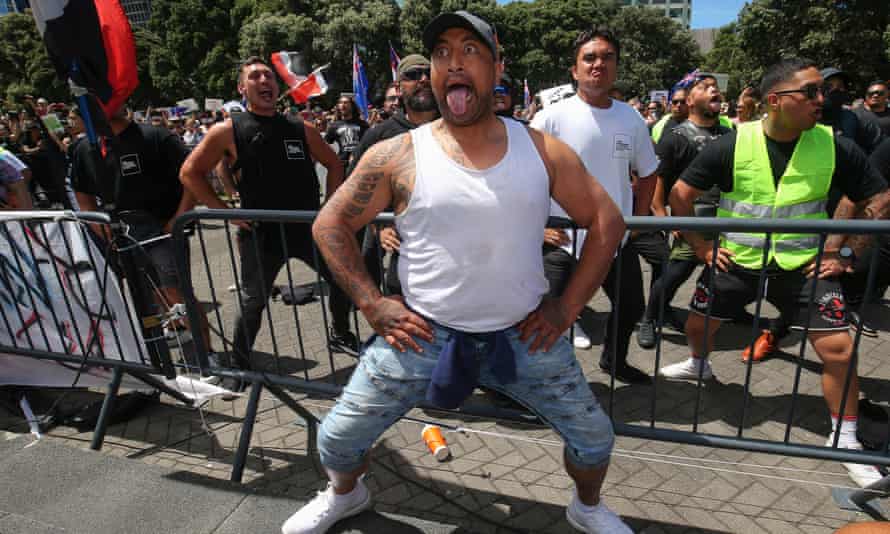
Anti-vaccine mandate protesters perform a haka outside parliament in Wellington. Photograph: Hagen Hopkins/Getty Images
A number of protesters waved large Trump flags, signs saying “we will drain the swamp” or “media treason” with a series of swastikas, or placards referencing a coming “Nuremberg trial” and depicting a noose. Some took the peculiar step of throwing tennis balls on to the parliamentary forecourt, tagged with slogans urging violence against Ardern.
Also present in the crowds were tino rangatiratanga and United Tribes of New Zealand flags, both of which are symbolic of Māori sovereignty movements. A speaker on parliament grounds said he hoped Ardern was scared, and said: “If you do decide to ignore us, you do so at your peril.” He made a series of demands including revoking workplace vaccination mandates and removing all other Covid safety restrictions. In October, the government released a new “traffic light” system for Covid management, including a legal framework for vaccination mandates that could affect around 40% of the workforce. The new rules, which begin at 90% vaccination, would loosen almost all restrictions for the fully vaccinated, but require vaccination certificates for many businesses and for workers in public-facing roles like eduction, nursing, and hospitality.
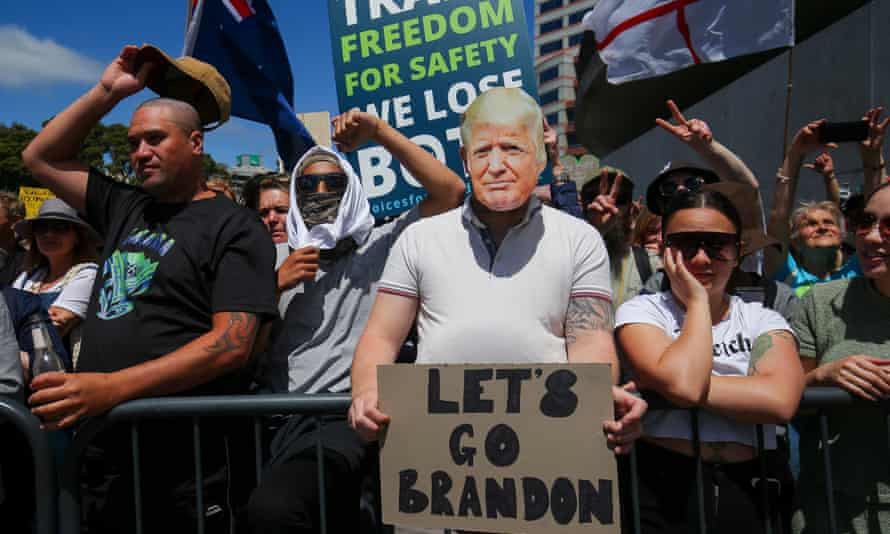
Some anti-vaccine mandate protesters in Wellington waved large Trump flags and signs saying ‘media treason’. Photograph: Hagen Hopkins/Getty Images
In a working paper released on Tuesday, research institute Te Pūnaha Matatini said it had observed “a sharp increase in the popularity and intensity of Covid-19-specific disinformation and other forms of ‘dangerous speech’ and disinformation, related to far-right ideologies” since the Delta outbreak and level 4 lockdown began in August. They also noted “a shift in reception to the Covid-19 vaccine from vaccine hesitancy to vaccine resistance”.
Online communities both spreading and being exposed to online Covid misinformation were often exposed to a hodge-podge of other conspiratorial claims, the researchers said. That may account for some of the mixed messaging at Tuesday’s protests, which blended QAnon narratives, Christian slogans, messages about freedom, exclusion and “apartheid” and Covid-specific concerns.
The researchers – while not writing specifically about today’s protest movement – concluded their findings “point to a broader threat: that Covid-19 and vaccination are being used as a kind of Trojan horse for norm-setting and norm-entrenchment of far-right ideologies in Aotearoa New Zealand … [including] anti-Māori sentiment, anti LGBTQIA+, conservative ideals around family and family structure, misogyny, and anti immigration”.
Opposition National party leader Judith Collins said her MPs would not be meeting with the protesters, and that she had never seen the level of security restrictions currently in place. “This is very much an anti-vaccination protest and we don’t really want to be seen with it,” Collins said.
Retrieved from: https://www.theguardian.com/world/2021/nov/09/new-zealand-anti-vaccine-mandate-protests-police-and-photographer-attacked




 Medicine