

 i_need_contribute

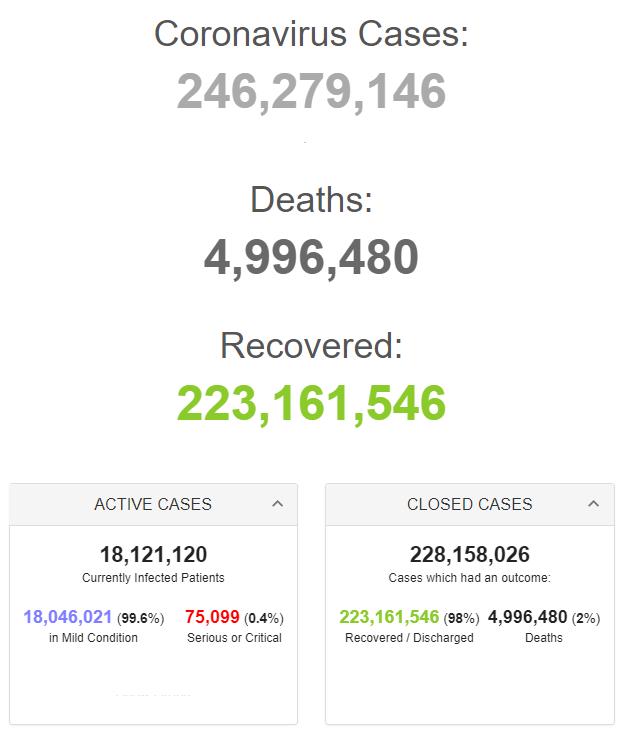

Retrieved from: https://www.worldometers.info/coronavirus/
By Tom Balmforth and Andrew Osborn
The Russian capital brought in its strictest COVID-19 related lockdown measures in more than a year on Thursday as nationwide one-day pandemic deaths and infections hit new highs amid slow vaccination take-up across the world's biggest country.
Moscow's partial lockdown, in which only essential shops like pharmacies and supermarkets are allowed to remain open and schools and state kindergartens are shut, comes ahead of a week-long nationwide workplace shutdown from Oct. 30.
Like Moscow, some regions decided to kick off their partial lockdowns on Thursday or even earlier in an effort to cut infection numbers ahead of the nationwide initiative.
Moscow's residents are allowed to leave their homes unlike a sweeping lockdown in summer 2020, but the new measures point to rising concern among officials over record numbers of deaths that the Kremlin has blamed on vaccine hesitancy.
Officials on Thursday reported an all-time high of 1,159 COVID-19 nationwide deaths in the past 24 hours, while the number of daily infections broke through the 40,000 barrier for the first time.
At the State Duma lower house of parliament, Vyacheslav Volodin, the speaker, proposed requiring all lawmakers to get vaccinated and suggested that stragglers should have to work remotely.
"Imagine the consequences for the country if parliament stops working," Volodin told the lower house. "Every day we're seeing how our ... colleagues are ending up in hospital beds," he said.
His proposal was met by angry shouts from the parliament's chamber with someone calling out: "What kind of PR is this?"
Many Russians have said they are reluctant to get vaccinated and have spurned the four vaccines Russia has registered, including the flagship Sputnik V vaccine.
Some people say they are hesitant due to mistrust of the authorities, while others cite concerns about the safety of vaccines.
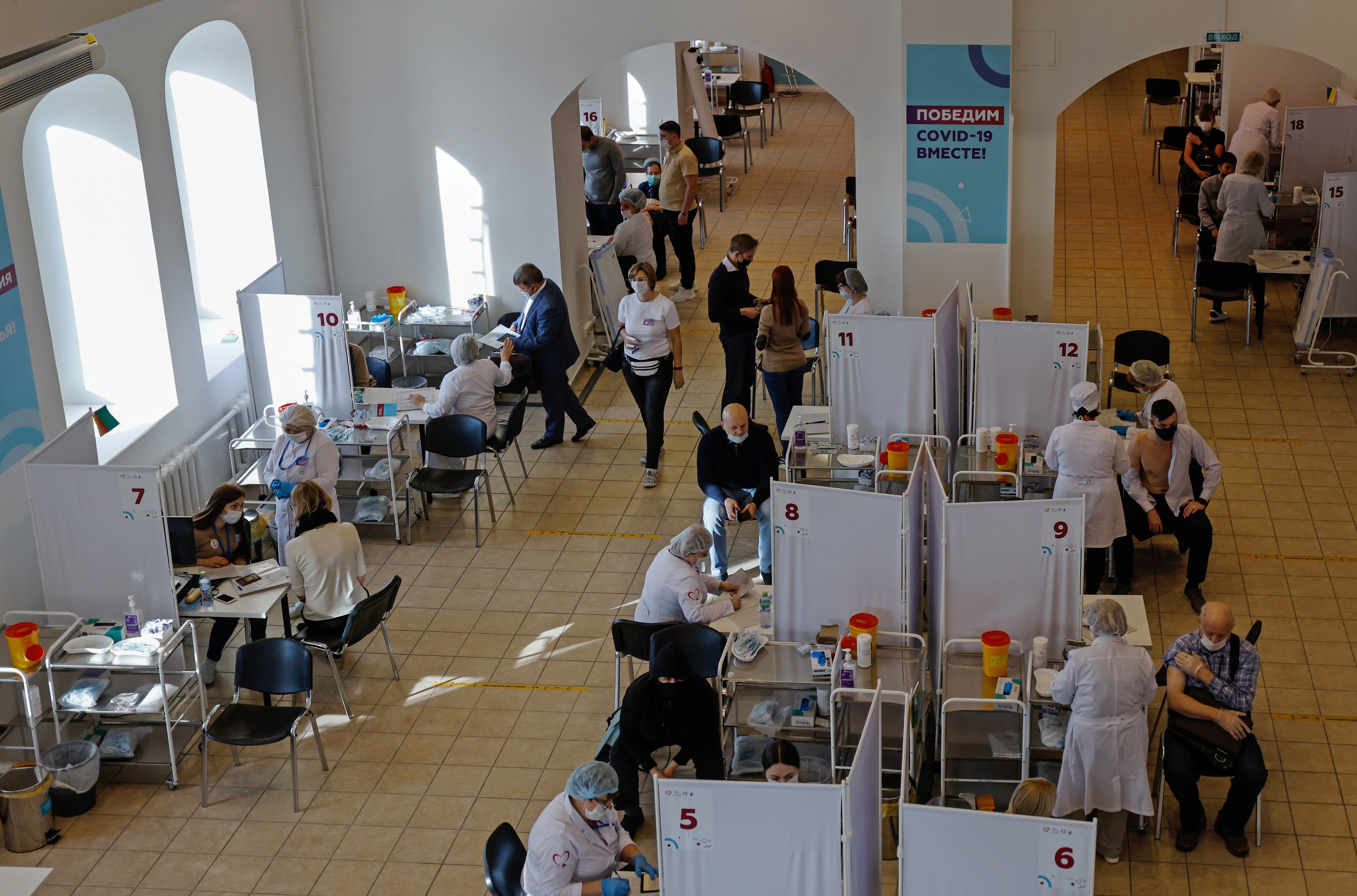
People receive a vaccine against the coronavirus disease (COVID-19) at a vaccination centre in the State Department Store, GUM, in Moscow, Russia October 26, 2021. REUTERS/Evgenia Novozhenina
As of Oct. 22, official data showed that 49.1 million Russians were fully vaccinated. The total population, excluding annexed Crimea, is officially estimated at around 144 million.
AD CAMPAIGN RELAUNCH?
The daily Kommersant newspaper reported on Thursday that the Kremlin planned to revamp the troubled public information campaign about the importance of getting vaccinated.
The new campaign would pay closer attention to Russia's more than 80 regions and strike a less aggressive and negative tone than previously, the report said.
The existing campaign has often highlighted the risk of death for Russians who decline to get vaccinated rather than linking vaccination to the freedom to be exempt from lockdown-style restrictions, it said.
However, the Kremlin denied it planned to relaunch the ad campaign, but said the strategy was constantly being adjusted and that the campaign would be continued.
Many Russians have decided that now is an ideal time to fly off for a foreign beach holiday instead of hunkering down at home.
There were mixed feelings about the lockdown on the streets of Moscow on Thursday. Some residents like Lyubov Machekhina said they thought it would obviously help slow infections.
But others like Mikhail, a Muscovite who did not give his surname, voiced doubts that there would be any real impact without a larger chunk of the population being vaccinated.
"In my opinion, it will change nothing. Perhaps, it will slow down (the spread of cases) a bit, but in fact, without herd immunity - it's nonsense. I don't believe it will work."
Retrieved from: https://www.reuters.com/world/europe/moscow-embarks-sweeping-lockdown-covid-19-deaths-surge-2021-10-28/
By Sangmi Cha
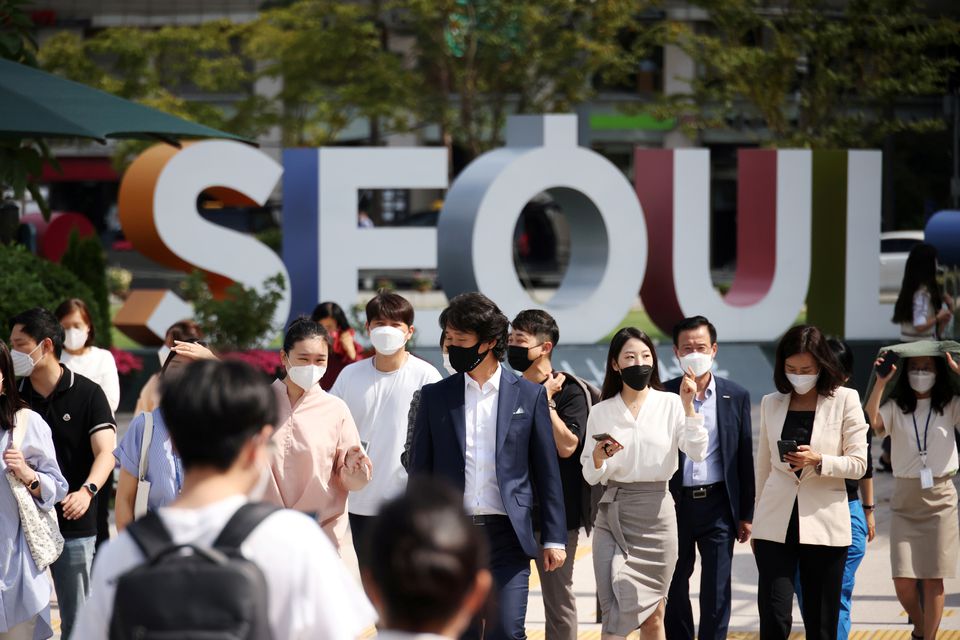
Commuters wearing masks to avoid contracting the coronavirus disease (COVID-19) walk on a zebra crossing in Seoul, South Korea, September 24, 2021. REUTERS/Kim Hong-Ji
South Korea said on Friday it will drop all operating-hour curbs on restaurants and cafes and implement its first vaccine passport for high-risk venues such as gyms, saunas and bars, as it tries to "live with COVID-19".
The first phase will go into effect on Monday and last for a month, officials said, with plans calling for all restrictions to be scrapped by February.
"Beginning November 1, our community will take the first step of resuming our normal life," Prime Minister Kim Boo-kyum said at a televised government meeting. "However, we must be aware that this doesn't mean the fight against coronavirus is over, but a new beginning."
The push comes as South Korea grapples with high daily case numbers, though they remain far below many of the worst hit countries, and serious infections and deaths are low.
Last week, South Korea met its goal of vaccinating 70% of its 52 million people, paving the way for the planned return to normal. It has now fully vaccinated about 72% of the population, and has given at least one dose of a vaccine to more than 79.8%.
While never under lockdown, South Korea has been battling the fourth wave of infections since July when the government imposed tight gatherings and social distancing restrictions.
Outdoor sports events are allowed to take up to 50% of spectators and up to 100 people can attend musicals or concerts regardless of vaccination status. Inoculated people will be allowed to consume popcorn and soda inside movie theatres.
Visits to high-risk venues such as bars and night clubs, indoor gyms, saunas and karaoke bars will require proof of vaccination, or a negative COVID-19 test result from within 48 hours.
South Korea has launched its own vaccine app that it says protects user privacy through blockchain technology.
While private gatherings will be allowed with up to 10 people nationwide regardless of vaccination status, restaurants and cafes will keep a cap on up to four unvaccinated people per group.
Authorities have said they will focus on hospitalisation and mortality rates rather than daily mitigation and expand self-treatment for those with only mild COVID-19 symptoms.
The Korean Medical Association (KMA) and experts have warned that the timing of the switch to the new strategy, with a relatively high number of cases and as winter approaches, may fuel a rise in COVID-19 cases.
South Korea reported 2,124 new COVID-19 cases for Thursday, bringing its cumulative tally to 360,536 infections with 2,817 deaths.
Retrieved from: https://www.reuters.com/world/asia-pacific/skorea-loosens-restrictions-first-step-toward-living-with-covid-19-2021-10-29/
In Depok, Indonesia, a young girl received a shot for preventable diseases like measles and diphtheria at an elementary school last year.Credit...Adi Weda/EPA, via Shutterstock
The pandemic dealt a serious setback to global efforts to immunize children against diseases like measles and polio, the Centers for Disease Control and Prevention reported on Thursday, reducing worldwide coverage for some vaccines to levels not seen since more than a decade ago.
The proportion of eligible children who received a polio vaccine fell to 83 percent in 2020 from 86 percent the year before, as did coverage with the third dose of the diphtheria-tetanus-pertussis vaccine, known as DTP3. Coverage with the measles vaccine also dipped slightly, to 84 percent last year from 86 percent in 2019.
Those setbacks, while seemingly small, meant that millions more children missed out on routine immunizations during the pandemic, putting them and their communities at risk.
Globally, nearly 23 million children targeted for the DTP3 shot were not vaccinated in 2020, compared with 19 million in 2019, the C.D.C. said. The vast majority of those had not received a single dose of diphtheria-tetanus-pertussis vaccine. Not since 2009 had coverage with that vaccine been so low.
The C.D.C. scientists involved in the report called for action to be taken to address the immunity gaps of preventable diseases in countries already saddled with Covid outbreaks. Scientists from the World Health Organization and UNICEF also were co-authors on the study.
The decline in vaccinations follows a decade of stagnant immunization levels. In 2019, measles deaths swelled to their highest levels in 23 years, a consequence of what public health experts described as insufficient vaccination coverage. Scientists said that the pandemic had hampered the tracking of measles outbreaks.
The pandemic also disrupted immunization programs, the C.D.C. report said, interrupting the supply of basic vaccines and making it more difficult to administer them.
Immunization levels for diphtheria-tetanus-pertussis and measles were lowest in much of Africa, the report said. The W.H.O. also said on Thursday that only five of Africa’s 54 nations were expected to reach a year-end goal of vaccinating 40 percent of their people against Covid. UNICEF, a United Nations agency working to distribute coronavirus vaccines, warned of a shortfall next year in syringes for both Covid and routine vaccinations.
Retrieved from: https://www.nytimes.com/2021/10/28/health/polio-measles-vaccinations-covid.html
By Vivian Wang
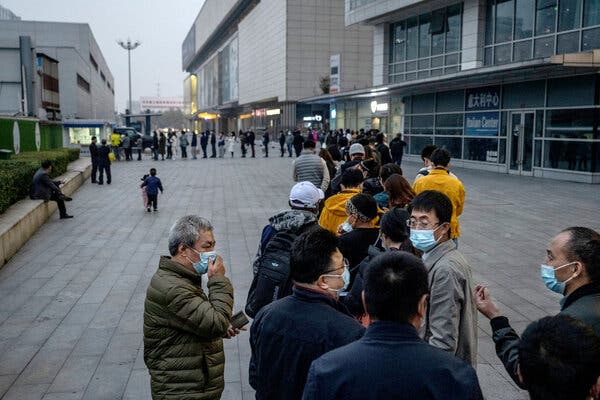
A line for a virus test in Beijing on Monday. China is trying to contain a new outbreak in at least 11 provinces and regions.Credit...Kevin Frayer/Getty Images
This week, after tracking every movement of a couple of retirees who tested positive after visiting Gansu Province, Inner Mongolia and Xi’an, China locked down a city of four million, as well as several smaller cities and parts of Beijing. The aim was to contain a new outbreak that has infected more than 240 people in at least 11 provinces and regions.
The no-holds-barred response is emblematic of China’s “zero Covid” policy, which has served the country remarkably well: China has reported fewer than 5,000 deaths since the pandemic began. The scale of the new outbreak, while tiny compared with many other countries, is large for China.
The policy has also, increasingly, made China an outlier. The rest of the world is reopening, including New Zealand and Australia, which also once embraced zero tolerance.
“Every locality should firmly adhere to the policy of ‘Defend externally against importation, defend internally against rebound,’” Mi Feng, a spokesman for the National Health Commission, said at a news conference on Sunday. “The current control measures cannot be relaxed.”
The strict strategy is the product of a uniquely Chinese set of calculations. Thriving exports have helped to keep the economy afloat. The ruling Communist Party’s tight grip on power enables lockdowns and testing to be carried out with astonishing efficiency. Beijing is set to host the Winter Olympics in February.
For many Chinese, the low case numbers have become a source of national pride. But experts — both in China and abroad — have warned that the approach is unsustainable.
“The regime thinks it needs to maintain a ‘zero Covid’ policy to maintain its legitimacy,” said Lynette Ong, a political scientist at the University of Toronto. “At a huge cost, though.”
By Aina J. Khan
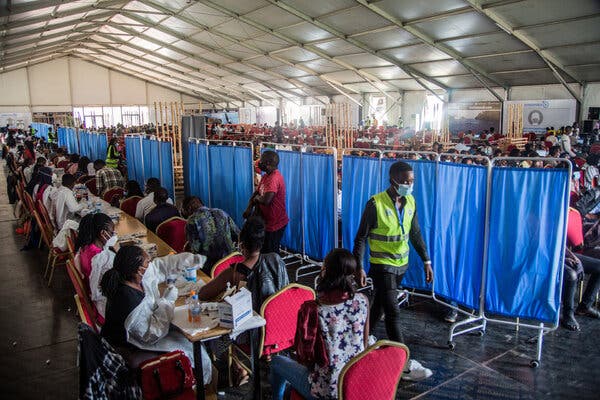
A vaccination site in Kigali, Rwanda, in September. The country is among those in the continent already facing a delay in syringe supplies.Credit...Jacques Nkinzingabo for The New York Times
As countries across Africa struggle to vaccinate 1.3 billion people, the continent faces another obstacle besides a lagging supply of doses: the looming likelihood of a shortage of syringes.
“Early next year, Covid-19 vaccines will start pouring into Africa, but a scarcity of syringes could paralyze progress” Dr. Matshidiso Moeti, the W.H.O.’s regional director for Africa, said at a news briefing. “Drastic measures must be taken to boost syringe production, fast. Countless African lives depend on it.”
Rwanda, South Africa and Kenya have already reported delays in receiving supplies of syringes, according to the W.H.O.
Covax, a global vaccine-sharing initiative that is working to supply many African countries with doses, is now seeking agreements with syringe manufacturers and trying to plan to keep vaccine deliveries from outpacing the availability of needles.
Africa has the lowest vaccination rate of any continent, and the W.H.O. estimates that about 59 million of the continent’s population have been infected with the coronavirus since the beginning of the pandemic, though only somewhat more than eight million cases have been officially recorded.
Unless “drastic measures” are taken to accelerate vaccinations, the organization said, only five African countries are projected to meet the target set by the W.H.O.: fully vaccinating 40 percent of their populations by the end of the year. Most of Africa’s more than 50 countries already missed the W.H.O.’s target of vaccinating 10 percent of their populations by the end of September.
Wealthier countries have monopolized vaccine supplies, creating global inequities in distribution. Those inequities are only likely to be deepened as those same wealthier nations, including the United States, roll out booster campaigns.
By contrast, vaccine deliveries via Covax ground to a halt after India imposed export restrictions on doses as it dealt with its own resurgence this year. In September, regional health experts saidthat the unpredictability of the limited supply of doses reaching African nations added more obstacles. Some shipments, they said, were within two or three months of expiring — a shelf life too short for some health systems to reliably deploy, and one that many ordinary people interpreted as a signal of poor quality, contributing to vaccine hesitancy.
Retrieved from: https://www.nytimes.com/2021/10/28/world/africa/africa-syringe-shortages-who.html
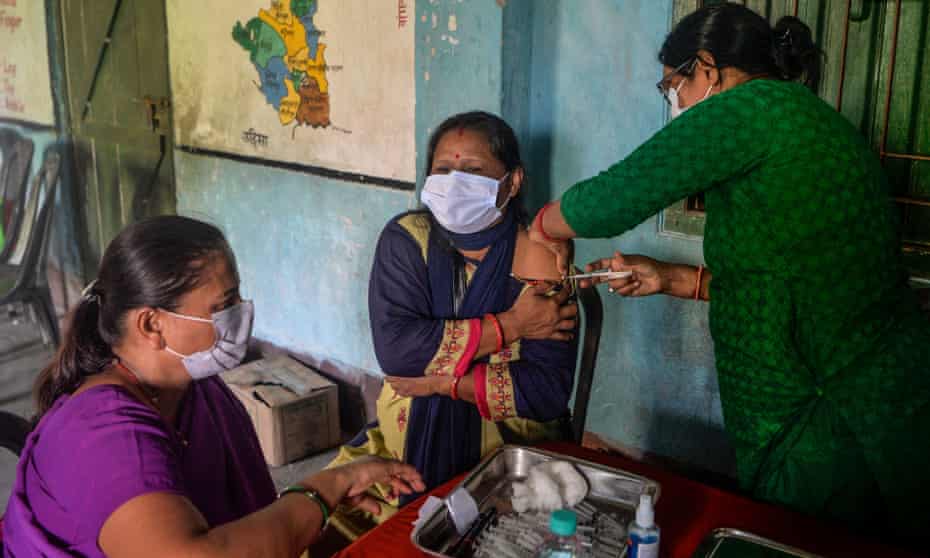
A health worker inoculates a woman with a dose of the Covishield vaccine at a vaccination camp in Milan More village, Siliguri, India. Photograph: Diptendu Dutta/AFP/Getty Images
More than 100 million Indians have not turned up for their second coronavirus vaccine dose, official data showed, raising concerns of a resurgence in the disease despite a relatively low infection rate.
Apart from leaving these people at risk of catching Covid-19, their “vaccine truancy” endangers India’s target of inoculating all adults by 31 December, a target that is in any case unlikely to be met owing to the earlier shortage of vaccines at the start of the inoculation campaign.
“We have seen this complacency with tuberculosis patients. They start taking the drugs and after a few weeks, they feel better so they stop even though they have to take them for six months,” said Bhavna Dewan, a health worker in Nainital. “It’s a similar mentality with the vaccine. I’m sure they feel one dose is enough because no one is falling ill.”
Mansukh Mandaviya, India’s health minister, is urging states to address the issue. From next month, he said, health workers will make door-to-door visits to find the truants.
The figure of 103.4m missed doses comes just a week after India celebrated administering 1bn doses thanks to the efforts of health workers who trekked over mountains, picked their way through landslide rubble, crossed turbulent rivers, and braved jungles to reach the remotest hamlets.
India has administered first doses to 725 million people, or to 77% of its’ 944 million adults, and second doses to 316 million, or 34%.
But some experts are wondering if giving the second dose might prove to be even more of a challenge if complacency, spawned by the belief that the worst is over, has set in.
For the last 29 days, new daily cases have been below 30,000. In the past few days, they have hovered around 13-to-15,000 a day, the lowest for eight months.
Life has returned to something very close to normal. People are celebrating festivals with abandon, socialising, shopping, and eating out. The low daily new infection rate has made many Indians believe a third wave is unlikely. Experts have also been saying that, barring a new variant, a third wave seems a remote prospect.
Still, Dr Satyajit Rath, a scientist at the National Institute of Immunology, said the 103.4 million figure was only a cause for concern if people never get their second shot.
“If people have always dallied a little in coming in for their second dose, maybe coming a week or two or a month later than prescribed because they were busy, then it is not alarming. It simply means that many of these 103.4 million people will catch up. But if a larger percentage of people are coming in late, then it is concerning. But we don’t know,” he said.
Retrieved from: https://www.theguardian.com/world/2021/oct/28/india-over-100-million-people-fail-to-turn-up-for-second-covid-vaccine
Here’s a round-up of the day’s leading Covid stories:
· A syringe shortfall threatens Africa’s Covid vaccine drive. As vaccines arrive to the continent, a scarcity of syringes could “paralyse progress”, the World Health Organization (WHO) said on Thursday. UNICEF, the United Nation’s fund for children, is predicting an “imminent shortfall” of up to 2.2 billion of the single-use syringes used to give jabs.
· New Zealand records another 125 Covid cases, pushing the country’s Delta outbreak past 3,000.
· The US economy grew at its slowest pace in more than a year in the third quarter as a resurgence in Covid cases further stretched global supply chains, leading to shortages and decreased consumer spending, Reuters reports.
· Russia sets more Covid restrictions amid record deaths and vaccine hesitancy. Recent rampant outbreaks in the countries have been driven by low vaccination rates.
· Britain has reported 39,842 new cases of Covid, government data showed on Thursday. A further 165 people were reported as having died within 28 days of a positive test for Covid, meaning the seven-day total was up 16.2% from the previous week.
· More than 100 million Indians have not turned up for their second coronavirus vaccine dose, official data showed, raising concerns of a resurgence in the disease despite a relatively low infection rate.
· Only five African countries will meet the target of fully vaccinating 40% of their populations against Covid unless the pace of inoculations increases, the World Health Organization(WHO) said on Thursday.
· Singapore reported 3,432 new cases of Covid on Thursday, a day after recording its highest single-day rise in cases which the city-state’s healthy ministry described as an “unusual surge”.
· Pfizer and BioNTech have announced that they expect to deliver 50m more doses of their Covid vaccine to the United States by the end of April.
· Airlines cast doubt on flying unvaccinated passengers to Australia.
· England set to remove final countries from Covid travel ‘red list’. At least 12 more countries’ vaccines also expected to be recognised in significant opening up of borders.
· Face mask row in Japan over cost of 80m left in storage unused. Wearing masks may be near-ubiquitous in Japan, but the government has come under fire after it was revealed that more than 80m face coverings it procured at the start of the coronavirus pandemic are still in storage, at a huge cost to taxpayers.




 Medicine