

 i_need_contribute
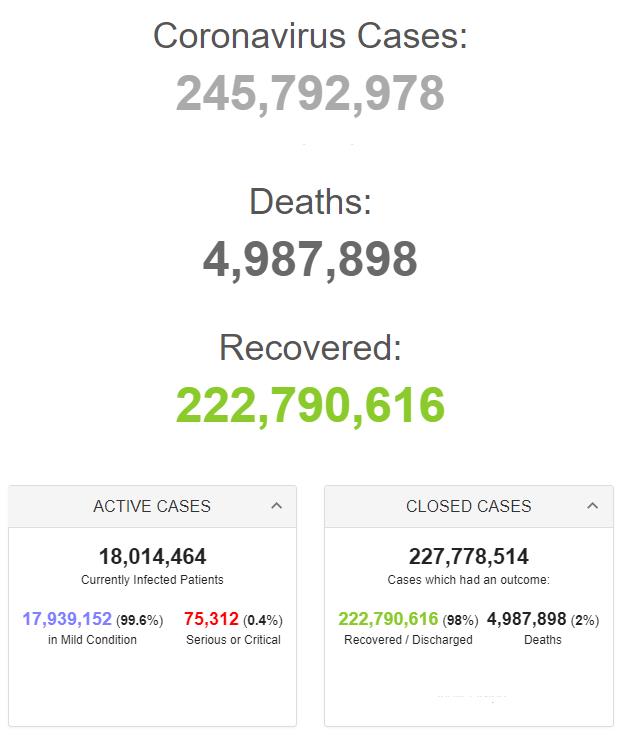

Retrieved from: https://www.worldometers.info/coronavirus/
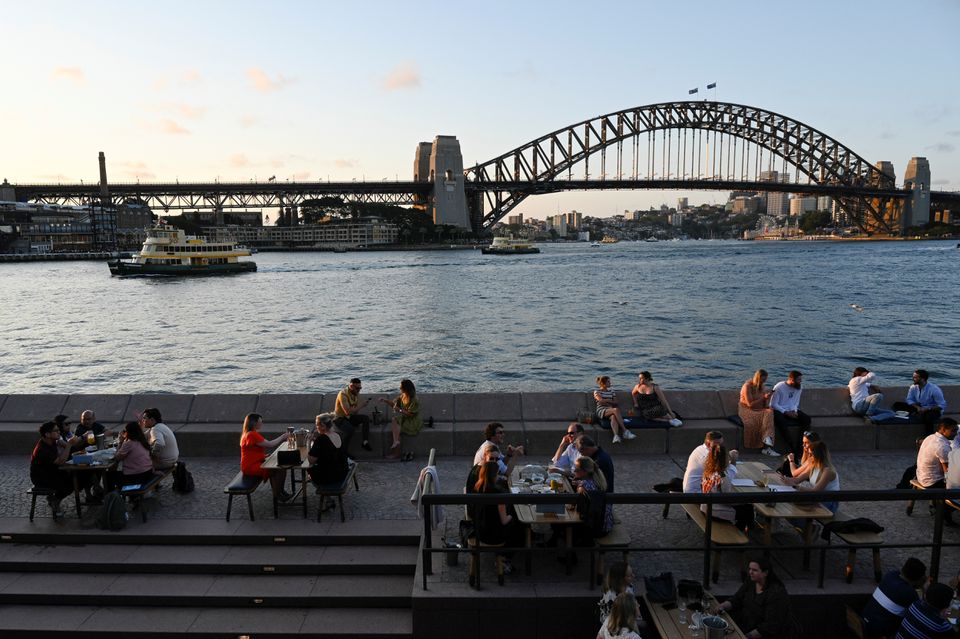
Patrons dine-in at a bar by the harbour in the wake of coronavirus disease (COVID-19) regulations easing, following an extended lockdown to curb an outbreak, in Sydney, Australia, October 22, 2021. REUTERS/Jaimi Joy
Australia on Thursday eased its COVID-related travel advice for several countries including the United States, Britain and Canada as it prepares to reopen its borders next week for the first time in over 18 months.
Australia will lift its outbound travel ban for fully vaccinated residents from Nov. 1 following a strong uptake of COVID-19 vaccines, as Sydney and Melbourne, its biggest cities, look to welcome overseas travellers without quarantine.
"The changes announced today are a vital next step in re-uniting Australian families and safely re-opening Australia to the world," Foreign Affairs Minister Marise Payne said in a statement on Thursday.
The updated country-specific travel advice will also help Australians to access travel insurance more readily, Payne said.
As Australia begins to ease COVID-19 travel curbs, Victoria on Thursday recorded its deadliest day of the Delta outbreak with 25 deaths and 1,923 cases, the biggest rise in infections in four days. Neighbouring New South Wales, home to Sydney, logged 293 new cases, down from 304 on Wednesday.
Despite the Delta wave, national coronavirus numbers are still relatively low by global standards, with about 166,000 cases and 1,694 deaths.
Australia has been gradually easing tough restrictions in Sydney and Melbourne, helped by higher vaccination levels after a third wave of infections fuelled by the highly infectious Delta variant spread rapidly across its southeast.
The relaxation in travel rules, however, is not uniform across Australia, as the country's states and territories have differing vaccination rates and health policies. read more
Under the updated travel advice framework, the 'do not travel' advisory, put in place for all destinations in March 2020, has been removed. But no destination will be set lower than 'level 2 - exercise a high degree of caution'.
Retrieved from: https://www.reuters.com/world/asia-pacific/australia-eases-covid-19-travel-advisory-ahead-border-reopening-2021-10-27/
A woman holds a small bottle labeled with a "Coronavirus COVID-19 Vaccine" sticker and a medical syringe in front of displayed Novavax logo in this illustration taken, October 30, 2020. REUTERS/Dado Ruvic
Novavax Inc (NVAX.O) said on Wednesday it had completed the real-time submission of an application for the authorization of its COVID-19 vaccine candidate in the United Kingdom.
The submission is based on data from a late-stage trial involving 15,000 volunteers in the UK, showing that the experimental vaccine was 96.4% effective against the original coronavirus strain.
The application also includes data from a 30,000-person late-stage trial in the United States and Mexico, showing that the vaccine, NVX-CoV2373, demonstrated 100% protection against moderate and severe disease and 90.4% effectiveness overall.
The United Kingdom has so far administered enough vaccine doses to have fully vaccinated about 76.1% of the country's total population, according to a Reuters tally.
However, cases have recently been on the rise and Prime Minister Boris Johnson said that the government will rely on vaccines rather than lockdowns to navigate a difficult winter. read more
Novavax in August pushed back its U.S. application timeline to the fourth quarter of this year from the third, saying the distribution of its vaccine will be initially prioritized to low-income countries, which still have an unmet need for primary vaccination doses.
Novavax said it now expects to submit the complete application seeking U.S. authorization by the end of the year.
The vaccine developer has been prioritizing regulatory submissions to low- and middle-income countries as it fell behind peers like Pfizer Inc (PFE.N), Moderna Inc (MRNA.O) and Johnson & Johnson (JNJ.N) in the race for authorization in the U.S. and Europe.
Last month, Novavax and its partner Serum Institute of India applied to the World Health Organization for an emergency use listing of Novavax's COVID-19 vaccine. read more
It has already filed for the shot's authorization in India, Indonesia and the Philippines.
Novavax said it now expects to complete additional regulatory filings in markets including Europe, Canada, Australia, New Zealand and to the World Health Organization soon.
Retrieved from: https://www.reuters.com/world/uk/novavax-files-covid-19-vaccines-uk-authorization-2021-10-27/
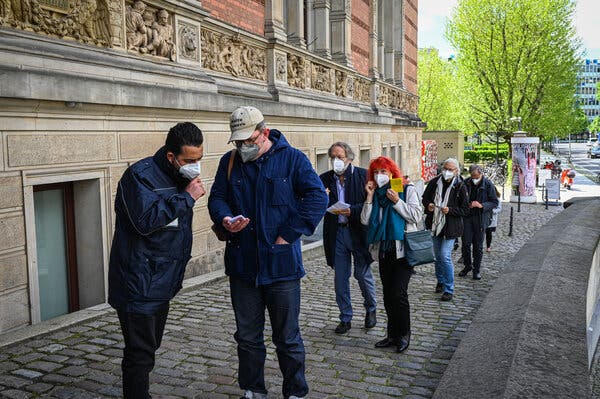
At the entrance of the Gropius Bau Museum in Berlin, visitors had to show a negative virus test or proof of vaccination to enter, in May.Credit...Lena Mucha for The New York Times
Germany’s new governing coalition plans to drop nationwide pandemic restrictions and hand responsibility back to state governments to set their own rules, which could vary from one region to another.
Representatives of the three parties that are expected to form the new federal government announced on Wednesday (not Tuesday, as an earlier version of this item said) that they intend to allow the country’s national epidemic status to lapse in late November. That status provides the legal framework for imposing national lockdowns, mask requirements and other measures.
The announcement could be considered the first public act of the new government, which is still in the complicated process of being formed by the three parties after the general election of Sept. 26. The new prime minister and cabinet are not expected to be inaugurated for several weeks yet. Officials warned that shifting responsibility to the states did not mean that restrictions would vanish.
“The 25th of November will not be a ‘Freedom Day’,” said Dirk Wiese, a deputy parliamentary group leader of the Social Democratic Party, which is expected to lead the new government, referring to a nickname used in Britain for the day nearly all virus restrictions were dropped there.
“We want to go through the fall and winter responsibly, so that by spring we have Covid-19 behind us,” Mr. Wiese said.
The other two parties working to form the new government are the Greens and the Free Democrats. All three gained seats in parliament in the election, while the party that led the outgoing coalition government, the Christian Democrats, lost ground.
The outgoing government remains in office in a caretaker role while the new one is formed. The departing health minister, Jens Spahn, a Christian Democrat, has said he too believed the national epidemic status should be allowed to lapse.
New coronavirus cases have risen by 80 percent over the past two weeks, according to a New York Times database, even though at least two-thirds of the population is fully vaccinated. The three coalition parties said on Wednesday that they would set up a federal panel to work on increasing the vaccination rate.
“We are of the common opinion that we are far from where we could and should be as far as vaccination is concerned,” said Katrin Göring-Eckardt, the parliamentary group leader for the Green party.
Retrieved from: https://www.nytimes.com/live/2021/10/27/world/covid-vaccine-boosters/new-german-leadership-says-it-will-let-federal-coronavirus-controls-lapse
By John Yoon, Raphael Minder and Cora Engelbrecht
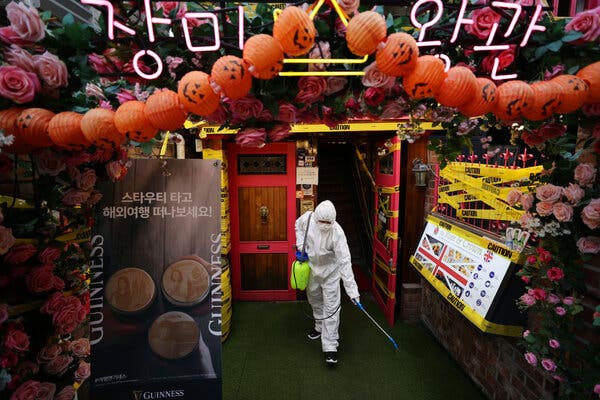
Spraying disinfectant in Itaewon, a popular nightlife district in Seoul, last year ahead of Halloween.Credit...Yonhap/EPA, via Shutterstock
South Korea warned residents that it would strictly enforce Covid restrictions during Halloween, as the government remains wary of large outbreaks that might threaten its reopening plans next month.
Local authorities have raised alarms that parties leading up to Oct. 31 pose a potential risk as South Korea prepares to ease Covid restrictions the next day. Halloween is not widely celebrated in South Korea, but it is becoming more popular, especially in the capital, Seoul.
“We are concerned, especially ahead of Halloween this weekend, that there might be many violations of social distancing rules,” the minister of health, Kwon Deok-cheol, said on Wednesday, urging people to comply with the restrictions that remain in place.
The country still has a mask mandate, limits the size of social gatherings and requires restaurants and bars to close at 10 p.m. in Seoul.
To mitigate the risk of an outbreak, which might jeopardize South Korea’s reopening, health officials said on Friday that they would intensively check businesses’ and customers’ compliance with Covid rules for seven days starting Wednesday from 8 p.m. to midnight. The inspectors will focus on areas including Itaewon, Hongdae and Gangnam Station in Seoul, and parts of Incheon and Busan, where there are many young people and foreigners who are expected to celebrate.
Partygoers may let their guard down knowing that the restrictions are set to expire on Nov. 1, said Robert Joe, 43, who lives in Itaewon.
“Everyone knows everything is going to be lifted more or less,” he said. “The sense of urgency, I think, has probably lessened.”
Foreigners caught violating rules, the health officials said on Friday, may be subjected to deportation, and businesses violating rules may be prosecuted, suspended or fined.
South Korea’s approach to the Halloween festivities contrasts that of the United States, where many health departments have only recommended that people take precautions, like getting vaccinated and wearing masks, instead of threatening penalties. In Massachusetts, the towns of Lexington and Belmont will offer free Covid tests after Halloween.
Halloween festivities will continue with lifted restrictions in other places, too. Northern Ireland will lift restrictions on indoor dancing and permit nightclubs to reopen on Oct. 31, and trick-or-treating will be allowed in Australia’s capital, Canberra.
Here’s what else is happening around the world:
In Sweden, health officials announced that health care workers, nursing staff and people over 65 will be eligible for a booster. The extra shots will eventually be extended to 1.5 million Swedes, according to the minister of health and social affairs, Lena Hallengren.
Denmark is also offering a booster to medical workers, older people and people who are at high risk of contracting the coronavirus. Norway, which is experiencing a rise in cases, is urging those over 65 to get a booster at least six months after receiving their second shot.
Spain’s Constitutional Court on Wednesday struck down the government’s second state of emergency, which was introduced in late 2020. The decision opens the door to thousands more reimbursement claims from people who were fined for violating Covid-19 lockdown rules.
The ruling is in line with a decision from July, when the same court also declared unconstitutional the first state of emergency. That one was introduced in March of 2020, when Spain was initially hit by the pandemic.
Spain’s second state of emergency lasted about six months, from November 2020 to May of this year. The court ruled on Wednesday that Spain’s left-wing government overstepped its constitutional powers, in particular by limiting parliamentary oversight over the lockdown rules. The ruling followed a complaint filed by Spain’s far-right opposition party, Vox.
Retrieved from: https://www.nytimes.com/live/2021/10/27/world/covid-vaccine-boosters/south-korea-covid-halloween
By Daniel Politi
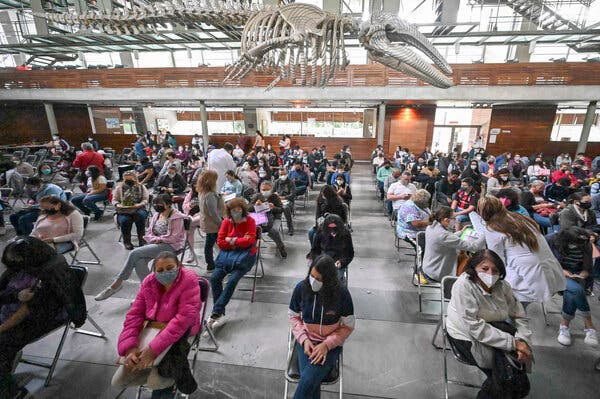
Under the watchful eye of a library dinosaur, minors and their families wait out their observation period after receiving the first dose of the Pfizer-BioNtech vaccine Monday in Mexico City.Credit...Alfredo Estrella/Agence France-Presse — Getty Images
The pace of vaccinations is picking up in much of Latin America and the Caribbean, but disparities in access to vaccine supplies persist, the Pan American Health Organization reported on Wednesday.
Overall, 44 percent of people in Latin America and the Caribbean have been fully immunized against Covid-19, a figure that has doubled since August, the organization said, but the rates vary from country to country.
For example, five nations — Guatemala, Saint Vincent and the Grenadines, Jamaica, Nicaragua and Haiti — have vaccination levels below 20 percent.
“We have reason to be optimistic, but we must remain vigilant,” said Dr. Jarbas Barbosa, the assistant director of the agency, which is part of the World Health Organization.
More than three million doses of vaccine are expected to arrive in the region through the global Covax distribution program this week, and “deliveries are expected to pick up in these final months of the year,” he said, “so we can continue to address one of the biggest challenges affecting our region: vaccine inequity.”
Though many countries in the region are starting to administer booster shots and vaccinate children, P.A.H.O. said that health officials should focus first on getting the vaccine to older adults, the group most at risk of dying from Covid-19.
“We still have a long road ahead to protect the most vulnerable,” Dr. Barbosa said.
By Maria Varenikova
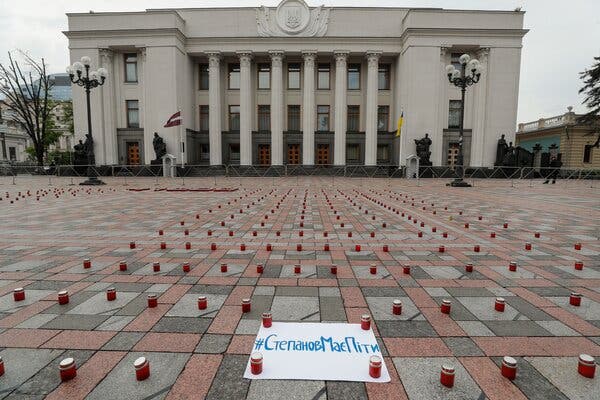
A memorial to the Ukrainian victims of Covid-19 in front of the Parliament building in Kyiv in May, part of a protest against the government’s handling of the pandemic.Credit...Sergey Dolzhenko/EPA, via Shutterstock
VINNYTSIA, Ukraine — An experiment in Ukraine that pursued an aggressive campaign to vaccinate most inhabitants of one small town has yielded the expected results: very low infection rates and no hospitalizations for Covid-19.
In April, when Ukraine was still short on vaccines, only certain categories of the population, like teachers and doctors, were allowed to get vaccinations. But the Health Ministry made an exception for the town of Morshyn, in western Ukraine, allowing local health authorities to attempt to vaccinate all 6,000 residents.
Morshyn was chosen partly because its economy, which depends on tourism to resorts and spas, had essentially shut down because of the pandemic, and because it was thought people would be receptive to vaccination so they could resume working.
The plan was to give 70 percent of the town a first dose of vaccine in one month. But despite the economic incentive, distrust in vaccines was an obstacle. Nationwide, 56 percent of Ukrainians still say they will not be vaccinated.
Morshyn’s authorities went on the offensive.
“We realized that we need to call each person individually,” Dr. Henadiy Yukshynsky, the town’s chief doctor, said in an interview with local media. “We created five special teams that called people and explained to everyone the need for vaccination.”
The local authorities posted billboards, set up tents with information tables inside, made videos for social networks and the news media, and created handouts advocating vaccination.
In the end, it took two months to vaccinate 72 percent of the town’s residents, far more than Ukraine’s nationwide rate of 16 percent, which is the lowest in Europe.
Across the country, infections and hospitalizations are soaring, with an average of 21,364 new cases a day over the past week. The death rate in Ukraine is higher now than during the first wave of Covid-19, with an average of 538 deaths per day. Panic is beginning to take hold, and more areas of the country have been designated “red zones” and placed under partial lockdown.
But life in Morshyn goes on as usual. It has no patients hospitalized with Covid-19 and only 19 cases of the virus, 15 of them in people who were not vaccinated.
Retrieved from: https://www.nytimes.com/live/2021/10/27/world/covid-vaccine-boosters/ukraine-covid-vaccination-campaign
New Zealand’s South Island has recorded its first Covid cases in a major city in over a year, with two cases detected in Christchurch, as the government announced it will begin relaxing its strict international border settings.
Covid-19 response minister Chris Hipkins said at this stage there would be no snap lockdown for the city, the largest in the South Island, despite the fact one of the cases may have been infectious in the community for almost two weeks.
“This is a good reminder to people around the country that cases can pop up and this highlights the importance to get vaccinated,” Hipkins said.
Both of Thursday’s new cases were members of the same household, and one had recently returned from Auckland.
New Zealand announced 89 new cases of Covid-19 on Thursday, including the two in Christchurch. According to the Ministry of Health, 89% of eligible adults in Canterbury, of which Christchurch is the main city, had had at least one dose of the vaccine, and 67% had had both doses. The region would require almost 111,000 people to get both doses before hitting the 90% target set by the government, where most restrictions can be lifted. Across the country, 85% of the eligible population (those aged 12 and over) have had at least one dose of the vaccine, or 72% of the full population; 70% of the eligible population have had both doses, or 60% of the full population.
Epidemiologist and public health prof Michael Baker said there needed to be stronger protections at the boundaries of the North and South Islands. “We may be seeding the whole South Island with cases right at the moment, because we’ve got increasing transmission in Auckland, and still people flying from Auckland all around the country – and we’ve got limited controls on that,” he said. Baker called for pre-departure testing, and for vaccine requirements on domestic flights.
Dr Apisalome Talemaitoga, chair of the Pasifika GP network, said via the Science Media Centre, “I just find it unbelievable that we are allowing unvaccinated people out of Auckland to travel – for whatever reason. People should be doubly vaccinated before they can do this.”
With the region still weeks away from 90% vaccination, Baker said there were “huge health and economic reasons for delaying widespread transmission in the South Island as long as possible”. Otherwise, he said, the region could end up facing restrictions or possible lockdowns until Christmas.
Hipkins said that the two infected people were co-operating with authorities but had not been scanning in using New Zealand’s location tracing app – a detail which may make contact tracing more difficult. Both are unvaccinated.
Giving a later update, the minister said that quarantine requirements for international arrivals would be eased next month.
“As vaccination rates have increased internationally, the number of Covid cases being picked up through our MIQ [managed isolation and quarantine] facilities has continued to decline. We now only get 2-3 cases per 1,000 arrivals and only around 1 in 2,000 is detected after seven days of isolation,” Hipkins said.
From 14 November, MIQ stays will be reduced from 14 days to seven, with travellers being tested on days zero, three and six. They will then isolate at home for short periods of around three days, and be tested again on day nine.
This will likely free up about 1,500 rooms a month in MIQ, Hipkins said. Some of this will be taken up by community cases but some will go into the booking system for travellers from overseas.
On 8 November, travellers from low-risk countries, starting with some Pacific islands, will be allowed to bypass MIQ altogether. Travellers will need to be fully vaccinated, unless they are New Zealand citizens.
In the first quarter of 2022, increasing numbers of fully vaccinated international travellers will be able to skip quarantine and self-isolate. This step in the new MIQ regime will be dependent upon the country transitioning to its new traffic light system.
Hipkins said: “My message to all New Zealanders, whether they’re here or abroad is a very, very simple one. Get vaccinated. Then we can all get back to doing the things that we love and to seeing the people that we love.”
But New Zealanders stranded overseas and desperate to get home are feeling dissatisfied with the announcement.
Rikki Sands, a New Zealand citizen based in Brisbane, has entered the MIQ lottery 4 times without success. Sands, who is a specialised mechanical and hydraulic engineer, his wife and two daughters have been planning to come home since the beginning of the year.
“I’ve got more chance of winning lotto than an MIQ spot at the moment,” Sands said.
He said the freeing up of 1,500 more MIQ spots was negligible, and did not give him any confidence he would get home sooner.
And he believes the justifications are unfair. “They said that the reason they can’t open the borders is because the local people aren’t getting vaccinated. But some of the ones that are coming in internationally are all going to be double vaccinated.
“Our family is all double-vaxxed and coming from Brisbane, Australia, which is a very low risk area, and we will be getting whatever tests are required before we fly. We just want to get home to our whānau [family].”
Retrieved from: https://www.theguardian.com/world/2021/oct/28/new-zealands-south-island-records-first-covid-cases-in-major-city-in-over-a-year
Here’s a round-up of the day’s leading Covid stories:
· Thousands of AstraZeneca Covid vaccine doses are going to waste in Australia despite near-record production and calls for increased donations to lower-income neighbouring countries. Almost 1,000 Covid vaccination providers are destroying expired AstraZeneca supplies, wasting 31,833 doses, data shows. About7m doses of AstraZeneca remain unused.
· Bangkok, Paris and London were the three most visited most visited international destinations in the year before the pandemic hit, according to a recent report.
· Israel will welcome vaccinated tourists from 1 November.
· Australia destroys thousands of expired AstraZeneca Covid vaccine doses despite near-record production. A total of 31,833 doses were reported to have been binned despite Australian production of the vaccine continuing at near-record rates.
· Australia confirms Covid booster shots will be available from 8 November after Atagi approval.
· The CDC says the seven day average of Covid cases in the U.S is down 16% to 765,900 per day.
· The UK recorded 43,941 new Covid-19 cases on Wednesday and 207 more people have died within 28 days of a positive test, official figures show.
· Europe was the only region in the world to report an increase in both Covid-19 cases and deaths this week, according to the WHO’s latest epidemiological update.
· Covid-19 infections continue to surge across Eastern Europe in particular, with reported cases rising in Bulgaria, Poland, Hungary and the Czech Republic.
· Novavax Inc. has filed for authorisation of its Covid-19 vaccine candidate in the UK.
· A landmark licensing deal between Merck and the UN-backed Medicines Patent Pool could expand access to the company’s antiviral Covid-19 pill throughout the developing world.
· New Zealand’s South Island records first Covid cases in major city in over a year.




 Medicine