

 i_need_contribute
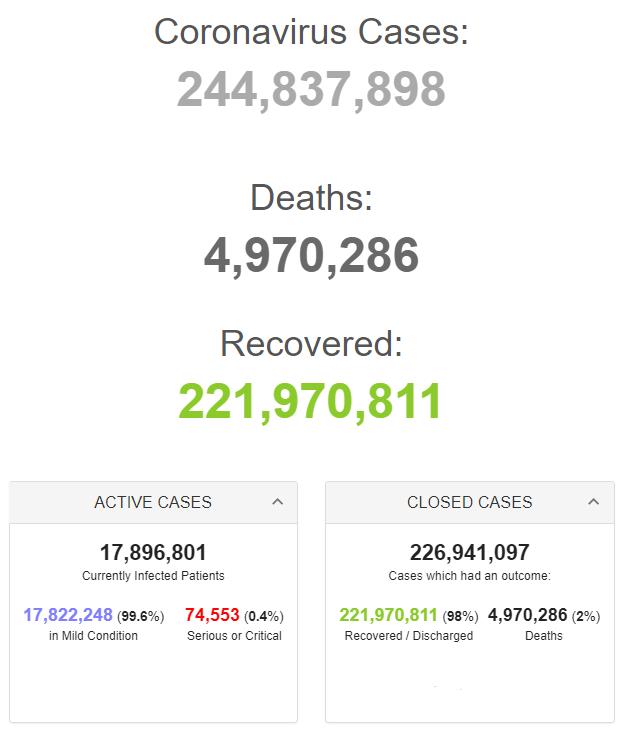

Retrieved from: https://www.worldometers.info/coronavirus/
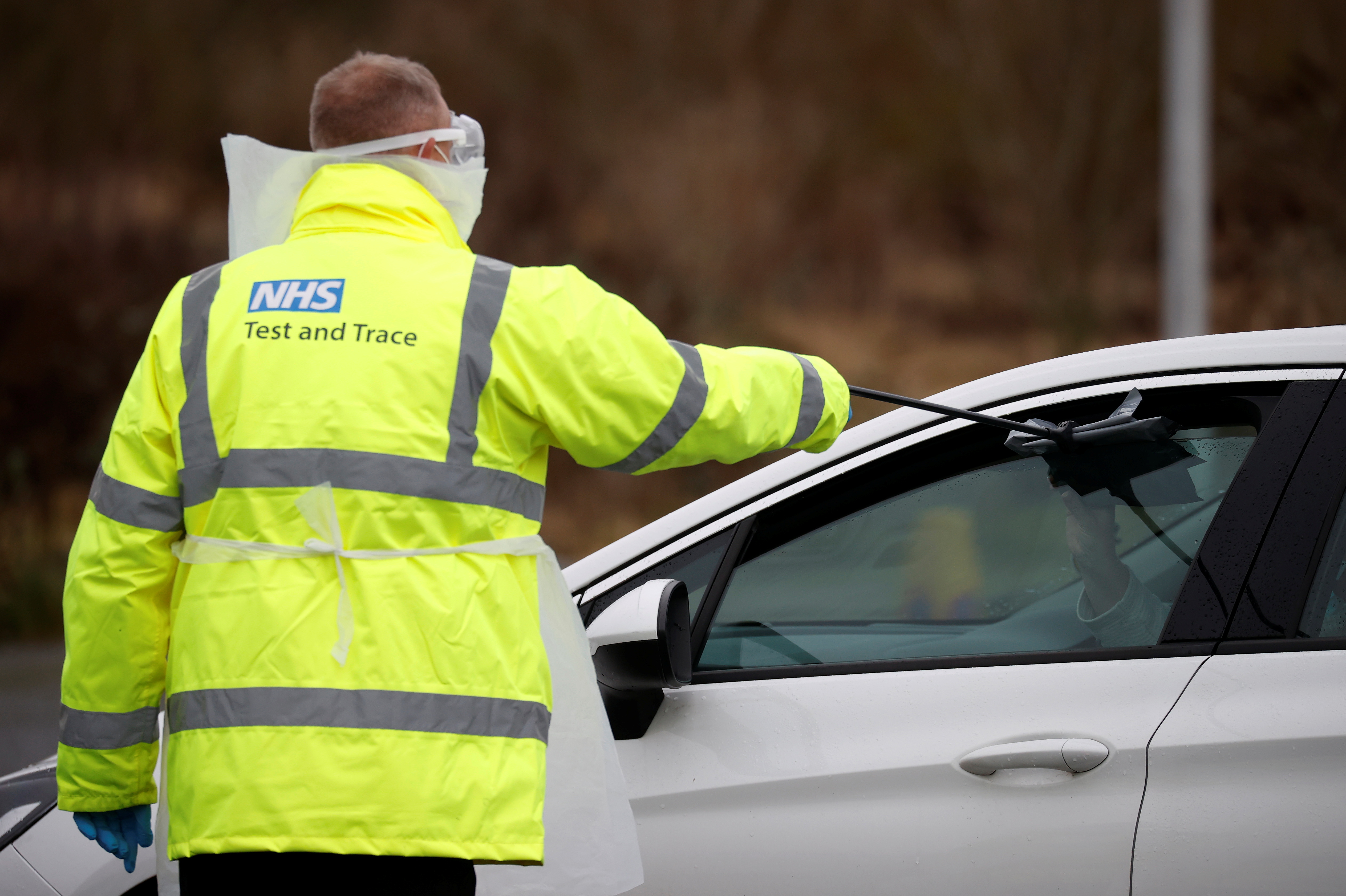
A member of NHS Test and Trace staff gives people a testing kit as they arrive at a mobile testing centre amid the outbreak of the coronavirus disease (COVID-19) in Southport, Britain, February 3, 2021. REUTERS/Phil Noble
Britain is likely to require staff in the National Health Service to be fully vaccinated against COVID-19, Health Secretary Sajid Javid said on Monday.
He told Sky News that mandatory vaccines for health workers would help to protect patients, and that he was not deterred by the fact there is already a staff shortage in the health system.
"We are considering it," he told Sky News. "We're yet to make a final decision but I am leaning towards doing it."
Retrieved from: https://www.reuters.com/world/uk/uk-likely-force-nhs-staff-have-covid-shots-javid-says-2021-10-25/
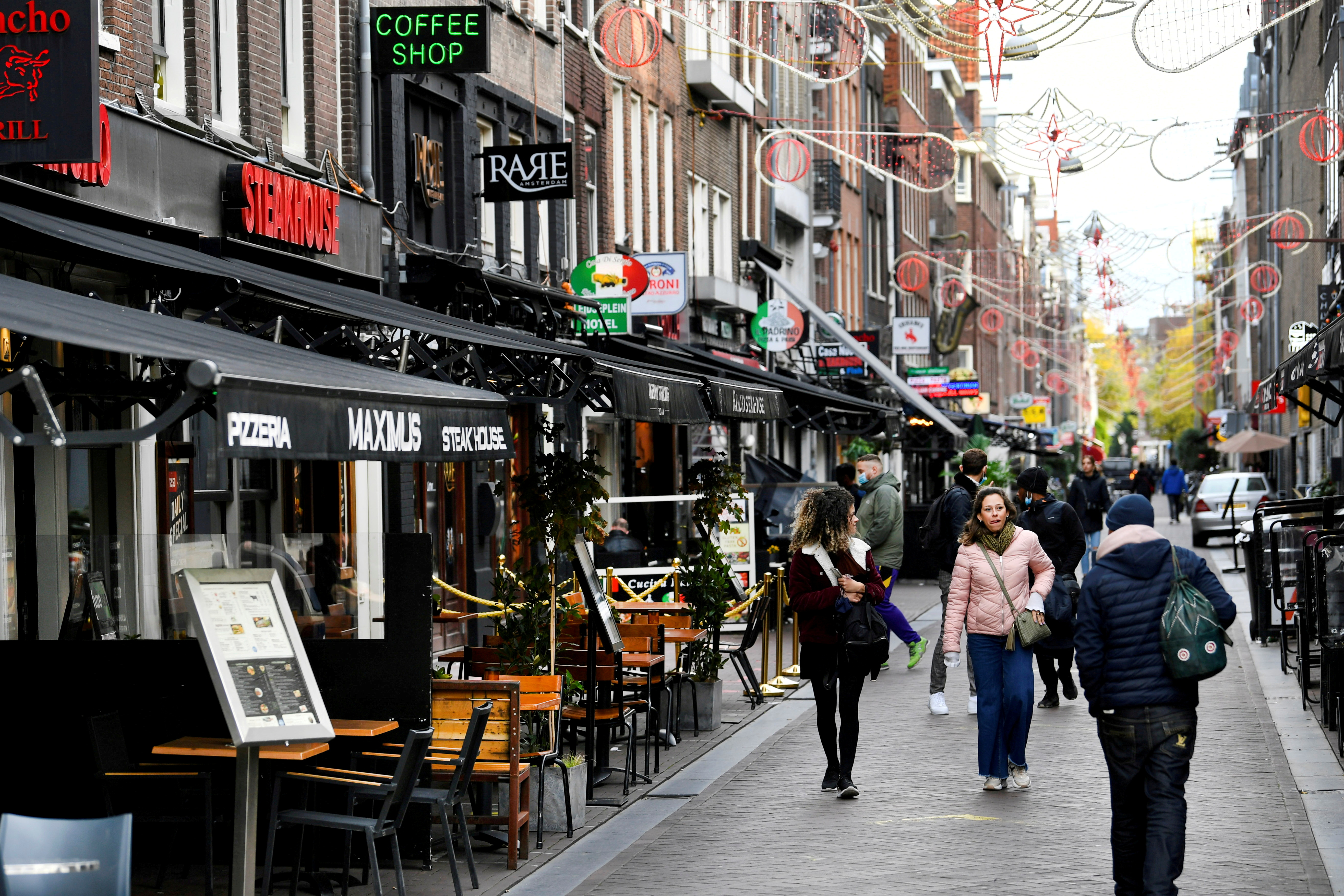
People walk past restaurants and bars in Amsterdam, Netherlands October 14 2020. REUTERS/Piroschka van de Wouw/File Photo
The Dutch government may impose new coronavirus restrictions to reduce pressure on hospitals struggling to deal with a swelling number of COVID-19 patients, Health Minister Hugo de Jonge said on Monday.
Coronavirus infections in the Netherlands have been rising for a month and reached their highest level since July in recent days, after most social distancing measures were dropped in late September.
The new wave of infections has driven up the number of COVID-19 patients in hospitals faster than predicted this month, De Jonge said, and many hospitals are already cutting back regular care again to deal with coronavirus cases.
The government has asked its group of health experts to advise on possible new measures and will decide on its policy on Nov. 2, De Jonge said, without specifying the options.
"It's not easy to find new measures that work, as it's mainly unvaccinated people who need care, who have the highest risk of getting infected and of infecting others," De Jonge said.
The Dutch government eased most COVID-19 restrictions on Sept. 25 and introduced a "corona pass" showing proof of vaccination or a recent negative test as a requirement for visitors to bars, restaurants, clubs or cultural events. read more
Since then, infections in the country of 17.5 million have increased and they jumped 75% relative to a week before on Sunday to 6,350. The number of COVID-19 related deaths reported over the weekend more than doubled to 25.
Four out of five COVID-19 patients on Dutch intensive care wards have not been vaccinated, the National Institute for Public Health said last week.
According to government data, 84.5% of the Dutch adult population has been fully vaccinated.
Retrieved from: https://www.reuters.com/world/europe/dutch-consider-new-coronavirus-curbs-infections-soar-2021-10-25/
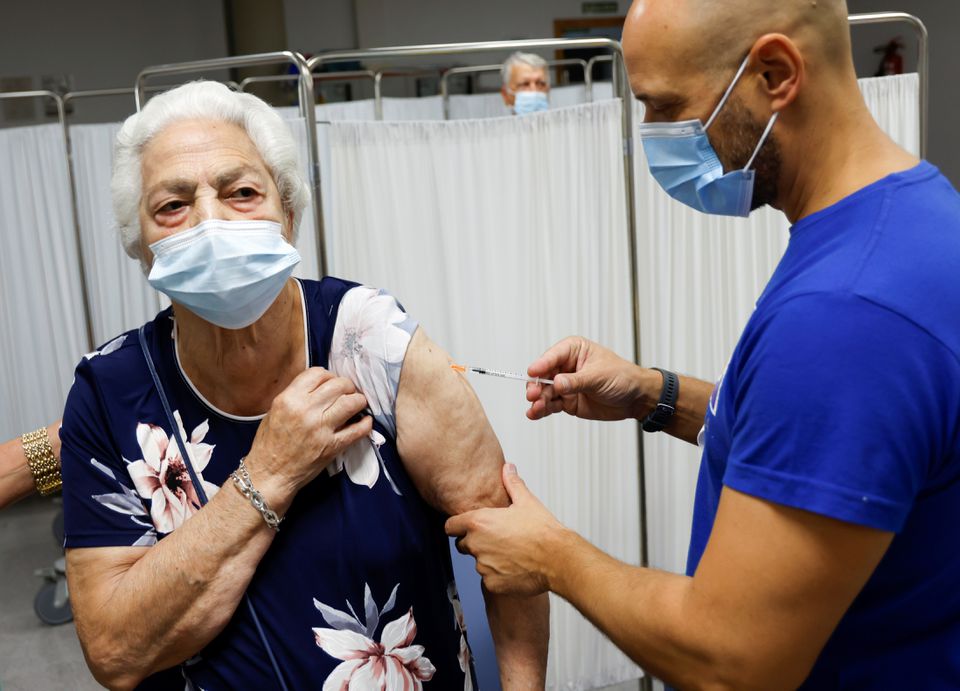
An elderly woman receives a coronavirus disease (COVID-19) vaccine booster coinciding with the flu vaccination campaign in Seville, Spain October 18, 2021. REUTERS/Marcelo del Pozo
Spain on Monday reached the grim milestone of 5 million COVID-19 cases during the pandemic, as it reported 4,485 new infections and 54 deaths since Friday.
The total number of people who have now tested positive for COVID-19 is 5,002,217 according to Health Ministry data.
More than three quarters of the Spanish population has now been fully vaccinated against COVID-19 and most restrictions on socialising have recently been dropped, although masks remain mandatory in enclosed spaces.
On Monday, the incidence rata over the past two weeks rose by two points to 46.3, edging back up after bottoming out earlier this month.
Spain has registered 87,186 deaths since the start of the pandemic.
https://www.reuters.com/world/europe/number-covid-19-infections-spain-hits-5-million-2021-10-25/
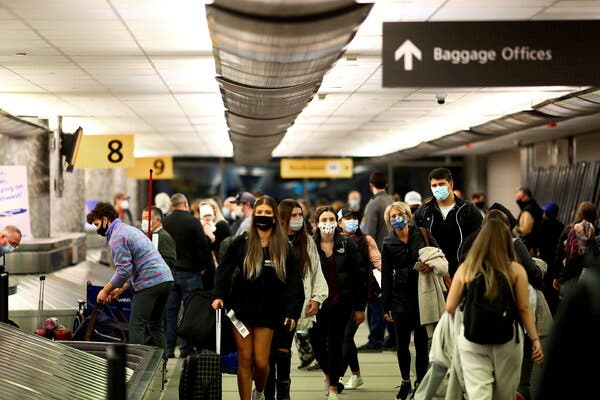
At the airport in Denver last year.Credit...Kevin Mohatt/Reuters
Children under the age of 18 who are unvaccinated against the coronavirus, and a limited category of foreigners arriving from countries with low vaccination rates, are among the travelers exempted from forthcoming requirements that will determine who can enter the United States, Biden administration officials said on Monday.
The Biden administration has announced that it would lift travel restrictions on Nov. 8 and reopen the United States to fully vaccinated international travelers who had been barred for nearly a year and a half from entering the country by air or crossing the land borders.
But the new travel system also comes with stringent requirements, and will seal the United States off from most foreigners who have not yet received a vaccine cleared by the World Health Organization or U.S. federal regulators. On Monday, senior officials detailed opportunities to enter the United States for certain travelers who struggled to obtain a vaccine because of a lack of uniform vaccine eligibility for minors, as well as limited access to the global supply.
Unvaccinated children under the age of 18 will be permitted to enter the United States when the new system takes effect, officials said, confirming an earlier report from The New York Times.Children older than 2 who are traveling with a fully vaccinated adult will need to show a negative coronavirus test within three days of their departure date. Those traveling alone or with an unvaccinated adult will need to show such a result one day before they travel to the United States.
The exemptions will also apply to adults flying from countries where less than 10 percent of the overall population is fully vaccinated, if they can show a “compelling reason” for entering the United States, officials said. That carve-out, they said, would apply to a narrow group of unvaccinated travelers; entering the United States for tourism would not clear the bar for an exemption.
Others who show a U.S. government-issued letter approving an emergency or humanitarian need to travel will also be allowed to cross U.S. borders.
Many leaders in the tourism industry have praised the new rules, which will signal a new chapter in the U.S. recovery from the pandemic. The restrictions imposed in the early days of the pandemic have barred tourists and separated family members from traveling to the United States for nearly 18 months.
But on Nov. 8, the country will open to those who can show that two weeks have passed since they received either a second shot of the two-dose vaccines cleared by U.S. federal regulators or the W.H.O. (in any combination), or a single shot of a one-dose vaccine greenlit by those organizations, like the one from Johnson & Johnson. Digital or print proof of vaccination status will be required.
In addition, fully vaccinated American citizens or legal permanent residents arriving by sea or air will need to show proof of a negative coronavirus test taken within three days of traveling. Those who are unvaccinated will need to test negative within one day of traveling. Those crossing the land border from Canada or Mexico will not have a testing requirement.
Travelers will also be required to provide their personal information for potential contact tracing after arriving in the United States.
Retrieved from: https://www.nytimes.com/2021/10/25/us/politics/vaccine-mandate-travel-us.html
By Jin Yu Young
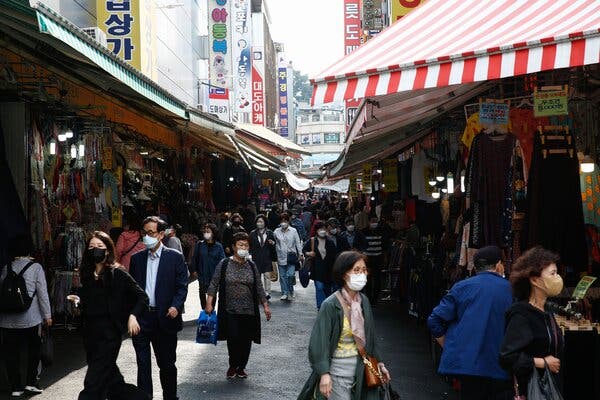
Shoppers wearing face masks at a market in Seoul this month.Credit...Jeon Heon-Kyun/EPA, via Shutterstock
President Moon Jae-in of South Korea announced on Monday that the country had achieved its goal of fully vaccinating 70 percent of its population of about 52 million and would be implementing a phased recovery plan next month.
While Seoul, the capital, has been under the strictest level of social-distancing regulations since the summer, limiting social gatherings to a maximum of two at one point and barring customers from sitting in cafes, regulations were eased starting last week. Last week, South Korea also added five countries to the list of those whose vaccinated tourists will be eligible for quarantine exemptions.
Under the phased recovery plan that starts next Monday, restrictions will loosen further, including allowing gatherings of up to 10 people, lifting restrictions on business operating hours, allowing spectators at some sporting events and allowing the use of showers at fitness centers. The new regulations will be observed for a four-week period, followed by a two-week evaluation term.
While South Korea’s vaccination program had a slow start compared to those in the United States and several countries in Europe and Asia, it quickly picked up its distribution to surpass the United States. The country was a week early in reaching its immunization quota on Saturday.
On Monday, South Korea’s government also said it would donate one million AstraZeneca Covid shots to Iran, in recognition of the 60-year friendship between the two countries. Earlier this month, South Korea donated over a million doses of the AstraZeneca vaccine to Vietnam and Thailand.
On Monday, South Korea reported 1,190 daily new cases. According to a database by Our World in Data, the country has seen a 35 percent decrease in cases over the past two weeks. The country has faced four waves of the pandemic since February, with its latest spike starting in July and still ongoing, the worst in terms of case count.
The government also announced a $519 billion budget for 2022 to help recover the pandemic-induced economic fallout. The proposed budget for next year is 8.3 percent higher than this year’s.
“We will do our best to recover both financially and in our daily lives,” Mr. Moon said at the National Assembly.
Retrieved from: https://www.nytimes.com/live/2021/10/25/world/covid-vaccine-boosters/south-korea-covid-restrictions
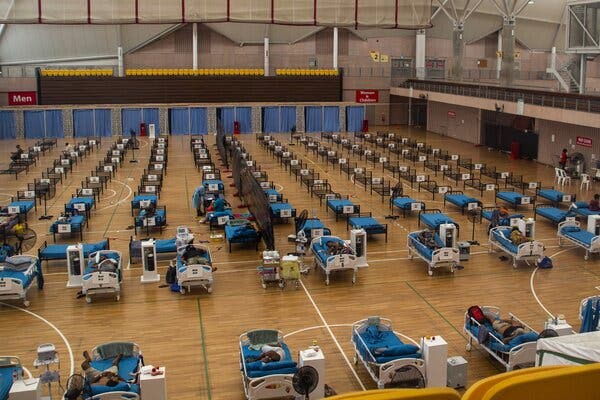
A temporary Covid hospital in Port Moresby, Papua New Guinea’s capital, this month.Credit...Andrew Kutan/Agence France-Presse — Getty Images
Papua New Guinea is facing its highest daily number of new Covid-19 cases since the pandemic began, and the surge threatens to overwhelm the country’s rudimentary health system, the Red Cross said on Monday. Data from global health organizations suggest that the crisis may be far deeper than the story told by official figures.
Since March 2020, the country has reported 27,627 confirmed cases of the coronavirus and 335 deaths. Figures from the World Health Organization indicate that the true number of infections may be more than twice that, according to an Agence France-Presse report.
At least 2.6 million people, or more than a quarter of the population of nine million, have visited clinics with symptoms consistent with flu or pneumonia since the pandemic began.
Papua New Guinea’s health services are poorly equipped to deal with a major outbreak. The country has only 500 doctors and fewer than 4,000 nurses, according to Human Rights Watch. With most of the population living outside of urban centers, access to health care is limited.
“Hospitals are full, and patients are being turned away in Port Moresby and provincial areas,” said Uvenama Rova, the top Red Cross official in Papua New Guinea, in a statement. “We are deeply concerned that the risks of hospitalization and death from Covid-19 are skyrocketing due to limited health infrastructure, high rates of illness, all compounded by poor access to safe water, hygiene and sanitation facilities.”
As of Sunday, just 207,207 people in the country had been vaccinated, because of problems with the rollout and a lack of supplies. Intense misinformation and vaccine hesitancy have affected even the country’s health staff: One survey of 130 people working in an emergency department in Port Moresby, the capital, showed 24 percent would refuse a vaccine and 37 percent were unsure, according to A.F.P.
An exclusive story from Reuters today reports an arrangement struck between the African Union (AU) and the White House to secure up to 110 million Covid-19 vaccine doses.
The AU is set to buy the vaccine from manufacturer and vaccine developer Moderna Inc. The White House will defer delivery of 33 million doses intended for the United States to facilitate the deal, officials told the news agency.
The AU’s doses will be delivered over the coming months, with 15 million arriving before the end of 2021, 35 million in the first quarter of next year and up to 60 million in the second quarter.
“This is important as it allows us to increase the number of vaccines available immediately,” the AU coronavirus envoy, Strive Masiyiwa, said. “We urge other vaccine producing countries to follow the lead of the (US government) and give us similar access to buy this and other vaccines.”
Masiyiwa said the Moderna purchase represented the first time the 55-member AU had secured vaccines that were not fully produced in Africa.
The new shipments of vaccine are well below what Africa needs to vaccinate its 1.3 billion people, who have had far less access to the life-saving vaccines than more prosperous parts of the world. Getting access to Moderna vaccines adds diversity to the AU’s vaccine supply with different storage requirements.
“We are grateful to have helped negotiate this encouraging step forward between Moderna and the African Union that will significantly expand access to vaccines on the continent in the near-term,” said Natalie Quillian, the White House’s deputy coordinator for Covid-19 response.
By Vivian Wang
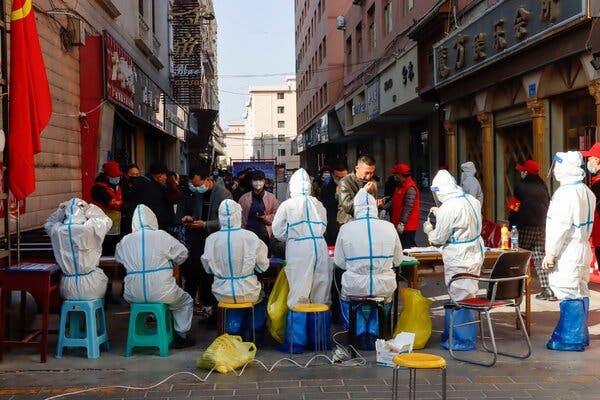
Coronavirus testing in Gansu, China, on Saturday.Credit...Agence France-Presse — Getty Images
Australia, home to the world’s longest lockdown, is scrapping quarantine requirements for vaccinated residents returning from overseas. New Zealand, famed for its commitment to a “Zero Covid” strategy, abandoned it this month. Around the world, people are vacationing, visiting family and resuming business trips across international borders.
Not China.
The country where the coronavirus pandemic began is also the only one in the world still trying to completely eradicate the virus within its borders. Officials have repeatedly dismissed the idea of living with the virus, citing China’s large population and their success in containment so far — even as the country has continued to record sporadic outbreaks, triggering mass testing and strict lockdowns.
“Every locality should firmly adhere to the policy of ‘Defend externally against importation, defend internally against rebound,’” Mi Feng, a spokesman for the National Health Commission, said at a news conference on Sunday. “The current control measures cannot be relaxed.”
China has continued to record local cases — around 130 in recent days, after a spate of cases linked to domestic tourists. Parts of Beijing, Inner Mongolia and Gansu Province are under lockdown. Schools and businesses in those areas of Beijing are closed, and organizers of the Beijing Marathon, which had been planned for this weekend, announced on Sunday that it would be indefinitely postponed.
China’s tough stance on loosening Covid restrictions is possible in part because of China’s huge domestic consumer base, which has helped to keep retail spending afloat, and because of the ruling Communist Party’s tight grip on power. The authorities can implement lockdowns and mandate multiple rounds of testing with astonishing efficiency.
In addition, many Chinese are satisfied with the government’s approach. Domestic travel has surged in areas with no cases, and the country’s low death rate — it has officially recorded fewer than 5,000 deaths — has become a source of nationalistic pride, especially at a time when China’s relations with many other countries are growing increasingly fraught.
Xi Jinping, China’s leader, has repeatedly pointed to China’s success in containment as proof of the superiority of its governance model. When Zhang Wenhong, a prominent virologist, suggested this summer that China learn to live with the virus, he was attacked viciously online as a lackey of foreigners.
There is a clear incentive for China to remain closed off, at least in the short term: With Beijing set to host the Winter Olympics in February, officials have acknowledged that they are under pressure to keep cases under control.
Still, the question of sustainability looms. China’s economic growth is slowing. The country’s diplomatic efforts may also suffer from its long isolation; Mr. Xi has not left China or received foreign visitors since early 2020, even as other world leaders prepare to gather in Rome for a Group of 20 summit and in Glasgow for climate talks.
Some officials have started to tentatively broach the idea of loosening restrictions, though without any timelines or firm commitments. Zhong Nanshan, one of the country’s most prominent doctors, told a Chinese magazine this month that China could begin opening up when vaccination rates had exceeded 85 percent, a goal that could potentially be reached this year.
But, he added, there was another caveat: Other countries would also need to get cases under control.
Retrieved from: https://www.nytimes.com/live/2021/10/25/world/covid-vaccine-boosters/as-the-rest-of-the-world-abandons-zero-covid-china-holds-out
Here’s a round-up of the day’s leading Covid stories:
· European Medical Agency approves Moderna booster. The medical body approved doses for all adults, saying the Spikevax booster can be given out and administered, after it gave the green light to the Pfizer/BioNTech’s Comirnaty jab earlier in October.
· US introduces new guidelines on non-US citizens’ entry into the country and testing for travellers. Foreign nationals will have to be fully vaccinated before entering the country, with some exemptions in place for under-18s. Those coming from countries with low vaccination rates will have to justify their visit.
· UK reports 38 people had died within 28 days of testing positive for Covid as of Monday, bringing the UK total to 139,571.
· Moderna moves towards expanding shots to children, saying a low dose of its Covid vaccine is safe and appears to work in six- to 11-year-olds.
· Children as young as three will start receiving Covid vaccines in China, where 76% of the population has been fully vaccinated. It comes as authorities continue to maintain a zero-tolerance policy towards outbreaks.
· Worst of US pandemic likely behind us but we can’t drop our guard, experts say. The number of new Covid cases and deaths in the US has been in a steady decline since early September but experts also caution that it’s not yet safe to abandon safeguards against the virus. That’s because parts of the US population and much of the world remain unvaccinated, which could allow for outbreaks and dangerous new variants of the virus to emerge.
· People in Tokyo can eat and drink in bars and restaurants later in the evening from today as Japan eases social distancing rules.
· Russia reports 37,930 new Covid-19 infections in the last 24 hours, its highest single-day case tally since the start of the pandemic.
· Spain reached the grim milestone of 5 million COVID-19 cases during the pandemic.
· Mexico reports more than 1,000 new Covid-19 cases, health ministry says.
· Facebook deleted a video of Brazilian president Jair Bolsonaro in which he warned of a link between Covid-19 vaccines and Aids.




 Medicine