

 i_need_contribute
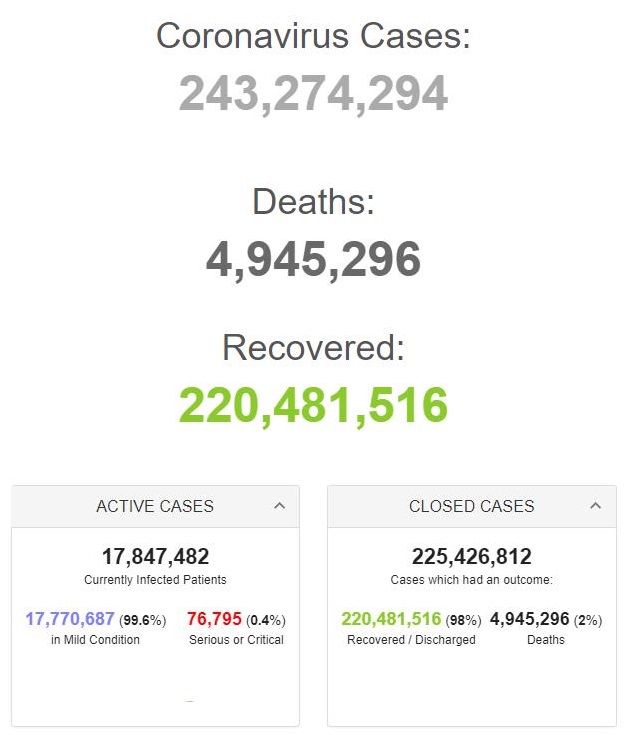
| Country, | Total | New | Total |
| Other | Cases | Cases | Deaths |
| World | 243,244,871 | 461,644 | 4,944,769 |
| USA | 46,174,547 | 80,835 | 753,747 |
| India | 34,142,441 | 15,759 | 453,076 |
| Brazil | 21,697,341 | 16,852 | 604,764 |
| UK | 8,641,221 | 52,009 | 139,146 |
| Russia | 8,131,164 | 36,339 | 227,389 |
| Turkey | 7,772,604 | 28,465 | 68,472 |
| France | 7,108,206 | 6,127 | 117,411 |
| Iran | 5,833,525 | 11,788 | 124,763 |
| Argentina | 5,277,525 | 1,541 | 115,796 |
| Spain | 4,995,176 | 1,881 | 87,102 |
| Colombia | 4,986,249 | 1,498 | 126,959 |
| Italy | 4,729,678 | 3,794 | 131,724 |
| Germany | 4,446,857 | 17,838 | 95,753 |
| Indonesia | 4,237,834 | 633 | 143,120 |
| Mexico | 3,767,758 | 5,069 | 285,347 |
| Poland | 2,956,217 | 5,602 | 76,300 |
| South Africa | 2,918,366 | 520 | 88,835 |
| Philippines | 2,740,066 | 4,761 | 41,237 |
| Ukraine | 2,701,600 | 22,415 | 62,389 |
| Malaysia | 2,413,592 | 6,210 | 28,234 |
| Peru | 2,192,205 | 199,945 | |
| Netherlands | 2,064,729 | 5,195 | 18,280 |
| Iraq | 2,042,117 | 1,882 | 22,875 |
| Thailand | 1,821,579 | 9,727 | 18,559 |
| Czechia | 1,718,808 | 3,280 | 30,590 |
| Japan | 1,715,743 | 397 | 18,157 |
| Canada | 1,693,169 | 2,911 | 28,667 |
| Chile | 1,676,019 | 1,793 | 37,640 |
| Bangladesh | 1,566,907 | 243 | 27,801 |
| Romania | 1,519,532 | 16,110 | 43,487 |
| Israel | 1,320,962 | 677 | 8,036 |
| Belgium | 1,299,439 | 6,552 | 25,816 |
| Pakistan | 1,266,826 | 622 | 28,328 |
| Sweden | 1,165,194 | 14,949 | |
| Portugal | 1,082,721 | 865 | 18,117 |
| Serbia | 1,078,032 | 7,327 | 9,331 |
| Morocco | 943,222 | 255 | 14,593 |
| Cuba | 941,562 | 1,435 | 8,133 |
| Kazakhstan | 923,060 | 1,844 | 11,847 |
| Vietnam | 877,537 | 3,636 | 21,487 |
| Switzerland | 861,123 | 1,478 | 11,191 |
| Jordan | 847,506 | 1,473 | 10,918 |
| Hungary | 841,277 | 2,361 | 30,468 |
| Nepal | 807,522 | 470 | 11,326 |
| Austria | 787,644 | 3,648 | 11,220 |
| UAE | 739,018 | 94 | 2,126 |
| Tunisia | 711,397 | 233 | 25,132 |
| Greece | 707,587 | 3,376 | 15,519 |
| Georgia | 680,182 | 4,411 | 9,617 |
| Lebanon | 636,147 | 700 | 8,441 |
| Guatemala | 591,767 | 307 | 14,566 |
| Belarus | 580,029 | 2,097 | 4,466 |
| Bulgaria | 559,893 | 4,816 | 22,839 |
| Costa Rica | 554,604 | 6,895 | |
| Saudi Arabia | 548,111 | 46 | 8,773 |
| Sri Lanka | 533,860 | 555 | 13,562 |
| Ecuador | 514,087 | 32,937 | |
| Azerbaijan | 509,862 | 2,005 | 6,829 |
| Bolivia | 508,166 | 483 | 18,887 |
| Myanmar | 491,584 | 683 | 18,465 |
| Panama | 471,060 | 205 | 7,303 |
| Paraguay | 460,646 | 31 | 16,229 |
| Slovakia | 446,305 | 3,091 | 12,883 |
| Croatia | 436,189 | 3,053 | 8,968 |
| Ireland | 423,260 | 2,026 | 5,369 |
| Palestine | 420,154 | 530 | 4,343 |
| Kuwait | 412,449 | 25 | 2,459 |
| Venezuela | 396,477 | 4,763 | |
| Uruguay | 391,700 | 178 | 6,069 |
| Lithuania | 379,515 | 3,135 | 5,551 |
| Dominican Republic | 373,929 | 889 | 4,097 |
| Honduras | 373,589 | 383 | 10,170 |
| Denmark | 372,533 | 1,247 | 2,696 |
| Ethiopia | 361,027 | 524 | 6,316 |
| Libya | 352,192 | 436 | 4,962 |
| S. Korea | 347,529 | 1,441 | 2,709 |
| Mongolia | 344,736 | 1,744 | 1,607 |
| Moldova | 323,469 | 1,787 | 7,386 |
| Egypt | 321,967 | 883 | 18,151 |
| Slovenia | 314,173 | 1,856 | 4,661 |
| Oman | 304,116 | 15 | 4,107 |
| Armenia | 288,906 | 2,603 | 5,902 |
| Bahrain | 276,395 | 59 | 1,392 |
| Kenya | 252,375 | 67 | 5,238 |
| Bosnia and Herzegovina | 247,182 | 627 | 11,283 |
| Qatar | 238,271 | 106 | 608 |
| Nigeria | 209,960 | 247 | 2,850 |
| Zambia | 209,589 | 18 | 3,658 |
| Algeria | 205,599 | 70 | 5,881 |
| Norway | 198,909 | 748 | 893 |
| North Macedonia | 198,646 | 490 | 7,012 |
| Latvia | 194,256 | 2,935 | 2,967 |
| Botswana | 184,919 | 868 | 2,396 |
| Uzbekistan | 182,421 | 361 | 1,297 |
| Kyrgyzstan | 180,223 | 114 | 2,643 |
| Albania | 180,029 | 566 | 2,855 |
| Estonia | 177,286 | 1,505 | 1,444 |
| Singapore | 162,026 | 3,439 | 280 |
| Afghanistan | 155,891 | 32 | 7,249 |
| Finland | 152,707 | 608 | 1,133 |
| Suriname | 47,677 | 200 | 1,048 |
| Aruba | 15,779 | 14 | 171 |
Retrieved from: https://www.worldometers.info/coronavirus/
The World Health Organization (WHO) on Thursday called on the world's 20 richest nations, holding a summit next week, to step up donations of COVID-19 doses to the global south where vaccinations lag.
"The @g20org countries must fulfil their dose-sharing commitments immediately," WHO director-general Tedros Adhanom Ghebreyesus told a news briefing.
Gordon Brown, WHO ambassador for global health financing, said that if the world's richest countries cannot mobilise for a vaccine airlift to developing countries, an epidemiological and economic "dereliction of duty will shame us all".
There is still a shortfall of 500 million vaccine doses to reach WHO's 40% vaccination target in all countries by year-end, while 240 million doses are lying unused in the West, Brown said.
Retrieved from: https://www.reuters.com/business/healthcare-pharmaceuticals/who-urges-g20-step-up-vaccine-donations-south-2021-10-21/
By Manas Mishra and Julie Steenhuysen
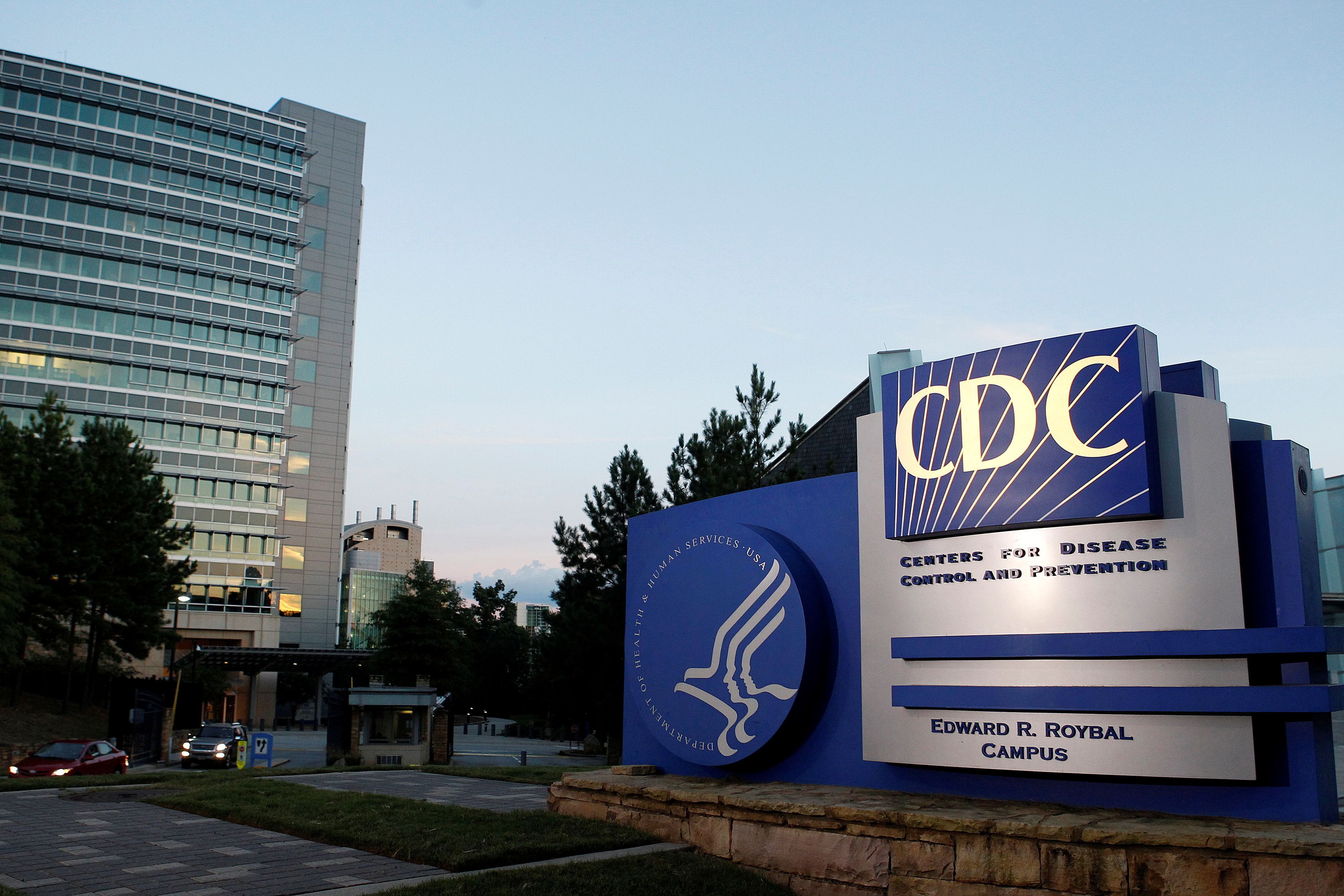
A general view of the U.S. Centers for Disease Control and Prevention (CDC) headquarters in Atlanta, Georgia September 30, 2014. REUTERS/Tami Chappell
The U.S. Centers for Disease Control and Prevention (CDC) on Thursday recommended the COVID-19 vaccine boosters for recipients of the Moderna Inc (MRNA.O) and Johnson & Johnson (JNJ.N) shots, and said Americans can choose a different shot from their original inoculation as a booster.
CDC director Rochelle Walensky signed off on the recommendations late on Thursday, aligning the agency with the U.S. Food and Drug Administration's authorization on Wednesday for the additional boosters and "mix-and-match" dosing.
Walensky said that vaccines authorized in the United States "are all highly effective in reducing the risk of severe disease, hospitalization, and death, even in the midst of the widely circulating Delta variant" of the coronavirus.
A panel of advisers to the CDC had unanimously backed COVID-19 vaccine boosters earlier on Thursday.
Still, health officials and public health experts said the booster rollout could be confusing.
The panel struggled with trying to make the language of its recommendations as clear as possible, and also offer flexibility for patients to get a vaccine of their choice.
"A really important aspect of all of this is being clear and not dancing on the head of a pin, so that we don't further confuse the American people," said Dr. Beth Bell, a panel member and clinical professor in the department of global health at the University of Washington in Seattle.
The recommendations also open the door for recipients of the one-shot J&J vaccine to get a dose of the Pfizer or Moderna vaccines that have been shown to afford greater protection in a variety of studies.
Although these vaccines have been highly effective in preventing serious illness and death, some government scientists have suggested that boosters are needed to keep immunity high, especially as the extremely contagious Delta variant can cause breakthrough infections among some who are fully vaccinated.
ACIP voted to recommend booster doses for everyone 18 and older who received a first dose of Johnson & Johnson's vaccine at least two months earlier.
For those who received their second dose of Moderna's vaccine at least six months earlier, ACIP recommended a third shot for those age 65 and over, as well as some individuals at risk or severe illness and those at high risk of exposure to the virus through their jobs.
Dr. Helen Talbot, an infectious disease expert at Vanderbilt University and a panel member, said she voted for the recommendation, but cautioned, "Moderna has very good vaccine efficacy. There will be some confusion with the higher versus lower dose."
Booster doses of the Moderna vaccine will be 50 micrograms, half the strength of the original shots.
"Those not at high risk should be really thoughtful about getting the higher dose. I do think we need to be very aware of potential complications."
Experts said communicating those risks could be an issue, especially given the flexibility of allowing people to choose a different vaccine from their original series.
"At the end of the day, even that phrase 'mix and match' pretty much gives people the latitude to ... do pretty much anything," Glen Nowak, a risk communication professor at the University of Georgia and former communications director for CDC’s National Immunization Program said after the meeting. "I think that's going to be an issue."
The FDA and CDC previously signed off on booster shots of the COVID-19 vaccine from Pfizer Inc (PFE.N) and partner BioNTech SE for the same groups included in the Moderna recommendations.
Pfizer released data on Thursday suggesting that a booster dose was highly protective for those age 16 and older compared with protection nearly a year after receiving the two-dose regimen due to waning efficacy over time.
About 11.6 million people have so far received a booster dose, according to data from the CDC.
The FDA and CDC have been under pressure to authorize the additional shots after the White House announced plans in August for a widespread booster campaign.
Other countries such as Israel have begun offering boosters to a broad population, but it is not yet known whether the United States will follow suit.
Retrieved from: https://www.reuters.com/world/us/us-cdc-advisers-weigh-moderna-jj-covid-19-vaccine-boosters-mix-and-match-shots-2021-10-21/
By Praveen Menon
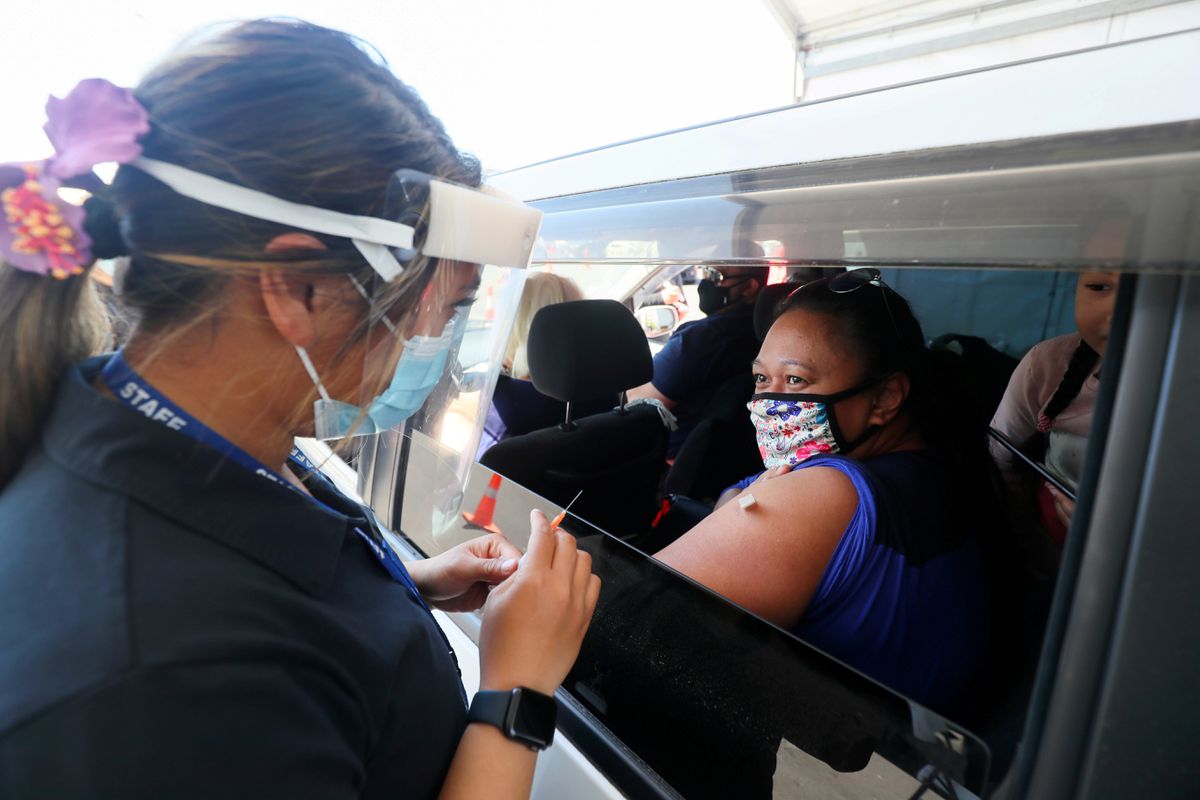
A member of the public receives a Pfizer vaccine at a drive-through coronavirus disease (COVID-19) vaccination clinic in Otara during a single-day vaccination drive, aimed at significantly increasing the percentage of vaccinated people in the country, in Auckland, New Zealand, October 16, 2021. REUTERS/Simon Watts/File Photo
New Zealand will end its strict coronavirus lockdown measures and restore more freedoms only when 90% of its eligible population is fully vaccinated, Prime Minister Jacinda Ardern said on Friday.
Once the poster child for stamping out COVID-19, New Zealand has been unable to beat an outbreak of the highly infectious Delta variant of COVID-19 centred in Auckland, forcing Ardern to abandon her elimination strategy and switch to living with the virus.
Ardern said reaching a 90% inoculation rate at every District Health Board in the country would make the South Pacific nation one of the most vaccinated countries in the world. Some 68% of eligible New Zealanders are fully vaccinated and 86% have had one dose.
"Ultimately we have balanced the desire to re-open quickly while continuing to keep people safe," Ardern said at a news conference in the capital Wellington.
When the vaccine target is reached, the country will move into a new traffic-light system to manage outbreaks in regions.
Vaccine certificate will be central to the new system, which will also use three settings - green, orange and red - to manage fresh outbreaks and cases, Ardern said.
"Fully vaccinated people will be able to reconnect with family and friends, go to bars and restaurants and do the things they love with greater certainty and confidence," said Ardern.
The new system would also mean an end to nationwide lockdowns.
"Instead we have the vaccines to create a level of safety and armour, and there will be much more predictability," she said.
New Zealand enforced the tightest pandemic restrictions among OECD nations, but pressure is mounting on Ardern to ease curbs as relatively small but persistent numbers of cases continue to plague its biggest city.
New Zealand reported a record 129 COVID-19 cases on Friday, a daily record for the third time this week, despite Auckland remaining in lockdown for over two months. Looser restrictions are in place in most of the rest of the country of 5 million. read more
The number of cases in the current outbreak reached 2,389 and New Zealand has recorded 28 coronavirus related deaths so far in the pandemic.
Authorities have warned infections are likely to trend higher until vaccination numbers rise.
Opposition National Party leader Judith Collins said the "hurdle" of 90% vaccination condemns every New Zealander to months of more lockdowns and uncertainty.
"It is great we now have 86% of Kiwis who have had at least one dose. But the reality is this last 4% will be the hardest to achieve," Collins said.
Retrieved from: https://www.reuters.com/world/asia-pacific/new-zealand-sets-90-vaccine-target-end-lockdowns-reopen-2021-10-21/
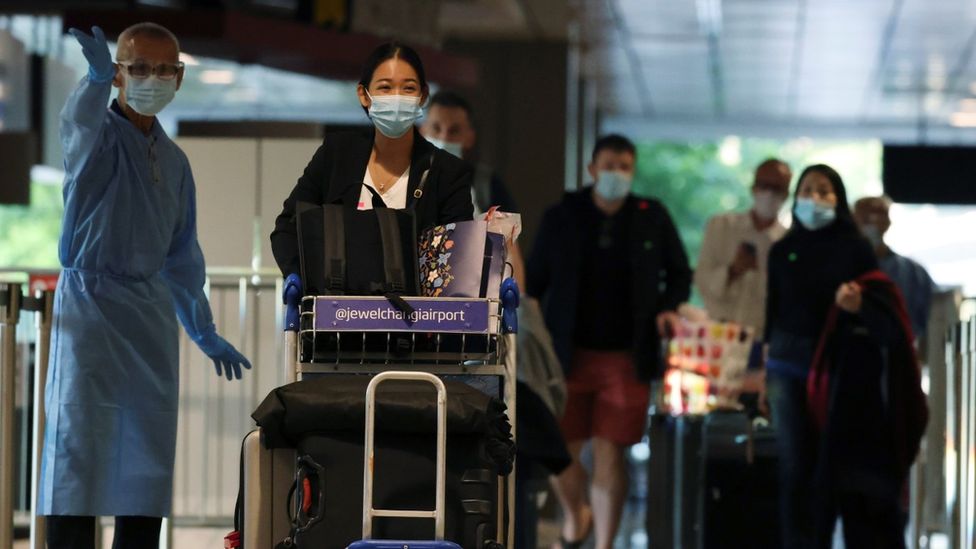
IMAGE SOURCE,REUTERS
Image caption,Singaporeans will be among the first foreign travellers allowed into Australia
Australia will soon establish a travel bubble with Singapore, with details of the plan to be revealed next week, says Prime Minister Scott Morrison.
Singapore will be only the second travel corridor for Australia, which has closed its borders to foreigners since the start of the pandemic.
It currently only allows New Zealanders to freely visit.
The deal with Singapore extends Australia's aims to reopen international travel next month.
But Australia will initially only allow vaccinated citizens, permanent residents and their family members to enter without needing to quarantine.
Mr Morrison last week said the nation would then prioritise visa holders and eventually, tourists.
Australians will be able to freely re-enter from 1 November.
The proposed bubble however "will see our borders open more quickly to Singapore", said Mr Morrison.
It will also initially favour those with work and study visas.
He said the deal was in its final stages of negotiation with Singaporean authorities.
Responding on Friday, Singapore's prime minister said he was "delighted" to hear of Australia's invite.
"Singapore and Australia have robust economic and investment links, and warm people-to-people ties," said Lee Hsien Loong. Many Australians live in Singapore and vice versa.
"Look forward to resuming close connectivity between our countries, as we move towards an endemic Covid future," he added.
Both countries have achieved highly vaccinated populations after switching to a "living with the virus" strategy, after previous aims to eliminate infections.
About 84% of Singapore's population is fully vaccinated, while Australia's over-16 population reached a 70% target this week.
Australia celebrated the end of its cities' lockdowns on Friday, after Melbourne became the final state capital to reopen.
Singapore, a major aviation hub, expanded its quarantine-free travel lanes to more countries this week.
Vaccinated people from Canada, Denmark, France, Italy, the Netherlands, Spain, Britain and the United States can now also can enter Singapore without the need to quarantine.
It had earlier been announced that visitors from Germany and Brunei could enter without quarantine.
Retrieved from: https://www.bbc.com/news/world-australia-59004988
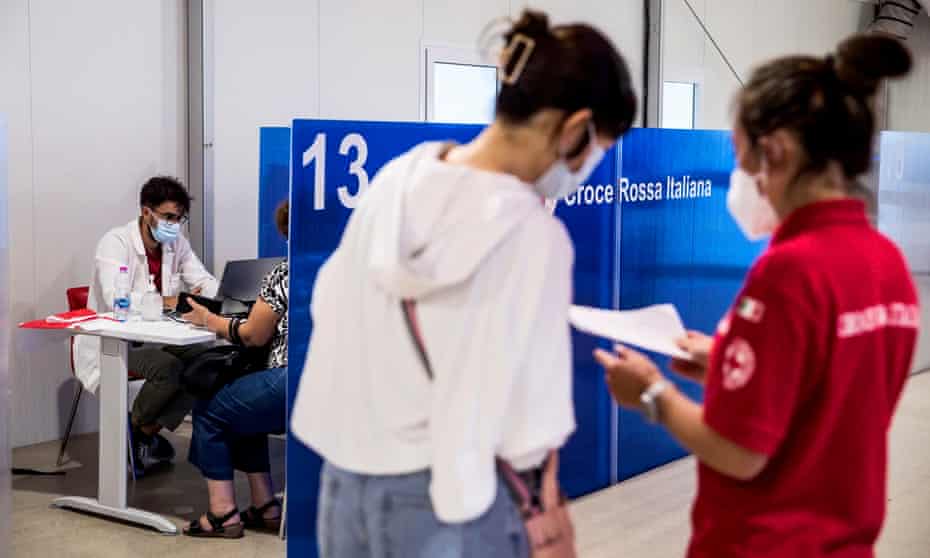
Healthcare workers carry out Covid-19 vaccinations at the Termini station in Rome. Photograph: Angelo Carconi/EPA
At the vaccination hub outside Termini train station in Rome, a steady flow of people have been turning up for their first Covid vaccine dose in recent days. The mood is begrudging. “If I didn’t have to do it, I wouldn’t,” said Rosanna Barbuto, a supermarket worker. Catalin, 41, who works in a factory, said: “I’m taking it because I need to work.”
They are among the vaccine-hesitant who caved in after Italy made it mandatory for all workers to present a so-called green pass to access their workplaces. The rules are the strictest in Europe and require workers to present proof of vaccination, immunity or of a negative test taken within the previous 48 hours. Some see Italy’s cautious approach as the key to its current low infection rate.
Barbuto, 59, said she was not against vaccinations, and took the flu jab every year. “I didn’t want to take the one for coronavirus as I wasn’t sure how safe it is. I was afraid. People were talking about the side-effects and then there were all these protests. But I need to work and so need the green pass, and I don’t want to keep spending money on tests.”
Elia works in a shopping centre and he, too, felt obliged to have the vaccine to continue to work. Those who break the green pass rules risk being suspended without pay or fined up to €1,500 (£1,270). Employers can be fined for failing to check if staff are complying.
“I was cautious because my wife and I want to have a baby and so we were taking our time to decide … but when the green pass came in for the workplace, we felt we had to do it,” said Elia. “We are not against vaccinations but don’t agree with the way the government has gone about this, telling people they can’t work if they don’t have this pass. They should have been more direct and made the vaccine an obligation instead of sneaking around the issue in this way.”
Italy’s goal with the green pass is to boost inoculations so as to reach its target coverage of 90% of the population by the end of October and to avoid another lockdown. As of Wednesday, 81% of the population aged over 12 were fully vaccinated.
The pass – also required to dine inside at restaurants, to enter museums, theatres, cinemas and stadiums, and for travel on planes and long-distance trains – was brought in over the summer in combination with the maintenance of other coronavirus measures, such as wearing face masks inside shops and when using public transport.
The seven-day average of new cases in Italy was 2,686 on Wednesday, down from 6,200 on 20 August and 14,003 on 20 April, a week before Italy began the gradual easing of lockdown restrictions and as the vaccination campaign was ramped up. Deaths have fallen from an average 440 in mid-April to 36 on Wednesday. However, at 131,688, the country has the second-highest death toll in Europe after the UK.
A study published on Wednesday found that the average age of vaccinated people who had died was 85 and who, on average, had five underlying illnesses.
Although the green pass has triggered sometimes violent protests, the majority of Italians are taking it in their stride, with 65% supporting the measure in a survey last week.
“We’re in a privileged place, the situation is finally being well managed by the government,” said Gianfranco Cappelluzzo, who was at the Termini vaccine hub waiting for his mother while she received a booster jab. “I support the green pass and find it foolish to be against it as we’re seeing evidence that it’s the right thing to do. Fortunately, resistance to this logic is marginal.”
A staff member at the hub said they had seen a gradual rise in Covid-19 vaccine first-timers since September. Nationally, the workplace rule triggered an instant increase in the number of bookings for first doses when it took effect last Friday. However, that figure appears to have tailed off over the last few days, with a higher number of bookings being made for booster shots.
“I’ll have my third dose when the time comes around,” said Cappelluzzo. “We can’t give up.”
The government has also dismissed the idea of making Covid-19 tests free, as a further way to sway people towards having the vaccine instead.
Giuseppe Longho, the owner of a chemist in Rome’s Esquilino district, has been selling coronavirus tests costing €22 each for about a year. The queue for the tests has grown longer since Friday.
“But we’ve been trying to convince customers to have the vaccine, especially those who are using the system to continue to work,” he said. “We don’t always succeed as many are angry and there is no way to negotiate. But some are realising that having to get tested every couple of days is tiresome and costly, and so they are starting to come to terms with having the vaccine.”
“We’re in a privileged place, the situation is finally being well managed by the government,” said Gianfranco Cappelluzzo, who was at the Termini vaccine hub waiting for his mother while she received a booster jab. “I support the green pass and find it foolish to be against it as we’re seeing evidence that it’s the right thing to do. Fortunately, resistance to this logic is marginal.”
A staff member at the hub said they had seen a gradual rise in Covid-19 vaccine first-timers since September. Nationally, the workplace rule triggered an instant increase in the number of bookings for first doses when it took effect last Friday. However, that figure appears to have tailed off over the last few days, with a higher number of bookings being made for booster shots.
“I’ll have my third dose when the time comes around,” said Cappelluzzo. “We can’t give up.”
The government has also dismissed the idea of making Covid-19 tests free, as a further way to sway people towards having the vaccine instead.
Giuseppe Longho, the owner of a chemist in Rome’s Esquilino district, has been selling coronavirus tests costing €22 each for about a year. The queue for the tests has grown longer since Friday.
“But we’ve been trying to convince customers to have the vaccine, especially those who are using the system to continue to work,” he said. “We don’t always succeed as many are angry and there is no way to negotiate. But some are realising that having to get tested every couple of days is tiresome and costly, and so they are starting to come to terms with having the vaccine.”
Retrieved from: https://www.theguardian.com/world/2021/oct/22/italy-green-pass-rule-prompts-rise-covid-jab-vaccine-uptake
New Covid cases in France jumped 18% to 6,127 compared to a week ago after rising 8% on Wednesday, health ministry data showed today.
New cases had already spiked last week - after falling continuously from more than 28,000 per day on August 17 - but that was at least partially in response to the fact that free Covid testing ended last week, which encouraged more people to take a test before the deadline.
After a 36% spike following the last day of free testing, new case numbers slowed down again on Sunday and Monday, but then picked up again from Tuesday.
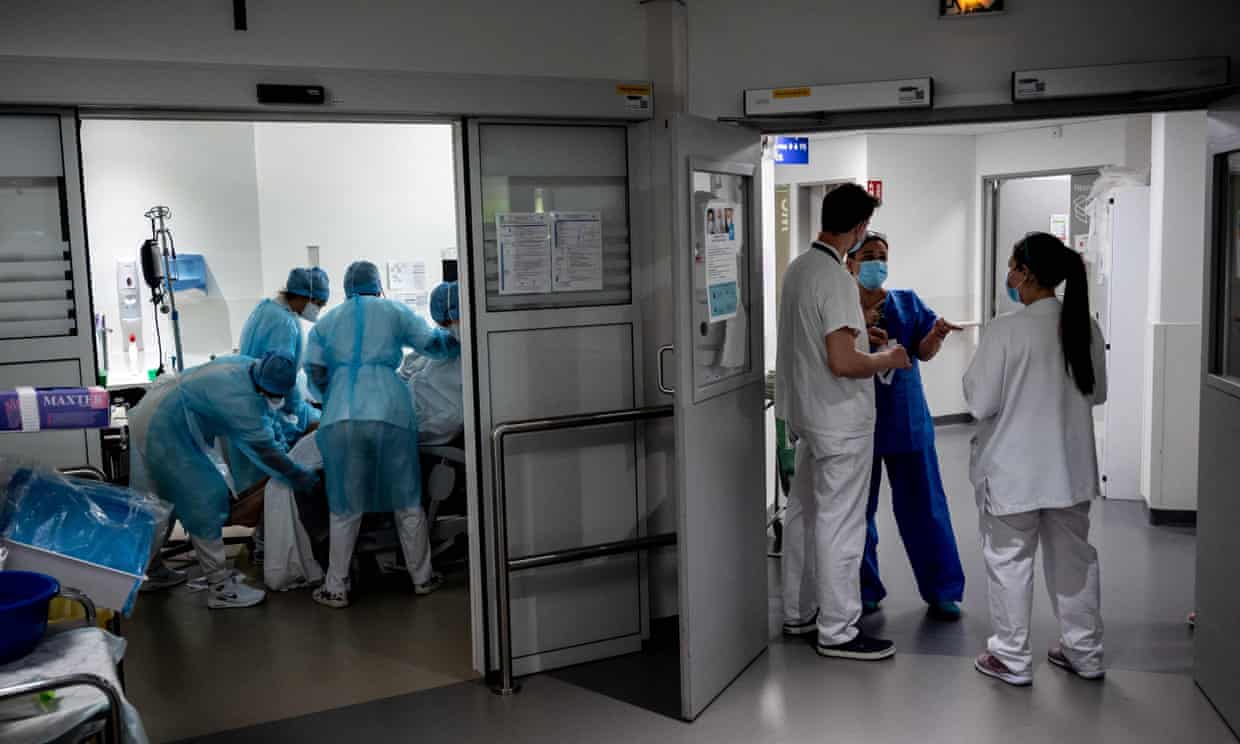
Staff members tend to a patient as others gather in a corridor in the Covid-19 intensive care unit at the Lyon-Sud Hospital in Pierre-Benite, near Lyon, central-eastern France. Photograph: Jean-Philippe Ksiazek/AFP/Getty Images
The total cumulative new cases now stand at 7.1 million. Hospital data - whose trend usually lags new case data by one to two weeks - continued improving with the number of Covid patients in intensive care falling by another 17 to 1,009.
France also registered 37 new deaths from the epidemic today, taking the total to 117,389.
· UK prime minister Boris Johnson resists calls to activate ‘plan B’ as daily Covid cases top 50,000. “The numbers of infections are high but we are within the parameters of what the predictions were, what Spi-M [modelling group] and the others said we would be at this stage given the steps we are taking. We are sticking with our plan,” Johnson told reporters.
· Infections in UK at highest level since July with 52,009 new coronavirus cases. That is the highest daily total on this measure, and the first time the daily tally has topped 50,000, for more than three months.
· Jeremy Hunt has called for the government to cut the time required between Covid vaccine doses to allow more booster jabs to be given. Relaxing six-month gap between second and third doses would speed up rollout, the former health secretary said.
· Melbourne, Australia, ends its sixth lockdown today after spending 267 days following stay-at-home orders, thought to be the longest lockdown in the world.
· Moscow announces a one-week nationwide lockdown as Russia Covid deaths rise. The country registered its highest daily number of coronavirus deaths and infections since the start of the pandemic.
· UK’s neighbours criticise British Covid policies as cases begin to surge across EU.
· Only 14% of promised Covid vaccine doses reach poorest nations, a report has revealed. Of 1.8bn doses pledged by wealthy nations, just 261m (14%) have arrived in low-income countries, according to the analysis by the People’s Vaccine alliance, a coalition of groups that includes Oxfam, ActionAid and Amnesty International.
· WHO estimates up to 180,000 health workers may have died from Covid in the period between January 2020 to May 2021, while calling for more health workers to be fully vaccinated.
Retrieved from: https://www.theguardian.com/world/live/2021/oct/21/coronavirus-news-live-india-administers-1bn-vaccine-doses-singapore-at-risk-of-being-overwhelmed-amid-record-deaths




 Medicine