

 i_need_contribute
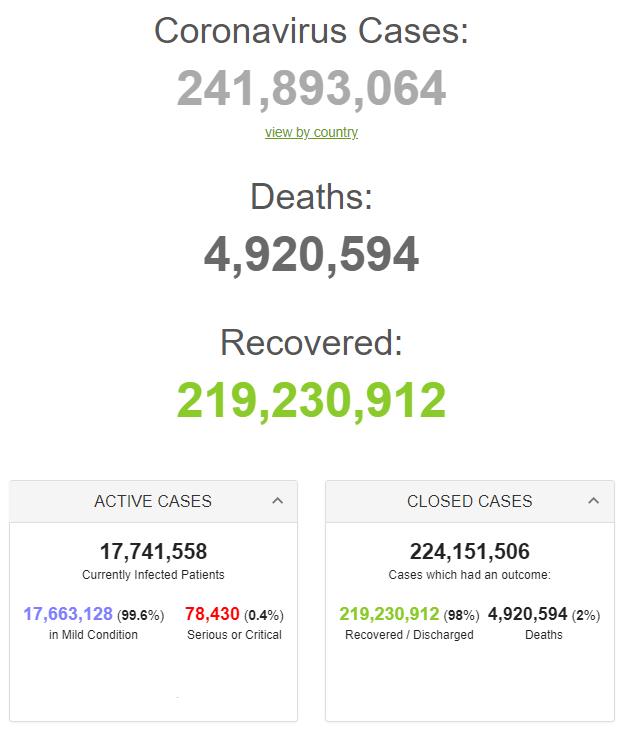
|
Country, |
Total |
New |
Total |
|
World |
241,877,515 |
+345,418 |
4,920,460 |
|
45,908,212 |
+53,135 |
746,509 |
|
|
34,093,387 |
+12,338 |
452,485 |
|
|
21,651,910 |
+7,446 |
603,521 |
|
|
8,497,868 |
+49,156 |
138,629 |
|
|
8,027,012 |
+34,325 |
224,310 |
|
|
7,683,517 |
+29,240 |
67,837 |
|
|
7,090,109 |
+1,057 |
117,306 |
|
|
5,796,659 |
+11,844 |
124,256 |
|
|
5,273,463 |
+912 |
115,704 |
|
|
4,988,878 |
+1,498 |
87,030 |
|
|
4,982,575 |
+1,043 |
126,886 |
|
|
4,719,493 |
+1,597 |
131,585 |
|
|
4,399,789 |
+6,568 |
95,511 |
|
|
4,235,384 |
+626 |
142,999 |
|
|
3,757,056 |
+1,993 |
284,381 |
|
|
2,941,126 |
+1,537 |
76,115 |
|
|
2,916,803 |
+210 |
88,619 |
|
|
2,727,286 |
+6,943 |
40,761 |
|
|
2,644,694 |
+9,524 |
60,810 |
|
|
2,396,121 |
+5,434 |
27,993 |
|
|
2,190,396 |
+387 |
199,882 |
|
|
2,051,065 |
+3,354 |
18,250 |
|
|
2,037,012 |
+1,559 |
22,785 |
|
|
1,793,812 |
+10,111 |
18,336 |
|
|
1,714,720 |
+429 |
18,103 |
|
|
1,709,725 |
+794 |
30,562 |
|
|
1,685,410 |
+2,323 |
28,564 |
|
|
1,672,065 |
+1,315 |
37,620 |
|
|
1,565,827 |
+339 |
27,778 |
|
|
1,467,401 |
+10,141 |
42,042 |
|
|
1,317,758 |
+1,100 |
8,010 |
|
|
1,285,512 |
+2,547 |
25,768 |
|
|
1,265,047 |
+663 |
28,280 |
|
|
1,080,097 |
+291 |
18,100 |
|
|
1,055,296 |
+6,461 |
9,157 |
|
|
942,280 |
+148 |
14,561 |
|
|
936,809 |
+1,844 |
8,079 |
|
|
918,146 |
+1,642 |
11,751 |
|
|
867,221 |
+3,168 |
21,269 |
|
|
843,204 |
+1,715 |
10,887 |
|
|
836,389 |
+3,274 |
30,402 |
|
|
805,560 |
+523 |
11,293 |
|
|
777,679 |
+1,897 |
11,180 |
|
|
738,690 |
+104 |
2,120 |
|
|
710,953 |
+47 |
25,100 |
|
|
697,033 |
+3,147 |
15,418 |
|
|
664,813 |
+2,479 |
9,510 |
|
|
634,209 |
+300 |
8,430 |
|
|
588,262 |
+193 |
14,387 |
|
|
573,943 |
+1,981 |
4,417 |
|
|
552,953 |
+358 |
6,857 |
|
|
547,969 |
+38 |
8,765 |
|
|
545,598 |
+4,979 |
22,488 |
|
|
532,218 |
+570 |
13,507 |
|
|
506,654 |
+177 |
18,872 |
|
|
503,452 |
+1,245 |
6,778 |
|
|
488,875 |
+1,022 |
18,388 |
|
|
470,395 |
+131 |
7,294 |
|
|
460,553 |
+24 |
16,228 |
|
|
437,938 |
+553 |
12,854 |
|
|
428,233 |
+319 |
8,907 |
|
|
418,675 |
+709 |
4,322 |
|
|
416,690 |
+1,576 |
5,306 |
|
|
412,371 |
+39 |
2,458 |
|
|
394,061 |
+1,299 |
4,734 |
|
|
391,167 |
+123 |
6,069 |
|
|
372,825 |
+237 |
10,106 |
|
|
370,350 |
+1,699 |
5,473 |
|
|
369,403 |
+752 |
2,688 |
|
|
359,495 |
+248 |
6,238 |
|
|
350,628 |
+638 |
4,904 |
|
|
343,445 |
+1,049 |
2,668 |
|
|
339,536 |
+1,131 |
1,556 |
|
|
319,339 |
+883 |
18,015 |
|
|
317,899 |
+1,370 |
7,273 |
|
|
308,501 |
+364 |
4,641 |
|
|
304,066 |
+12 |
4,106 |
|
|
283,183 |
+1,192 |
5,805 |
|
|
276,188 |
+70 |
1,391 |
|
|
252,066 |
+33 |
5,224 |
|
|
237,996 |
+67 |
608 |
|
|
209,536 |
+15 |
3,658 |
|
|
209,387 |
+89 |
2,838 |
|
|
205,364 |
+78 |
5,873 |
|
|
196,896 |
+545 |
884 |
|
|
186,869 |
+1,255 |
2,897 |
|
|
184,051 |
+2,195 |
2,389 |
|
|
181,312 |
+354 |
1,290 |
|
|
179,913 |
+68 |
2,636 |
|
|
178,188 |
+217 |
2,829 |
|
|
173,335 |
+821 |
1,429 |
|
|
151,207 |
+1,310 |
1,120 |
|
|
151,112 |
+10 |
1,927 |
|
|
150,731 |
+2,553 |
239 |
|
|
145,263 |
+2,128 |
1,543 |
|
|
138,047 |
+278 |
2,036 |
|
|
120,806 |
+166 |
565 |
|
|
46,996 |
+549 |
1,029 |
|
|
15,732 |
+12 |
170 |
Retrieved from: https://www.worldometers.info/coronavirus/
The U.S. Food and Drug Administration is planning to allow Americans to get a different booster shot of a COVID-19 vaccine than the one initially taken, the New York Times reported on Monday.
The FDA in September authorized a booster dose of Pfizer Inc (PFE.N) and partner BioNTech's two-shot COVID-19 vaccine for those aged 65 and older and some high-risk Americans.
The regulator's advisory panel has also backed the use of Moderna Inc (MRNA.O) and Johnson & Johnson's (JNJ.N) COVID-19 vaccine booster shots.
The government would not recommend one shot over another, and it might note that using the same vaccine as a booster when possible is preferable, the NYT report said, citing people familiar with the agency's plans.
The FDA declined to comment on the matter.
U.S. health officials have been under pressure to authorize the additional shots after the White House announced plans in August for a widespread booster campaign pending approvals from the FDA and the U.S. Centers for Disease Control and Prevention.
A study by the National Institutes of Health last week showed people who got Johnson & Johnson's COVID-19 vaccine as a first shot had a stronger immune response when boosted with vaccines from Pfizer and Moderna.
Retrieved from: https://www.reuters.com/world/us/us-fda-allow-mixing-matching-covid-19-boosters-nyt-2021-10-18/
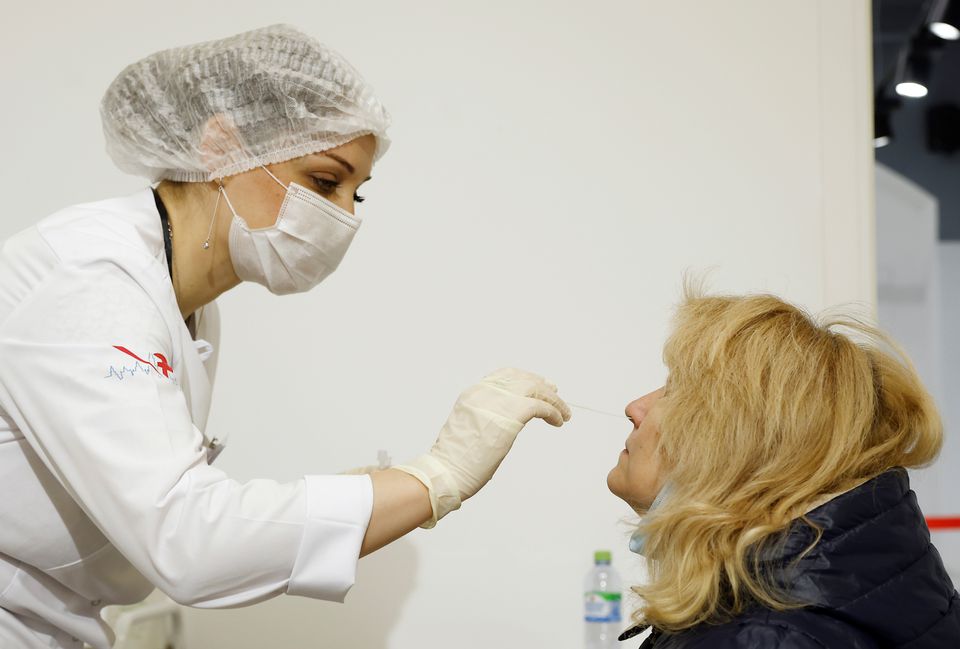
A woman undergoes a free coronavirus disease (COVID-19) rapid antigen test at a testing centre in the State Department Store, GUM, in Moscow, Russia October 18, 2021. REUTERS/Maxim Shemetov
Many Russian regions on Monday announced plans to keep cafes, museums and other public venues open only to those who have recently recovered from COVID-19, have proof of inoculation with a Russian vaccine or a negative coronavirus test, as new cases in the country hit a record.
The round of unpopular measures that limits freedoms in Russia comes as the number of daily COVID-19 infections reached an all-time high of 34,325 despite the state-driven vaccination programme.
St. Petersburg, Russia's second-largest city of around 5 million people, said on Monday only people with a QR code showing they meet the criteria will be allowed to visit cafes or restaurants from Dec. 1, joining many other regions that have imposed similar restrictions.
From Nov. 15, St. Petersburg will require a QR code for those who want to attend swimming pools, gyms, theatres and cinemas.
Earlier this year, Moscow was first to impose a QR code system, under which a unique electronic code was required to visit restaurants, gyms, beauty parlours, hairdressers, cinemas or to stay in hotels. The system was halted in mid-July.
The restrictions, designed to rein in the COVID-19 surge, prompted a backlash from businesses that said the measures threatened the closure of thousands of firms in the service industries. But they helped increase the number of vaccinations.
Russia was quick to develop and launch its Sputnik vaccine when the coronavirus pandemic struck last year, but uptake has been slow, with many Russians citing distrust of the authorities and fear of new medical products.
Only around 48 million out of 144 million Russians were fully vaccinated as of mid-October, with 51 million having received one shot.
Other regions in Russia that have already imposed or are planning to gradually introduce various QR code requirements include Bashkiria, Nizhegorod region, Perm region, Saratov and Krasdonar regions, among many others.
Retrieved from: https://www.reuters.com/world/europe/russian-regions-introduce-qr-codes-entry-public-venues-covid-19-cases-hit-record-2021-10-18/
By Yadarisa Shabong and Pushkala Aripaka
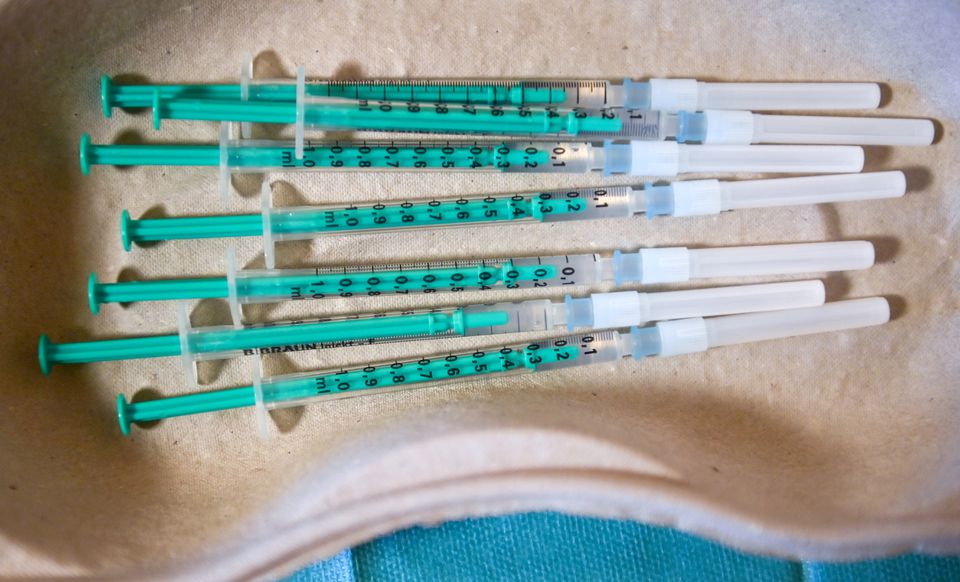
Pharmacist Susanne Wohlgemuth prepares Pfizer/BioNTech COVID-19 vaccinations at the Haus an der Linde nursing home in Lichtentanne, Saxony, Germany December 27, 2020, the day when the country starts its vaccination programme. Hendrik Schmidt/Pool via Reuters
Europe's drug regulator said on Monday it was evaluating use of the Pfizer-BioNTech (PFE.N), (22UAy.DE) COVID-19 vaccine in children as young as five, while also taking steps to aid an increase in production and boost the shot's reach.
The European Medicines Agency said it would review data, including results from an ongoing study, for the vaccine - known as Comirnaty.It has already been authorised for use in those 12 years of age and older in the European Union and United States.
The two-shot vaccine, based on new mRNA technology, was found to induce a strong immune response in five- to 11-year- olds in a clinical trial of 2,268 participants, the drugmakers said last month. read more
Pfizer and German partner BioNTech submitted data on Comirnaty for young children last week.
While children are less susceptible to severe COVID-19, they can spread the coronavirus to others, including those more at risk of severe illness.
Alongside vaccinating children, regulators and drugmakers are also considering booster doses for the vulnerable, underscoring the need to increase production and extend access to protection from the virus to as many people as possible.
The EMA also said on Monday it had approved two more manufacturing sites for producing the vaccine in the Italian cities of Monza and Anagni, while also giving the green light to a ready-to-use formulation of Comirnaty.
The sites would produce up to 85 million additional doses to suppply the European Union in 2021, the regulator said. Pfizer and BioNTech are the biggest supplier of COVID-19 vaccines to the bloc.
The drugmakers' new approved formulation that does not require dilution would also allow for longer storage and easier transportation at regulator refrigerator temperatures of 2°C to 8°C.
In a statement, BioNTech said the new formulation for individuals 12 years and older will be available in a phased rollout starting in early 2022.
Retrieved from: https://www.reuters.com/world/europe/eu-regulator-evaluating-use-pfizers-covid-19-vaccine-young-children-2021-10-18/
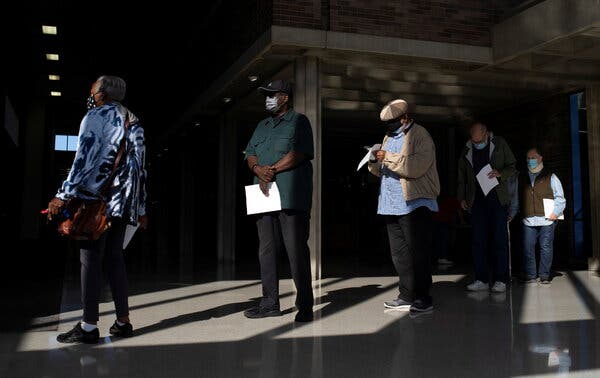
People in line for Pfizer-BioNTech Covid-19 booster vaccinations in Southfield, Mich., last month.Credit...Emily Elconin/Reuters
Even as the coronavirus wave driven by the Delta variant is receding in much of the United States, many counties across the country’s northernmost regions are experiencing rising cases as colder weather arrives.
The top five states in new daily cases per capita are led by Alaska, which is logging the highest daily average: 125 cases per 100,000 people, according to a New York Times database. The next four states, with at least 67 cases per 100,000 people, are Montana, Wyoming, North Dakota and Idaho.
Cases are at least trending downward or holding steady in those states. The five states with the fastest rising caseloads are Vermont, Colorado, New Hampshire, Michigan and Minnesota, and the two counties with the most cases per capita in Vermont and New Hampshire are on the Canadian border.
The virus followed a similar pattern last fall: Cases receded in the Southern regions after summer surges, while they steadily increased throughout the North as the weather became colder and people moved indoors.
The big difference this year is that Covid-19 vaccines are widely available, and most experts don’t expect another catastrophic winter wave, but they are warning Americans not to let their guard down as long as a large portion of the population remains unvaccinated.
In Minnesota, the average reported cases have climbed by 12 percent in the past two weeks. Scott Smith, a spokesman for Minnesota’s health department, said in an email that the department was more concerned about factors like the reopening of schools and relaxed mitigation measures than wintry weather.
Dr. Rafael Meza, a professor of epidemiology at the University of Michigan, said increases were happening across Michigan but appeared to be higher in the center and in the Upper Peninsula. Dr. Meza said that factors like vaccination rates and school mask mandates could be part of the reason.
Cases have been high in Michigan’s school-aged children, especially in districts that do not have mask mandates, according to Dr. Natasha Bagdasarian, the state’s chief medical executive.
“The weather drives people indoors into poorly ventilated spaces, and when either academic activities or social activities occur without masks in indoor, poorly ventilated spaces, that’s when transmission occurs,” Dr. Bagdasarian said, adding that winter was “coming at a very bad time for us here in Michigan.”
Retrieved from: https://www.nytimes.com/live/2021/10/18/world/covid-delta-variant-vaccine/covid-cases-us-winter
By Jin Yu Young
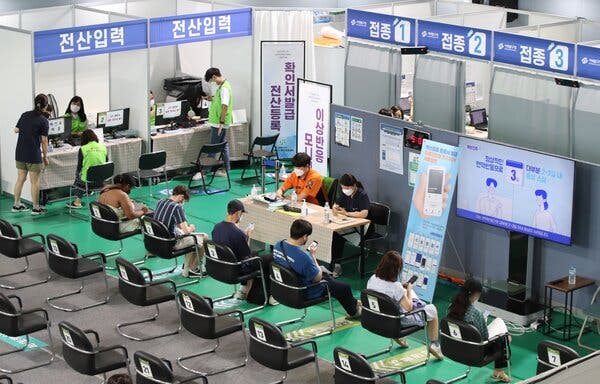
A vaccination center in Seoul in August. On Monday, South Korea opened its vaccination program to 16- and 17-year-olds and pregnant women.Credit...Yonhap/EPA, via Shutterstock
South Korea on Monday eased its virus restrictions as the average number of daily cases fell by more than 40 percent in the past two weeks.
Under the new rules, the government will allow gatherings of up to four people who are not fully vaccinated and will permit venues including performing spaces and movie theaters to stay open until midnight, two hours longer than before. Some of the changes may vary depending on the area.
South Korea never went into a full lockdown but has imposed stringent social-distancing rules, including a mask mandate, even outdoors.
Once held up as a model in fighting the pandemic because of how it contained the virus without shutting down the economy, South Korea has struggled with recent outbreaks. Its vaccination campaign got off to a slow start, but is accelerating, with more than 60 percent of the population fully vaccinated, according to a New York Times database. Health officials said the pace of vaccinations outperformed expectations, and on Monday, the country opened its vaccination program to 16- and 17-year-olds and pregnant women. People ages 12 to 15 will become eligible next month.
President Moon Jae-in and the first lady, Kim Jung-sook, received booster shots of the Pfizer-BioNTech vaccine on Friday, part of an effort to encourage more people to get inoculated.
Retrieved from: https://www.nytimes.com/live/2021/10/18/world/covid-delta-variant-vaccine/south-korea-relaxes-its-virus-restrictions
By Daniel Politi
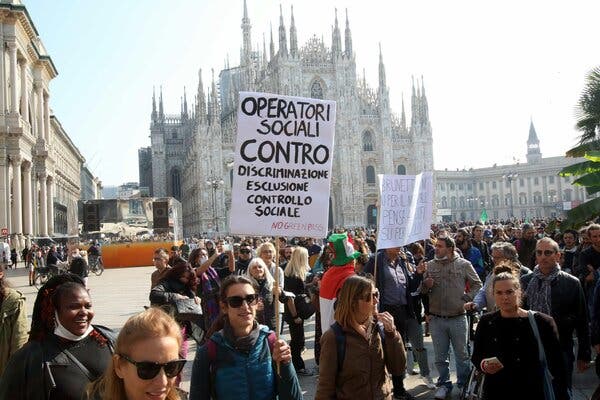
University students protesting against the Green Pass in Milan. Opponents of the pass include vaccine skeptics, conspiracy theorists, and workers angry about having to pay for swabs.Credit...Paolo Salmoirago/EPA, via Shutterstock
ROME — Italy on Friday set a new bar for major Western democracies seeking to move beyond the pandemic by enacting a sweeping law that requires the nation’s entire work force — public and private — to have government-issued health passes, essentially forcing Italians to choose between getting a pass and earning a living.
With the step, Italy, the first democracy to quarantine towns and apply national lockdowns, is again first across a new threshold, making clear that it is willing to use the full leverage of the state to try to curb the pandemic and get the economy moving.
Italy’s measures, which require proof of vaccination, a negative rapid swab test or recent recovery from Covid-19 to go to the workplace, now stand as some of the toughest among Western democracies, which have struggled to balance public health needs with civil liberty concerns.
For many Western governments, that has resulted in refraining from national mandates while seeking other ways to encourage, coax and even mildly coerce people to get vaccinated.
In France, President Emmanuel Macron has tried to make life uncomfortable for unvaccinated people, requiring a health pass to enter restaurants and for long-distance train travel, for instance, but has mandated vaccines only for some essential workers.
President Biden has appealed to private companies to mandate coronavirus vaccinations for employees, asking them to take the initiative as an effort that he announced in September to require 80 million U.S. workers to get the shot undergoes a lengthy rule-making process.
Under Italy’s new rules, those who do not have a Green Pass, as the health certificate is called, must take unpaid leave. Employers are responsible for verifying the certificates, which are for the most part shown on a cellphone app, though hard copies are also acceptable. Workers risk fines of up to 1,500 euros — or about $1,750 — for not complying.
Not everyone has been accepting of the requirements. Last weekend, a demonstration of 10,000 Green Pass opponents — a mix of vaccine skeptics, conspiracy theorists, anti-establishment types and workers livid about having to pay for frequent swabs — was hijacked by right-wing extremists and turned violent, prompting Italy to once again reckon with its fascist legacy.
But on Friday, the rollout went more or less smoothly, with only scattered protests, as the majority of citizens accepted the new pass as a fact of Italian life and a tolerable sacrifice, like wearing masks indoors, to help the country get out of the pandemic and return to normalcy.
The Green Pass has so far faced no serious legal challenge. Government officials said that the measure was already working, and that more than 500,000 previously reluctant people — much higher than expected — have gotten inoculated since the government announced its plan last month.
Under the leadership of Prime Minister Mario Draghi, the country has turned around a faltering start to its vaccination begun under the previous government led by a prime minister affiliated with the Five Star Movement, an anti-establishment party that came to power in 2018 in part by encouraging skepticism about vaccines.
Today Italy has inoculated more than 80 percent of its population over the age of 12, after earlier putting in place tough requirements for health workers and teachers and significantly increasing vaccination rates in those categories.
But to reach the most reluctant unvaccinated workers — an estimated 3.8 million people — the government has now taken one of the Western world’s hardest lines
Countries in Latin America and the Caribbean desperately need to increase investment in the health sector, so that the sector can become a motor toward economic recovery from the Covid-19 pandemic, two United Nations agencies reported on Thursday.
“We don’t see a trade-off between health and the economy,” Alicia Bárcena, the head of the Economic Commission for Latin America and the Caribbean, said at a news conference. “The pandemic has already shown us that investment in health is necessary for sustainable growth.” Ms. Bárcena added, “Without health, there can be no sustainable economic recovery.”
On average, Latin American and Caribbean countries spend 3.8 percent of their gross domestic product on health, significantly lower than the 6 percent share the World Health Organization recommends, according to a new joint report by the commission and the Pan American Health Organization, which is part of the W.H.O.
That shortfall in spending contributes to a shortage of health professionals, with only 20 physicians available for every 10,000 people, far fewer than the 30 recommended by the W.H.O.
Dr. Carissa F. Etienne, P.A.H.O.’s director, said that “structural weaknesses of the region’s health systems” affected the region’s ability to respond to the pandemic and left the region short of resources to handle other health issues.
“It is time to transform Latin America and the Caribbean’s health systems,” she said.
Though the region is home to about 8 percent of the world’s population, it has accounted for 30 percent of worldwide deaths attributed to the coronavirus — more than 1.5 million so far.
Many countries in the region have had difficulty immunizing their populations; on average, only 39 percent of people in Latin America and the Caribbean are fully vaccinated, the agencies’ report said.
The pandemic has brought into focus the region’s dependence on imported vaccines and medicines, highlighting the need to increase local manufacturing capacity, they said.
The economic effects of the pandemic have been devastating in Latin America and the Caribbean. Taken together, the region’s economies contracted more sharply in 2020 than in any other year since 1900. The region’s economy is expected to expand by 5.9 percent this year, but even that big a rebound will not be enough to restore output to 2019 levels.
Unemployment, poverty and inequality have all soared, as women in particular dropped out or were pushed out of the work force.
“In addition to giving rise to an alarming public health situation in the countries of Latin America and the Caribbean, the pandemic has also revealed the weaknesses of the economic, social and environmental aspects of the region’s development model,” the agencies said in the report.
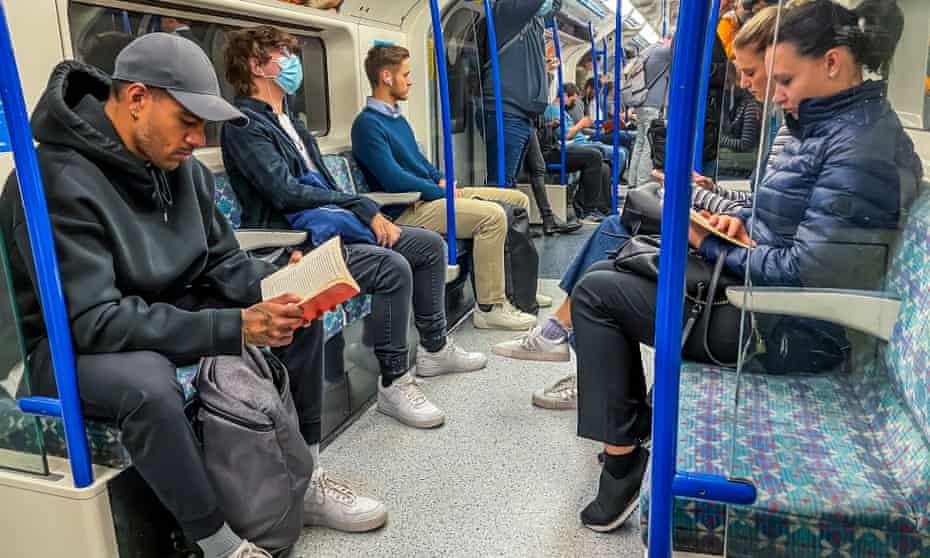
As cases rise in the UK, experts point out that the Covid statistics from Europe demonstrate it didn’t have to be this way in Britain. Photograph: Guy Bell/Rex/Shutterstock
Downing Street has warned of “challenging” months ahead as UK coronavirus cases reached their highest level since mid-July.
The reported number of Covid cases in the UK increased steadily through October and reached 49,156 on Monday, the highest reported since 17 July and a 16% rise in new cases over the past week.
The figure is only 19,000 cases short of the peak number of cases ever recorded in the UK. On 8 January 2021, 68,053 new cases were reported at the height of the most devastating wave of the pandemic last winter.
The prime minister’s official spokesperson said a rise in coronavirus cases was expected over the winter and that the government would keep a “close watch” on the statistics.
Hospitalisations and deaths are also increasing according to Monday’s data, with 5,561 people admitted to hospital over the past week, up 6.9% on the week before, and the number dying within 28 days of testing positive reaching 869 over the past seven days, up 11.4% on the week before.
“We always knew the coming months would be challenging,” Boris Johnson’s official spokesperson said. “What we are seeing is case rates, hospitalisations and deaths still broadly in line with the modelling as set out a few months back now. The vaccination programme will continue to be our first line of defence, along with new treatments, testing and public health advice. But we will obviously keep a close watch on cases.”
The rise in UK cases is largely driven by infections among secondary school children, though some older age groups, including those who have children in school, are also experiencing rises. Hospitalisations and deaths are mostly driven by infections in older and more vulnerable groups, including those whose immunity has started to wane.
Dr Kit Yates, a mathematical biologist at the University of Bath and a member of the Independent Sage group of experts, said that with Britain nearing 50,000 cases on Monday, there had been only 16 days throughout the whole pandemic when cases were higher in the UK.
“The narrative has become that case numbers aren’t important, but they still are,” he said. “They don’t mean the same as they did before vaccination, but the link between cases and deaths has not been broken. We are seeing over 120 deaths a day on average, which for me is unacceptable. Just glancing at the numbers from our neighbours in Europe demonstrates that it didn’t have to be this way.”
Prof Andrew Hayward, who advises the government on the Covid crisis, told BBC Radio 4’s World At One that it was concerning the UK had very high rates of infection and higher rates of hospitalisation and death than many European countries, adding that waning immunity was probably one reason for infections being so high.
“We shouldn’t be complacent because there is still huge potential for the NHS to come under a lot of pressure and for there to be a lot of unnecessary deaths,” he said. “So we need to get the vaccination rates up and we need to be prepared potentially to think about other measures if things do get out of control.”
Earlier this month, Prof Neil Ferguson, head of the influential modelling team at Imperial College London, called for teenage vaccines and boosters to be accelerated to reduce the risk of a substantial wave this winter.
Retrieved from: https://www.theguardian.com/world/2021/oct/18/uk-covid-cases-50000-in-one-day-no-10-challenging-winter
· UK government warns of “challenging” winter months ahead in battle against Covid as cases continue to rise. Epidemiologist and government adviser Prof Andrew Hayward said the situation was “concerning” and there was “huge potential for the NHS to come under a lot of pressure”.
· A study found the Valneva Covid vaccine may be as effective as the Oxford/AstraZeneca vaccine. The vaccine uses inactivated Sars-CoV-2 virus and can be stored in fridge. Like the Oxford/AstraZeneca vaccine, the Valneva jab was found to stimulate responses from other components of the immune system, including T-cells. However, the Valneva jab gave rise to T-cells able to respond not only to the coronavirus spike protein, but to two other key proteins.
· Russia set another new record daily caseload, recording 34,325 new cases in the last 24 hours. That’s up just slightly on the previous day’s 34,303. There were 998 further deaths. The population of Russia is around 144 million people. Despite the rising cases, Moscow continues to see a busy nightlife.
· UK government ordered to reveal firms awarded “VIP” access to multimillion-pound contracts for the supply of personal protective equipment (PPE) in the early months of the Covid pandemic, in a ruling from the Information Commissioner’s Office (ICO).
· UK Covid cases near 50,000 in one day after steadily increasing through October and reaching 49,156 on Monday, the highest reported since 17 July and a 16% rise in new cases over the past week.
· UK private laboratory is under investigation for potentially issuing more than 40,000 false negative Covid tests was not fully accredited to perform the work, contrary to assurances made by health officials.
· The EU has exported over 1bn vaccine doses worldwide, according to head of the European Commission, Ursula von der Leye.
· Colin Powell, former US secretary of state, dies at 84 of Covid complications. Powell played a pivotal role in attempting to justify the 2003 invasion of Iraq.




 Medicine