

 i_need_contribute
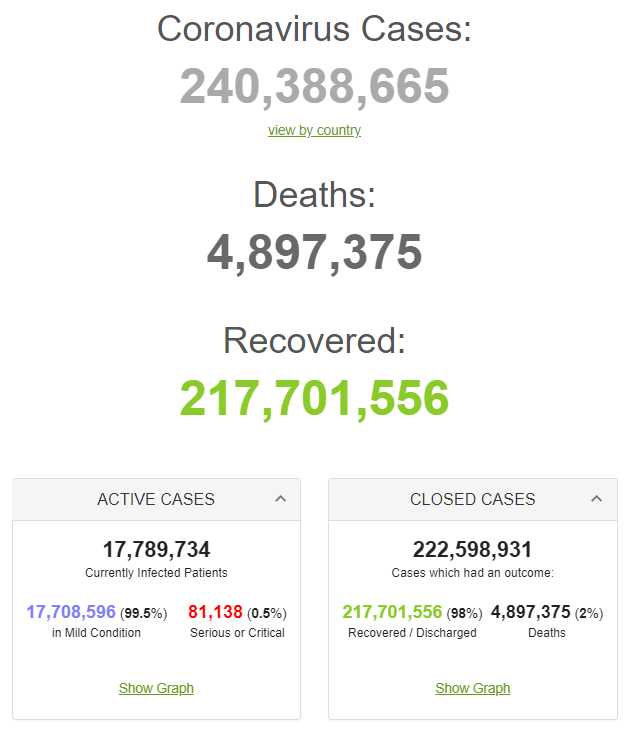
|
Country, |
Total |
New |
Total |
|
World |
240,360,196 |
+443,659 |
4,896,785 |
|
45,639,012 |
+89,680 |
741,893 |
|
|
34,036,684 |
+17,004 |
451,847 |
|
|
21,612,237 |
+14,288 |
602,201 |
|
|
8,317,439 |
+45,066 |
138,237 |
|
|
7,892,980 |
+31,299 |
220,315 |
|
|
7,570,932 |
+30,709 |
67,044 |
|
|
7,074,276 |
+5,187 |
117,211 |
|
|
5,754,047 |
+11,964 |
123,498 |
|
|
5,270,003 |
+1,350 |
115,633 |
|
|
4,982,138 |
+1,932 |
86,917 |
|
|
4,977,043 |
+1,387 |
126,759 |
|
|
4,709,753 |
+2,668 |
131,461 |
|
|
4,366,243 |
+11,756 |
95,334 |
|
|
4,232,099 |
+1,053 |
142,848 |
|
|
3,738,749 |
+6,320 |
283,193 |
|
|
2,931,064 |
+3,000 |
76,018 |
|
|
2,914,827 |
+947 |
88,506 |
|
|
2,698,232 |
+7,835 |
40,221 |
|
|
2,597,275 |
+18,881 |
59,935 |
|
|
2,369,613 |
+8,084 |
27,681 |
|
|
2,187,368 |
+1,122 |
199,775 |
|
|
2,036,628 |
+3,623 |
18,231 |
|
|
2,030,498 |
+2,383 |
22,681 |
|
|
1,751,704 |
+11,276 |
18,029 |
|
|
1,712,649 |
+731 |
18,020 |
|
|
1,704,437 |
+1,499 |
30,526 |
|
|
1,673,397 |
+3,157 |
28,421 |
|
|
1,665,916 |
+1,191 |
37,583 |
|
|
1,564,485 |
+466 |
27,737 |
|
|
1,414,647 |
+16,383 |
40,765 |
|
|
1,312,908 |
+1,070 |
7,972 |
|
|
1,272,669 |
+3,667 |
25,726 |
|
|
1,261,685 |
+1,016 |
28,201 |
|
|
1,077,963 |
+777 |
18,071 |
|
|
1,031,283 |
+6,786 |
8,946 |
|
|
941,009 |
+506 |
14,520 |
|
|
928,684 |
+2,364 |
7,994 |
|
|
910,832 |
+1,985 |
11,644 |
|
|
853,842 |
+4,151 |
20,950 |
|
|
838,523 |
+1,268 |
10,847 |
|
|
831,866 |
+1,141 |
30,341 |
|
|
804,276 |
+398 |
11,269 |
|
|
768,711 |
+2,169 |
11,143 |
|
|
738,268 |
+116 |
2,117 |
|
|
687,278 |
+2,572 |
15,289 |
|
|
649,407 |
+4,212 |
9,370 |
|
|
632,271 |
+629 |
8,406 |
|
|
584,613 |
+1,412 |
14,204 |
|
|
565,865 |
+2,052 |
4,353 |
|
|
550,134 |
+1,050 |
6,771 |
|
|
547,797 |
+36 |
8,755 |
|
|
534,312 |
+3,183 |
22,102 |
|
|
529,755 |
+1,340 |
13,429 |
|
|
505,157 |
+556 |
18,811 |
|
|
496,780 |
+1,448 |
6,720 |
|
|
484,317 |
+1,514 |
18,255 |
|
|
469,796 |
+227 |
7,284 |
|
|
460,301 |
+24 |
16,208 |
|
|
431,757 |
+1,871 |
12,791 |
|
|
422,908 |
+1,851 |
8,847 |
|
|
416,676 |
+738 |
4,288 |
|
|
412,228 |
+32 |
2,455 |
|
|
409,647 |
+1,626 |
5,306 |
|
|
390,575 |
+181 |
6,065 |
|
|
388,743 |
+1,350 |
4,681 |
|
|
371,431 |
+463 |
10,065 |
|
|
368,131 |
+752 |
4,082 |
|
|
366,607 |
+767 |
2,676 |
|
|
360,763 |
+2,861 |
5,349 |
|
|
357,550 |
+778 |
6,141 |
|
|
348,647 |
+559 |
4,849 |
|
|
337,679 |
+1,937 |
2,618 |
|
|
332,789 |
+1,920 |
1,497 |
|
|
315,842 |
+865 |
17,846 |
|
|
312,442 |
+1,666 |
7,137 |
|
|
304,963 |
+1,081 |
4,627 |
|
|
304,025 |
+12 |
4,103 |
|
|
276,666 |
+1,589 |
5,675 |
|
|
275,912 |
+50 |
1,391 |
|
|
251,669 |
+186 |
5,202 |
|
|
237,741 |
+79 |
607 |
|
|
209,431 |
+20 |
3,657 |
|
|
205,005 |
+105 |
5,864 |
|
|
195,963 |
+421 |
6,888 |
|
|
195,385 |
+356 |
884 |
|
|
181,856 |
+605 |
2,386 |
|
|
179,711 |
+340 |
1,280 |
|
|
179,583 |
+91 |
2,627 |
|
|
178,298 |
+2,408 |
2,857 |
|
|
176,667 |
+495 |
2,797 |
|
|
168,884 |
+1,060 |
1,409 |
|
|
120,273 |
+153 |
560 |
|
|
45,861 |
+269 |
1,000 |
|
|
15,692 |
+29 |
170 |
Retrieved from: https://www.worldometers.info/coronavirus/
By Steve Holland
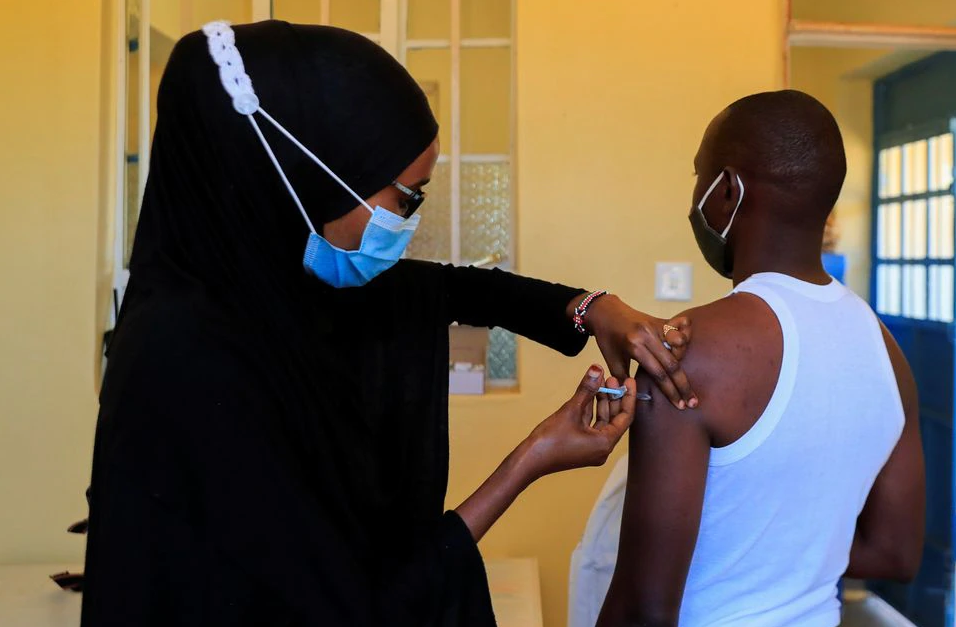
A nurse administers the coronavirus disease (COVID-19) vaccine to a man at the Bissil Health Centre within Iibissil settlement, Matapato North of Kajiado county, Kenya August 23, 2021. REUTERS/Thomas Mukoya
President Joe Biden told visiting Kenyan President Uhuru Kenyatta on Thursday that the United States will make a one-time donation of more than 17 million doses of the Johnson & Johnson (JNJ.N)vaccine to the African Union, the White House said.
The meeting with Kenyatta at the White House marked Biden's first as president with an African leader. Kenya holds the rotating presidency of the U.N. Security Council this month. The United States and Kenya have long cooperated on economic and security initiatives including counterterrorism.
Biden said the 17 million doses will be in addition to 50 million the United States has already donated to the African Union. The donation of the vaccine doses will help the African Union's own regional procurement of J&J via the African Vaccine Acquisition Trust, the White House said.
Kenyatta said the United States "has done its best to step up in terms of not only helping Kenya, but the African continent."
The African Union, which has 55 member states and a combined population of over 1.3 billion people, has accused vaccine manufacturers of not giving its members fair access. Of 5.7 billion doses of coronavirus vaccines administered around the world by mid-September, only 2% had been in Africa.
The 17 million doses of J&J are available for delivery immediately and will be delivered to the African Union in the coming weeks, the White House said.
African countries and the World Health Organization have been urging drugmakers for months to set up vaccine plants on the continent to help it secure supplies of COVID-19 shots that have been hoovered up by wealthier nations.
As of last week, only about 4.5% of Africans had been fully vaccinated against COVID-19, according to the continent's top public health official John Nkengasong.
Biden also said the two countries will discuss what the U.S. can do to help with security issues in the Horn of Africa and ways to fight climate change.
Retrieved from: https://www.reuters.com/world/africa/us-donates-17-million-jj-doses-african-union-2021-10-14/
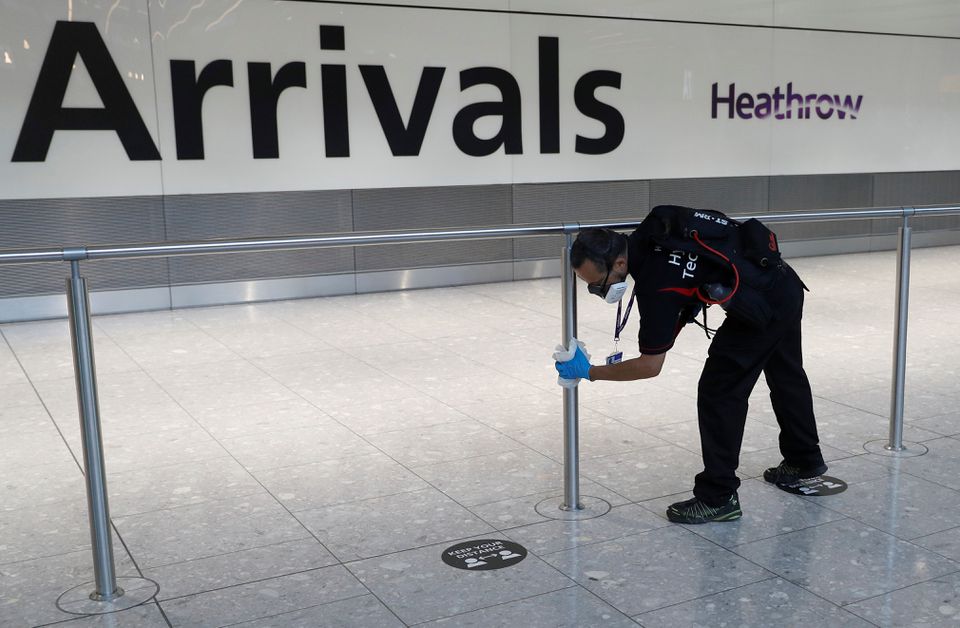
A worker sanitises a barrier at the International arrivals area of Terminal 5 in London's Heathrow Airport, Britain, August 2, 2021. REUTERS/Peter Nicholls
Fully vaccinated passengers arriving in England from low-risk countries from Oct. 24 will no longer have to take expensive COVID-19 tests, the British government said on Thursday.
Last month the government simplified the rules for international travel to England in a boost to the tourism industry, which has blamed the testing and complicated rules for the slowness of a recovery in air travel over the summer. read more
The government said that from Oct. 24, the start of school half-term holidays across much of England, fully vaccinated passengers and most under 18s arriving from countries not on the red list could take a lateral flow test on or before day two of their arrival, rather than a PCR lab test.
Lateral flow tests are cheaper and provide a faster result.
"Taking away expensive mandatory PCR testing will boost the travel industry and is a major step forward in normalising international travel and encouraging people to book holidays with confidence," Secretary of State for Transport Grant Shapps said in a statement.
The government said passengers must use lateral flow tests purchased from a private provider listed on the government's website, rather than free ones available as part of the government Test and Trace scheme, and passengers must upload a photo of their test and booking reference to verify the result.
Anyone with a positive lateral flow test will be provided with a free confirmatory PCR test through the National Health Service.
Retrieved from: https://www.reuters.com/world/uk/england-eases-covid-19-testing-rules-most-incoming-passengers-oct-24-2021-10-14/
By Aina J. Khan
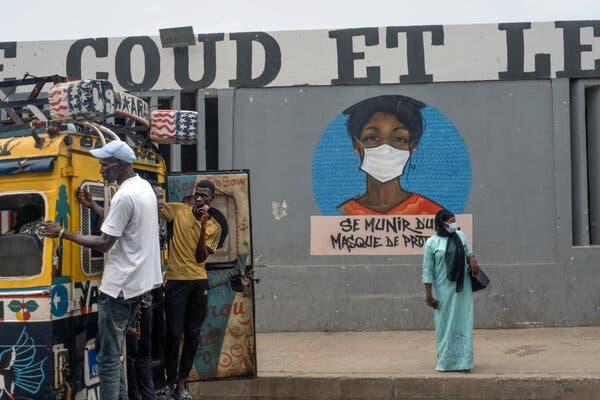
Senegal is one of eight countries involved in a community-based initiative to enhance coronavirus testing in Africa. Covid-19 graffiti in Dakar, Senegal, in September.Credit...Ricci Shryock for The New York Times
Official statistics on coronavirus cases in Africa give the impression that the continent has avoided the worst of the pandemic. But in a continent where most deaths are not formally registered and many countries are struggling to vaccinate their people, the great majority of coronavirus cases — an estimated six out of seven — are going undetected, according to Dr. Matshidiso Moeti, the Africa director at the World Health Organization.
Speaking at a news briefing on Thursday, Dr. Moeti said the W.H.O. estimated that about 59 million people in Africa had been infected with the coronavirus from the beginning of the pandemic through Oct. 10. Only somewhat more than 8 million cases have been officially recorded.
“Now is the time to go on the offensive against Covid-19, and work with local communities to break transmission chains and stop wider outbreaks from happening,” Dr. Moeti said.
The W.H.O.’s analysis was derived from a coronavirus calculator developed by Resolve to Save Lives, a global public health organization that focuses on cardiovascular disease and on preventing epidemics. The calculator estimates infections based on the number of reported cases and deaths and “an infection fatality rate grounded in population-based studies,” according to a statement by the W.H.O.
Africa remains the continent with the lowest vaccination rates. In nearly half of the African countries that have received Covid-19 vaccines, only 2 percent of the population or less has been fully vaccinated, according to the W.H.O.
In a meeting at the White House, President Biden told President Uhuru Kenyatta of Kenya that the United States would donate more than 17 million doses of Johnson & Johnson’s vaccine to the African Union.
Those doses and earlier shipments to the African Union represent more than half of the Johnson & Johnson doses that the U.S. has bought so far for domestic use, the White House said in a statement.
“Along with the 50 million doses already sent to Africa, and the Pfizer vaccine, which continues to ship several times a week to the continent, these doses will help close the vaccine equity gap,” the statement said.
With limited testing available in many countries, Dr. Moeti said, communities in Africa often were “flying blind,” with asymptomatic people passing on the virus without being aware that they have it.
In a bid to curb transmission, she announced a community-based initiative to enhance coronavirus testing in eight countries: Burundi, Ivory Coast, Republic of Congo, Democratic Republic of Congo, Guinea-Bissau, Mozambique, Senegal and Zambia. The initiative includes wider use of antigen detection, a relatively inexpensive type of test that yields results in around 15 minutes, and a “ring-based” strategy of voluntary testing for anyone living within 100 meters of a positive case.
Dr. Moeti said coronavirus cases appeared to be trending “downward or plateauing” in most African countries, though some were still reporting increases, including Angola, Gabon, and Cameroon. In Rwanda, which had enforced one of the continent’s strictest lockdowns, bars resumed normal operations in late September after being closed for 18 months.
Several African countries are also dealing with outbreaks of other infectious diseases, including the deadly Ebola virus. Ivory Coast confirmed its first Ebola case in almost 30 years in August, and the Democratic Republic of Congo has since reported two fatal cases of Ebola, Dr. Moeti said. Guinea had an outbreak early in the year.
Retrieved from: https://www.nytimes.com/2021/10/14/world/covid-africa-who.html
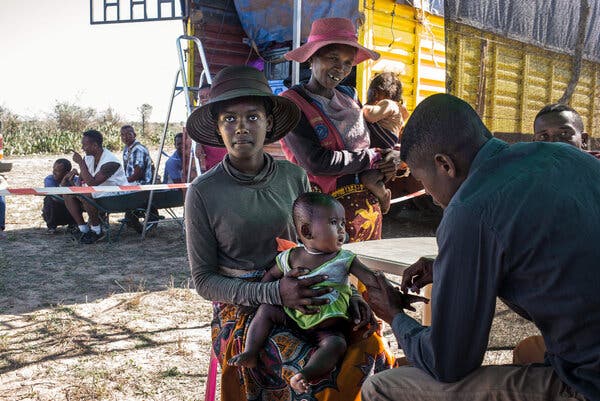
A baby is vaccinated against tuberculosis, polio and measles in the village of Tanarake, Madagascar, in September.Credit...Rijasolo/Agence France-Presse — Getty Images
Deaths from tuberculosis, the world’s biggest infectious disease killer until the Covid-19 pandemic arrived, have increased for the first time in more than a decade, totaling more than 1.5 million people in 2020. That trend is expected to worsen in 2021 and 2022, according to a report released on Thursday by the World Health Organization.
The report confirmed the warnings from the W.H.O. and other global health organizations that the Covid-19 pandemic would reverse years of progress against other infectious diseases, including TB, H.I.V. and malaria.
“This is alarming news that must serve as a global wake-up call to the urgent need for investments and innovation to close the gaps in diagnosis, treatment and care for the millions of people affected by this ancient but preventable and treatable disease,” Dr. Tedros Adhanom Ghebreyesus, the W.H.O.’s director general, said in a statement.
Reported diagnoses of TB also dropped sharply, to 5.8 million cases in 2020 from 7.1 million in 2019, suggesting that many more cases than before are going undiagnosed and untreated — a trend that is likely to have a long-term effect on TB deaths. And only 2.8 million people were given preventive treatment for TB in 2020, a 21 percent decrease from 2019.
In many poor countries, health care workers, funds and testing equipment that would normally be dedicated to TB were redirected to cope with Covid-19, according to the W.H.O. report. Lockdowns and disruptions in supply chains also interrupted access to treatment and care.
At the same time, global funding for TB has fallen to $5.3 billion from $5.8 billion, less than half of what’s needed, according to the W.H.O. report.
There were some glimmers of good news amid the sobering statistics. In the Russian Federation, the incidence of TB fell by 6 percent a year between 2010 and 2020, and the W.H.O. European Region overall exceeded the 2020 goal with a decrease of 25 percent.
Retrieved from: https://www.nytimes.com/2021/10/14/health/tuberculosis-deaths-covid.html
By Daniel Politi
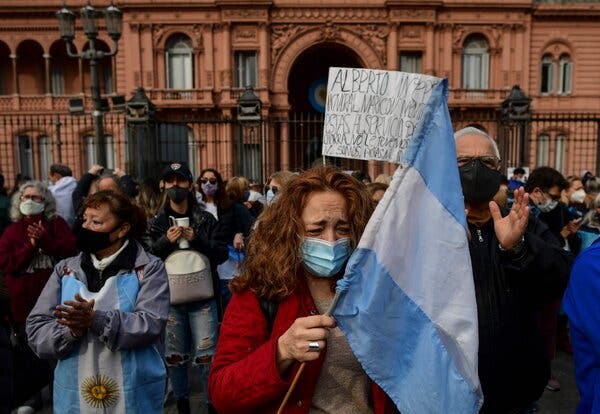
Marchers in Buenos Aires in August honored people who had died from Covid-19 and protested the Argentine government’s pandemic policies. Credit...Ronaldo Schemidt/Agence France-Presse — Getty Images
Countries in Latin America and the Caribbean desperately need to increase investment in the health sector, so that the sector can become a motor toward economic recovery from the Covid-19 pandemic, two United Nations agencies reported on Thursday.
“We don’t see a trade-off between health and the economy,” Alicia Bárcena, the head of the Economic Commission for Latin America and the Caribbean, said at a news conference. “The pandemic has already shown us that investment in health is necessary for sustainable growth.” Ms. Bárcena added, “Without health, there can be no sustainable economic recovery.”
On average, Latin American and Caribbean countries spend 3.8 percent of their gross domestic product on health, significantly lower than the 6 percent share the World Health Organization recommends, according to a new joint report by the commission and the Pan American Health Organization, which is part of the W.H.O.
That shortfall in spending contributes to a shortage of health professionals, with only 20 physicians available for every 10,000 people, far fewer than the 30 recommended by the W.H.O.
Dr. Carissa F. Etienne, P.A.H.O.’s director, said that “structural weaknesses of the region’s health systems” affected the region’s ability to respond to the pandemic and left the region short of resources to handle other health issues.
“It is time to transform Latin America and the Caribbean’s health systems,” she said.
Though the region is home to about 8 percent of the world’s population, it has accounted for 30 percent of worldwide deaths attributed to the coronavirus — more than 1.5 million so far.
Many countries in the region have had difficulty immunizing their populations; on average, only 39 percent of people in Latin America and the Caribbean are fully vaccinated, the agencies’ report said.
The pandemic has brought into focus the region’s dependence on imported vaccines and medicines, highlighting the need to increase local manufacturing capacity, they said.
The economic effects of the pandemic have been devastating in Latin America and the Caribbean. Taken together, the region’s economies contracted more sharply in 2020 than in any other year since 1900. The region’s economy is expected to expand by 5.9 percent this year, but even that big a rebound will not be enough to restore output to 2019 levels.
Unemployment, poverty and inequality have all soared, as women in particular dropped out or were pushed out of the work force.
“In addition to giving rise to an alarming public health situation in the countries of Latin America and the Caribbean, the pandemic has also revealed the weaknesses of the economic, social and environmental aspects of the region’s development model,” the agencies said in the report.
Israel is seeing a sharp drop in new infections and severe illness, aided by its use of vaccine boosters, vaccine passports and mask mandates, scientists and health officials said.
The country is four months into one of its worst Covid-19 outbreaks. Since peaking in early September, daily infections have fallen more than 80%, with severe cases nearly halved, Reuters reports.
“Day by day we are breaking the Delta wave,” Prime Minister Naftali Bennett said on Tuesday, crediting government policy for “close, smart and flexible management allowing life alongside coronavirus.”
Since administration of boosters, mostly unvaccinated, often younger, people are bearing the brunt of serious illness. They make up about 75% of hospitalised patients in severe condition, while those vaccinated with two or three shots account for a quarter of such cases.
Rather than imposing new lockdown measures, the government opted for a ‘Living with Covid’ strategy and bet on a third booster dose of the Pfizer Inc (PFE.N)/BioNTech vaccine for people age 12 and up, mandated face coverings and enforced use of a ‘Green Pass’ - proof of vaccination, recovery from the illness or a negative test for the virus - at restaurants and other venues, even for children.
So far, the strategy has kept schools and the economy open.
· FDA experts endorse Moderna vaccine booster shot. An independent group of Food and Drug Administration (FDA) has recommended a booster shot of the Moderna Covid-19 vaccine for high-risk groups and people older than 65.
· Latvian president Egils Levits has contracted Covid-19 despite being fully vaccinated, his chief of staff said. The Baltic country reported a new record for daily coronavirus cases.
· Lateral flow tests to replace PCR tests for vaccinated travellers to England. Fully vaccinated international passengers arriving in England from countries not on the red list can take a cheaper and quicker lateral flow test from 24 October instead of the PCR version, the government has announced.
· The UK recorded a further 45,066 Covid cases. It is the highest daily figure since mid-July. The official data also confirmed a further 157 people had died within 28 days of testing positive for Covid as of Thursday, bringing the UK total to 138,237.
· Only one in seven Covid cases in Africa are being detected, meaning the continent’s estimated infection level may be 59 million people, according to a new study by the World Health Organization.
· Italy braced for unrest as Covid pass becomes mandatory for all workers. The strictest vaccine mandate in Europe is set to take effect on Friday and is expected to bring fresh protests and leave some industries struggling with staff shortages.
· Indigenous people infected with Covid Delta strain at twice the rate of other Australians. Aboriginal and Torres Strait Islander people have been infected at twice the rate of non-Indigenous Australians during the country’s deadly third coronavirus wave, a senior Indigenous health leader says.




 Medicine